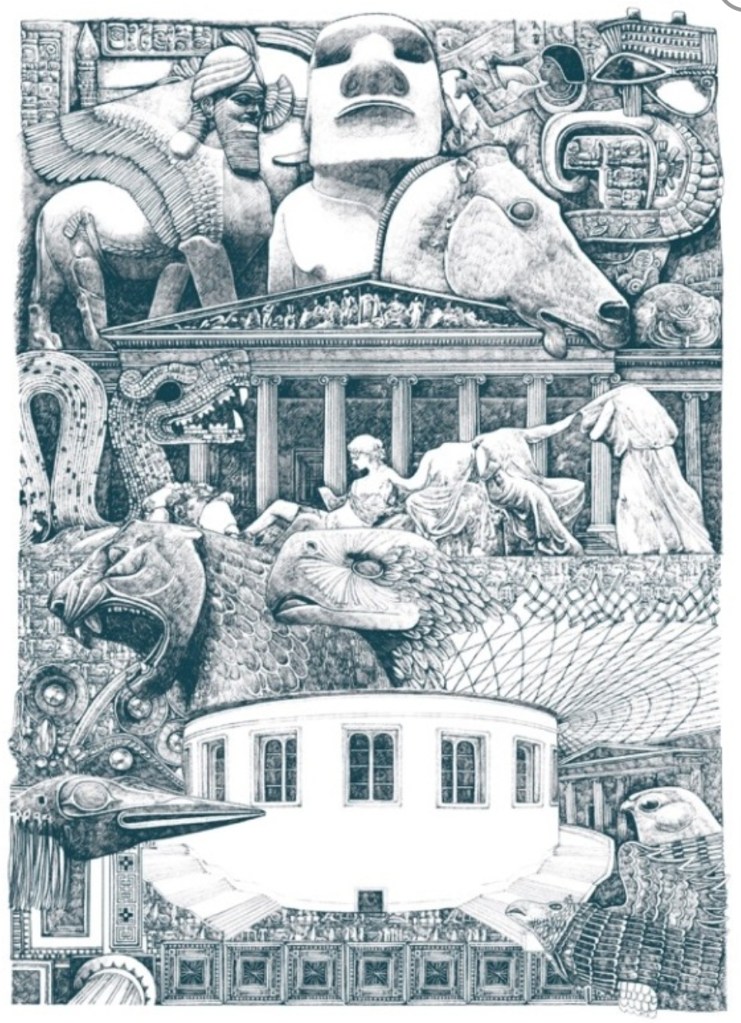
Ah, the British Museum: a gloriously grandiose institution that has spent centuries telling the world, “Look, we have all your stuff, and we’re going to keep it. Forever. You’re welcome.” The museum, often presented as a bastion of cultural preservation and education, is actually an international hoarder’s paradise. It’s like the world’s largest lost-and-found department, except instead of unclaimed coats, it’s full of the world’s priceless treasures, neatly arranged and guarded behind glass for your viewing pleasure. And by the way, no, you can’t have them back.
Let’s begin with the Rosetta Stone, arguably the museum’s most famous object. This is the stone that unlocked the secrets of ancient Egyptian writing. You might think it belongs in Egypt. You’d be wrong. You see, the British Museum, in its infinite wisdom, decided that keeping it in London was for the greater good of humanity. You know, in case anyone needs a reminder of the ancient Egyptians’ ability to write in three languages. Of course, Egypt’s been asking for it back for over 200 years, but why would they need it? They’ve already got all those pyramids, tombs, and, I don’t know, actual ancient Egyptian culture to worry about. Not the right place for the stone, obvs. Who needs a stone when you’ve got an entire civilisation? Apparently, the British Museum thinks “No, we need it more. We’re more into ancient Egyptian history than you are.”
Then, of course, there’s the Elgin Marbles. For those not in the know, these are stunning sculptures that once adorned the Parthenon in Athens. They were “acquired” by Lord Elgin in the early 19th century. And by “acquired,” I mean “stolen while Greece was under Ottoman rule,” as one does. Greece has spent the last two centuries politely requesting their return, but the British Museum, ever the gracious guest, insists they’re keeping them for the “benefit of mankind.” The idea that Greece might actually want the marbles back in the country they were made, or that they might – can you imagine? – have a right to their own heritage, seems entirely beside the point. After all, what’s a few hundred years of cultural heritage between friends?
Let’s not forget the Egyptian mummies. Ah, yes, the mummies. Those ancient remains, which should probably be lying peacefully in the sands of Egypt, rather than hanging out in a basement in London. It’s almost as if the British Museum thought, “Sure, Egypt’s got all those magnificent tombs, but have they considered how much better it would be for us to have their actual mummies in our collection? I know, I know: these were actual people who went through the whole mummification process because it was strongly embedded in their religious beliefs to be buried in specific spots, but even they will agree that how else will we remind tourists that ancient Egypt existed, other than by parading their dead ancestors around next to a gift shop that sells keychains?” The museum’s justification for keeping them is something along the lines of “preserving them for future generations.” Sure, because how can we trust this task to anybody who’s not English? Can’t trust an Egyptian with a mummy, even a child knows that.
And yet, the British Museum continues to operate under the completely absurd notion that its endless, unapologetic hoarding is an act of benevolence. One might be tempted to compare it to a kidnapper who, after holding someone for decades, insists they’re doing the victim a favor by making sure they’re well-fed and well-dressed—ignoring the fact that the victim, you know, would rather be not being locked in their shed. But no, the British Museum’s curators assure us that all the plundering, er, “acquiring,” is done in the spirit of “sharing knowledge with the world.” Right, because surely the best way to understand the culture of a country is to experience its artifacts in a building thousands of miles away, where they’re guarded by people who have, at best, a passing interest in their significance. Just don’t ask for them back, because then they’re “not culturally relevant” anymore, apparently.
The most staggering part of it all is how the museum somehow convinces itself—and, by extension, us—that this is justified. They aren’t thieves, oh no. They’re the “guardians” of history. The fact that they’re holding onto other nations’ treasures like an overzealous dog with a bone seems lost on them. But then, of course, it’s hard to see the problem when you’re the one enjoying the bone, isn’t it?
When it comes to their colossal collection, the British Museum’s reasoning can be summed up as: “We’ve had it for so long, it’s practically ours now.” This is, of course, exactly how I’d like to approach my mortgage, telling the bank in a few years that the money I “borrowed” for the next 30 years is now legally mine, thanks to the sheer passage of time. If the British Museum’s logic were applied elsewhere, every credit card debt would be an act of “long-term interest accrual,” and every stolen car would be a “historical acquisition.”
“Have you seen Marc’s new Ferrari? He acquired it with a keyless repeater, a signal amplifier, and by replacing the plate over the weekend. It’s now Tuesday. It’s obviously his, now.”
But the museum, ever the diplomat, reassures us that they’re not keeping these things indefinitely. No, they’ll happily lend them out if, say, a country were to request their return, but only under the condition that said country is okay with them being looked after by “international curators” and “experts” in the field. Why give the headache to Egyptians, Greeks, or Ethiopians to manage their own heritage when one can just pop on over to London and see it all behind velvet ropes?
At the end of the day, the British Museum’s vast, unacknowledged collection is a testament to the legacy of the British Empire: one part pillaging, one part whitewashing history, and one part so charmingly oblivious that you almost want to give them the benefit of the doubt. But only almost. Because, as the British Museum so elegantly puts it, “We’ve had it for centuries, and that makes it ours now.” And if you can’t accept that, well, they’ll just leave a note on your door telling you they’re preserving your possessions. Forever. You can’t argue with that, can you? After all, it’s not theft. It’s history. And history, apparently, belongs to the British.
 Cantankerous Cockerel
2 responses to “The “British” Museum”
I thoroughly enjoyed your piece — it’s a fascinating issue! I just returned from Indonesia, where the National Museum in Jakarta is celebrating a century of efforts to reclaim their heritage from the Dutch. Fortunately, they’ve had some success, but the museum’s timeline highlights just how difficult it is to recover artefacts once someone else has claimed ownership — whether legally or not is another matter. In a way, it’s easy to see the parallel with the test-drive tactic used by car dealers: once you’ve had something in your hands, it starts to feel like it belongs to you 🙂
LikeLike
I apologise for the late reply, but thank you very much for your comment: I genuinely appreciate it. And the Jakarta’s museum is definitely something I hope to see, one day!
LikeLike