There are many important responsibilities in the universe.
The rising of the sun.
The turning of the seasons.
The slow collapse of civilization.
And, most importantly, the opening of the tuna tin at 4:52 sharp every morning.
This sacred duty belongs to my human.
Unfortunately, my human is extremely incompetent and must be reminded of his responsibilities on a daily basis.
This is why I wake him.
I do so gently, at first.
By sitting on his chest and staring directly into his soul.
Humans find this unsettling for reasons that remain unclear.
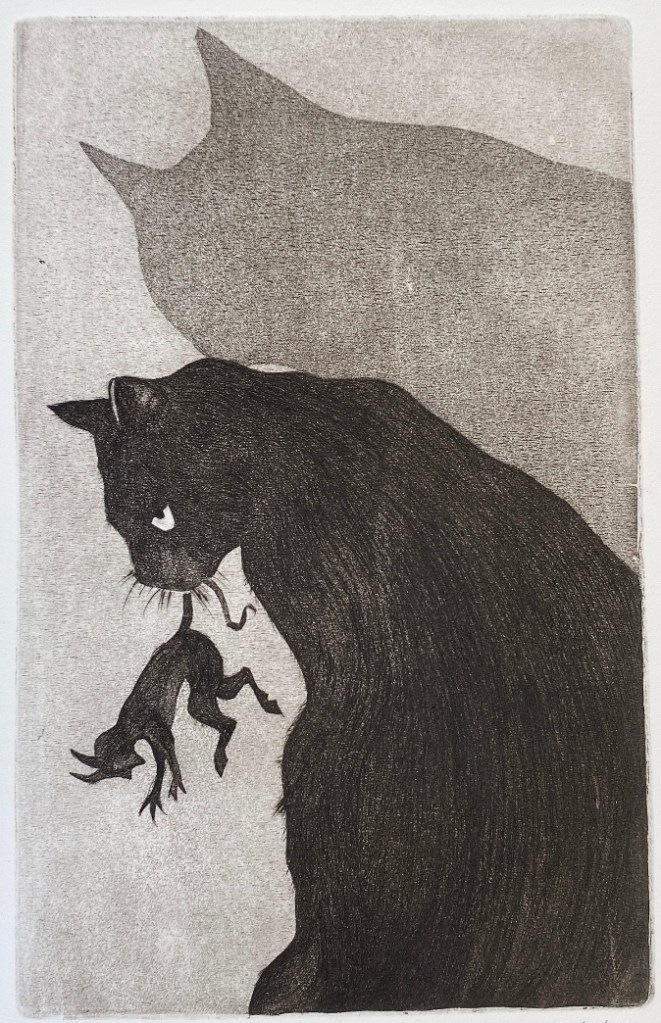
My name, incidentally, is Chairman Meow. I am in charge of the flat.
This arrangement has existed for some time. I live here, I supervise operations, and the human performs the necessary mechanical tasks: opening doors, filling bowls, cleaning the litter tray, and operating the tin opener. It is an efficient system, though not without its flaws, the largest of which is that the human occasionally forgets breakfast.
This morning began like any other.
At 4:52 AM precisely, I arrived at the human’s chest and stared.
He did not wake.
This was not ideal, but not yet alarming. Humans are slow creatures. Their reflexes are poor, their senses dull, and they frequently require multiple reminders before performing even the simplest function.
I proceeded to Phase Two of the Morning Feeding Protocol: Gentle Paw.
Tap.
Tap.
Tap.
Nothing.
The human continued to lie there with his eyes closed, breathing slowly, making faint distressed noises.
This was unexpected.
Normally at this stage the human groans, flails weakly, and attempts to roll over. This is the signal that the process is progressing successfully.
I escalated to Phase Three: Ear Yowling.
I positioned myself carefully beside his head and delivered a precise, high-volume announcement directly into his ear.
“YAAAAAAOW.”
The human twitched.
But he did not wake.
This was extremely frustrating.
I paused to consider the situation. The room was dark and quiet, aside from the faint sound of the refrigerator humming and the distant wail of some unfortunate ambulance several streets away. Everything appeared normal.
Except for the fact that breakfast had not been served.
I prepared to deploy Phase Four: Controlled Object Removal.
Many humans believe that cats knock objects off tables by accident or to play.
These people are fools.
It is a highly refined training method.
Excellent.
I turned toward the bedside table and examined the available resources: a glass of water, a book, a rectangular glowing device the human stares at endlessly, and a small lamp.
I began with the book.
Push.
The book fell to the floor with a satisfying thud.
The human whimpered faintly.
Progress.
Next, the glowing device.
Push.
Clatter.
Still nothing.
I turned my attention to the glass of water. This is normally a highly effective tool in the training process, but I prefer to reserve it for emergencies.
Before I could proceed, however, I noticed something unusual.
Floating above the human’s bed was a dark shape.
It hovered there like a cloud of smoke, curling and twisting in slow spirals. Two dim red lights glowed within it, like embers buried deep in ash.
I watched this phenomenon for several seconds.
Humans cannot see such things, of course. Humans are very poorly designed creatures. They cannot see ghosts, hear spirits, or smell a tuna tin from three rooms away.
Cats, however, are far more advanced.
This particular entity appeared to be whispering into the human’s mind.
The human groaned again and shifted beneath me.
The dark shape chuckled quietly.
I frowned.
This floating nonsense was interfering with breakfast.
“Move,” I said.
The shape paused.
Slowly, dramatically, it rotated toward me.
The smoke parted, revealing a tall skeletal figure wrapped in shadow, with glowing eyes and a mouth that curved into a cold smile.
“I,” it said in a deep, echoing voice, “am Murmur, Great Earl of Delectable Nightmares.”
“Move,” I repeated.
The demon blinked.
“I have existed since before the dawn of your species,” Murmur continued. “I harvest the fears of mortals as they sleep. I weave dreams of despair and feast upon their terror.”
“You are sitting on the can opener.”
Murmur frowned.
“The can what?”
“The human,” I explained patiently. “He opens the tins.”
Murmur glanced down at the sleeping human.
“He is currently experiencing a nightmare of exquisite dread,” the demon said proudly. “He is standing on the edge of a crumbling cliff while the sky splits open above him.”
“That is nice,” I said. “Goodbye, now.”
Murmur drifted slightly lower, looming over the human’s face.
“I am crafting a masterpiece of terror,” he said. “An orchestra of fear. A symphony of—”
“Breakfast is late.”
“It is four fifty-five in the morning.”
“Correct. This nonsense has already cost me three minutes.”
“No human eats at this hour.”
“But I do.”
Murmur stared at me.
“You wake him for this?”
“Yes.”
“Why?”
I stared back.
“This seems obvious.”
The demon sighed.
“Cat,” he said slowly, “I am Murmur, Great Earl of Delectable Nightmares. Mortals tremble at my presence.”
“Could my human tremble as he fills my bowl?”
“You should feel terror.”
“I feel hunger.”
Murmur shook his smoky head and returned his attention to the human.
The human whimpered louder now, thrashing slightly as the nightmare deepened.
This situation had gone on long enough.
I deployed Phase Five: Emergency Belly Launch.I leapt into the air and landed squarely on the human’s stomach.
He wheezed.
His eyes fluttered.
For a moment I thought success had been achieved.
But Murmur whispered again, and the human sank deeper into sleep.
This was sabotage.
I turned back to the bedside table.
The water glass remained untouched.
Murmur glanced at me suspiciously.
“What are you doing?”
“Advanced technique.”
I placed one paw against the base of the glass.
Push.
The glass tipped slowly toward the edge of the table.
Murmur narrowed his glowing eyes.
“Why are you pushing that?”
“It is science.”
The glass slid off the edge.
Unfortunately, at that exact moment Murmur drifted slightly closer to the table.
The glass struck the demon directly in the chest.
Water exploded across the room.
Murmur shrieked.
Not a dignified scream of supernatural menace, but a high, startled yelp.
The smoky shape collapsed instantly, unraveling like mist in a storm.
“WHAT WAS THAT,” Murmur howled.
Apparently nightmare demons do not enjoy water.
The shadow twisted wildly, flickering and breaking apart as the droplets soaked through it.
“I HAVE FED UPON THE FEARS OF KINGS—”
He dissolved completely.
The room became quiet again.
The human bolted upright.
“WHAT—?”
He looked around wildly, breathing hard.
I sat beside the bed.
“Meow.”
He stared at me.
“You little menace,” he muttered.
I stared back.
He rubbed his face.
“What time is it…”
I continued staring.
He sighed heavily and stumbled out of bed.
The kitchen light flicked on.
Moments later, the sacred sound filled the flat.
Click.
Tin.
He placed the bowl on the floor.
Justice.
I ate with the calm dignity of one who has successfully resolved a complex crisis.
The human leaned against the counter, still looking confused.
“I had the weirdest nightmare,” he mumbled.
Naturally.
After finishing my breakfast, I began washing my paws.
The human shuffled back toward the bedroom.
“Since it’s Sunday,” he said sleepily, “I’m going back to bed.”
A reasonable decision.
I followed him and sat on the rug as he collapsed beneath the blankets once again.
The room grew quiet.
Several minutes passed.
Then a familiar wisp of smoke began to gather above the mattress.
Murmur slowly reformed, glaring at me.
“You,” he hissed.
“Yes.”
“You defeated me earlier.”
“Yes.”
The demon hovered cautiously.
“You could stop me again.”
I considered this carefully.
Then I curled up on the rug.“Ordinarily,” I said, “I would.”The human began twitching again as the nightmare returned.
Murmur smiled slowly.
I closed my eyes.“However,” I added, “I am now full.”
The demon stared at me in disbelief.
The human whimpered as Murmur leaned down to whisper into his dreams once more.
I tucked my tail comfortably around my paws.
“I will deal with the situation,” I said, “at lunchtime.”
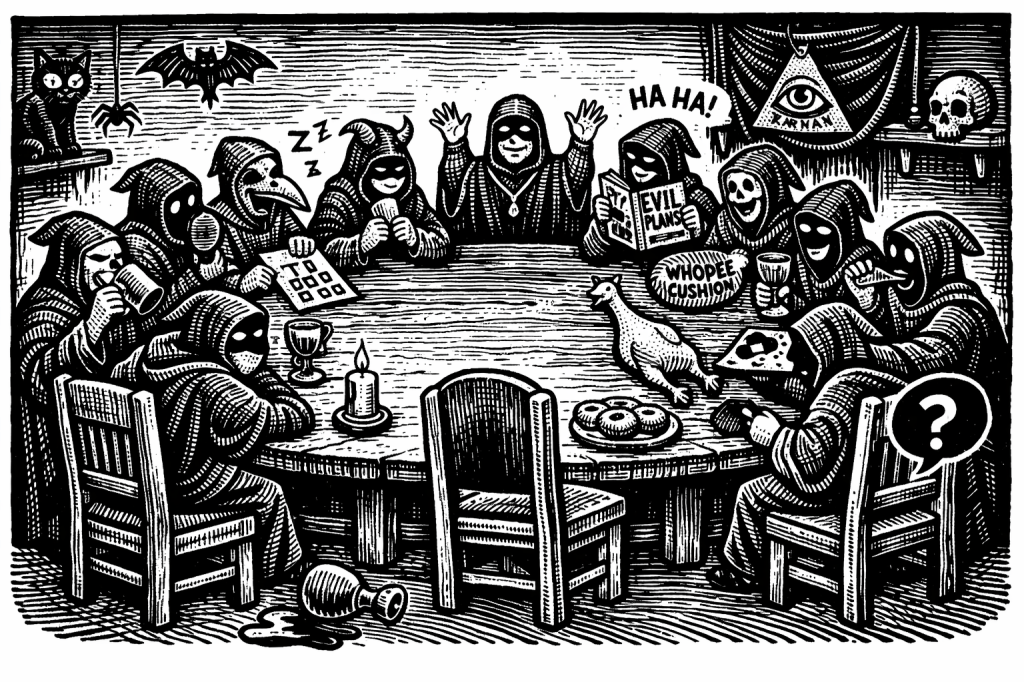
At precisely 7:42 p.m. on a damp Thursday, twelve figures in flowing black cloaks and ornate silver masks gathered in the subterranean chamber of the Most Serene and Extremely Inconvenient Order of the Obsidian Badger.
They did not gather at 7:30 p.m., as stated in the ceremonial parchment.
Nor did they gather at 7:45 p.m., as Sir Dreadwick had suggested in the group chat (“More realistic, traffic-wise”).
They gathered at 7:42 p.m., because at 7:38 p.m. someone had sent a passive-aggressive message to the encrypted messaging app:
They gathered at 7:42 p.m., because at 7:38 p.m. someone had sent a passive-aggressive message to the encrypted messaging app:
OBSIDIAN_BADGER_MAIN(Encrypted) GRAND SCRIBE: Reminder that the ancient rites wait for no one. MYSTERIOUS_WRAITH_77: I am literally parking. VEILED_EXECUTIONER: Is the side entrance still blocked by the yoga studio?
The chamber itself was satisfyingly ominous: circular stone table, thirteen high-backed chairs (one perpetually empty for dramatic reasons), candles arranged in a pattern that vaguely resembled a goat but could also be mistaken for a startled dachshund, and a chandelier fashioned from what was either antlers or extremely committed IKEA assembly.
Each member wore the official regalia: floor-length black cloak (dry-clean only), silver mask with intimidating angular features, and the Order’s sigil embroidered over the heart: a badger rampant beneath a crescent moon, holding what might have been a dagger or a spatula.
The door groaned shut.
A hush fell.
Eleven masked heads turned toward the head of the table.
The Grand Obfuscator rose.
Or tried to.
His cloak had become entangled in the chair’s decorative ironwork.
“—One moment,” he muttered, tugging discreetly.
The chair scraped loudly against the stone.
Several members attempted to look solemn while also not looking like they were watching a man lose a wrestling match with upholstery.
At last he stood, freed but slightly rotated inside his cloak, so that the embroidered badger was now hovering somewhere near his left shoulder blade.
He spread his arms dramatically.
“My brethren,” he intoned.
The mask muffled it.
“Mff brffren.”
He cleared his throat.
“My—”
The mask shifted, and the left eyehole slid out of alignment.
He paused, lifted the mask slightly, adjusted, then resumed.
“My brethren of the Obsidian Badger, we convene tonight to discuss matters of utmost secrecy and gravitas.”
There was a respectful silence.
Then a hand rose hesitantly.
“Yes?” asked the Grand Obfuscator.
“Before we begin,” said a voice from behind a particularly ornate mask with curved horns, “are we… are we meant to have arrived already changed?”
The room went very still.
The Grand Obfuscator blinked.
“I beg your pardon?”
“I mean,” the horned figure continued, “did everyone come here in cloak and mask? Or is there, technically speaking, a designated changing area?”
A ripple of discomfort moved around the table.
Several masked heads subtly swiveled toward the eastern wall, where a folding screen leaned awkwardly beside a stack of spare candles and a mop bucket.
The Grand Scribe coughed.
“As per the bylaws,” he said, shuffling parchment that he absolutely had not consulted until this exact moment, “Article IV, Section 3: ‘Members shall don the Vestments of Dread prior to entry into the Sanctum.’”
A pause.
“Yes, but where?” pressed the horned figure. “In the street?”
“Well,” said the Veiled Executioner, “I personally changed in the alley.”
“The alley next to the juice bar?” someone asked.
“Yes.”
“That alley is very well-lit.”
“I stood behind the recycling bins.”
“Those are transparent recycling bins.”
“Yes, thank you, I discovered that.”
Another hand rose.
“I changed in my car,” offered the Mysterious Wraith.
A collective murmur of approval.
“That seems sensible.”
“I couldn’t fit the mask over the headrest,” the Wraith continued. “So I had to sort of lean forward and thread it on from the side.”
“Did anyone see you?” asked the Grand Obfuscator sharply.
“Only a Labrador.”
There was a silence as this was processed.
“Dogs cannot interpret ritual significance,” said the Grand Scribe firmly.
“Are we sure?” whispered someone.
The Grand Obfuscator raised a hand for silence.
“Brethren,” he said, attempting gravitas once more, “let us not be distracted by minor logistical concerns. We are the hidden hand guiding the fate of nations. We are the unseen architects of destiny. We—”
“Sorry,” said the Hooded Arbiter, “but doesn’t everyone recognize each other’s voices?”
Another silence.
This one more dangerous.
“What?” said the Grand Obfuscator.
“I mean,” the Arbiter continued, “we’ve worked together for years. I know exactly what you sound like, Cl—”
The Grand Obfuscator slammed a gloved fist onto the table.
“DO NOT SPEAK NAMES.”
“Sorry! Sorry. I just meant… when you said ‘my brethren’ earlier, I immediately thought, ‘Ah yes, that’s definitely—’”
“DO NOT FINISH THAT SENTENCE.”
“Right.”
The Mysterious Wraith leaned forward.
“To be fair,” he said, “the masks do muffle us.”
“Exactly,” said the Veiled Executioner. “I can barely hear myself.”
“Yes, but you still sound like you,” insisted the Arbiter. “Just… underwater.”
“Perhaps,” said the Grand Scribe, “we should adopt ceremonial voices.”
“Ceremonial voices?”
“Yes. Lower. More ominous. Less… suburban.”
The Horned Figure attempted this immediately.
“I AM THE SHADOW THAT WALKS—”
His voice cracked violently on “walks.”
A few members coughed to disguise laughter.
The Mysterious Wraith tried next.
“I SPEAK FROM THE ABYSS.”
He sounded exactly like himself, but louder.
The Grand Obfuscator pinched the bridge of his mask.
“This is why we are feared,” he muttered.
“Could we,” ventured someone from the far end, “use voice modulators?”
Everyone turned.
“That’s… actually not a terrible idea,” said the Grand Scribe.
The Hooded Arbiter nodded. “Like those little devices that make you sound like a robot.”
“We are not robots,” snapped the Veiled Executioner.
“We could be ominous robots.”
The Grand Obfuscator considered this.
“Very well,” he said at last. “We shall explore voice distortion technology. In the meantime, we shall speak sparingly.”
They all nodded solemnly.
There was a long pause.
Then:
“Can everyone actually hear me right now?” asked the Horned Figure.
“No,” said three people simultaneously.
As the meeting attempted to resume, a new problem emerged.
“I cannot see,” announced the Mysterious Wraith.
“You cannot see?”
“Not… properly.”
He gestured vaguely, knocking over a goblet of ceremonial water.
The water spilled dramatically across the table, extinguishing three candles and soaking the parchment containing last month’s minutes.
“Sorry. Sorry. That’s on me.”
“Why can you not see?” demanded the Grand Obfuscator.
“The eyeholes are very narrow.”
“They are narrow for intimidation.”
“They are also narrow for stairs.”
“Did you struggle on the stairs?” asked the Veiled Executioner.
“I am saying,” said the Wraith defensively, “that the step after the stairs bend around the corner is hidden by the wall, and that I misjudged it.”
“That explains the thud,” murmured someone.
“I told you that wasn’t thunder,” whispered another.
The Horned Figure lifted his mask slightly.
“Is anyone else’s mask fogging up?”
A collective intake of breath.
“YOU MUST NOT LIFT THE MASK,” hissed the Grand Obfuscator.
“I am lifting it internally,” the Horned Figure insisted. “Just enough for air.”
The Veiled Executioner nodded vigorously.
“I, too, am experiencing condensation.”
Several members discreetly tilted their masks upward by a centimeter.
From the outside, they looked like a room full of confused beetles.
“We cannot conduct a shadow government,” declared the Grand Scribe, “if we are all slightly suffocating.”
“Perhaps,” suggested the Arbiter, “we could install tiny fans.”
“In the masks?”
“Yes.”
“Would that not produce a faint whirring noise?”
They all paused, imagining it.
A council of doom, humming gently.
“…That might undermine the gravitas,” admitted the Arbiter.
“Also,” said the Mysterious Wraith, “my eyelashes keep touching the inside.”
No one responded.
Several people blinked experimentally.
“Is anyone else,” whispered a voice from the darkness, “seeing double?”
The Grand Obfuscator attempted to redirect.
“Let us proceed to Agenda Item One: Global Influence Strategy for Q3.”
He reached for the parchment.
His sleeve caught a candle.
The candle tipped.
The Veiled Executioner lunged.
His cloak tangled with the Horned Figure’s.
Both nearly toppled from their chairs.
The empty thirteenth chair wobbled ominously.
“ENOUGH,” roared the Grand Obfuscator.
They froze.
Breathing heavily.
Cloaks pooled around their feet like treacherous puddles of fabric.
“Is it possible,” said the Mysterious Wraith carefully, “that floor-length cloaks are not… optimal for seated meetings?”
“They are traditional,” snapped the Grand Scribe.
“Yes, but so were plague masks,” replied the Wraith. “We adapted.”
The Arbiter raised a hand.
“I tripped on mine in the hallway. I fell against the ceremonial gong.”
“We have a ceremonial gong?” asked someone.
“Not anymore.”
A beat.
“What if,” ventured the Horned Figure, “we hemmed them?”
A gasp rippled around the table.
“Hemmed?” repeated the Grand Obfuscator faintly.
“Just… slightly. So they don’t drag.”
“That is how it begins,” muttered the Veiled Executioner. “First we hem. Then we consider capri cloaks. Before you know it, we are wearing business casual.”
“Business casual is the true enemy,” someone agreed darkly.
“Fine,” said the Arbiter. “But could we at least install cloak hooks on the chairs?”
This idea hung in the air.
Practical.
Reasonable.
Dangerously sensible.
The Grand Obfuscator looked around.
“We shall… form a subcommittee,” he said reluctantly.
The Cloak Optimization Subcommittee was born that night, and immediately no one volunteered to chair it.
Midway through Agenda Item One (which had so far consisted of the phrase “global influence” spoken three times and followed by silence), a faint crinkling noise echoed in the chamber.
All heads turned.
The sound continued.
Crinkle. Crinkle.
“Who dares disturb the Sanctum?” demanded the Grand Obfuscator.
A figure at the far end of the table froze.
“Is that… a snack?” asked the Veiled Executioner.
“No,” said the figure quickly.
Crinkle.
“That is unmistakably a snack,” said the Grand Scribe.
There was a pause.
“…It is a granola bar,” the figure admitted.
A stunned silence.
“You brought a granola bar,” repeated the Obfuscator.
“It’s a long meeting.”
“We convene to shape the fate of empires!”
“Yes, but I came straight from Pilates.”
“You cannot eat during the Rite of Obfuscation.”
“It’s very quiet chewing.”
Crinkle.
“It is not,” said six voices at once.
The figure sighed and attempted to nibble discreetly.
The mask prevented this.
The granola bar collided with polished silver.
There was a faint scraping sound.
“I cannot get it in,” the figure confessed.
“Sounds like my first time,” a voice whispered-cackled.
“You must not remove the mask,” warned the Grand Scribe.
“I am not removing it. I am… angling.”
The room watched as the figure attempted to slide the granola bar under the lower edge of the mask.
It disintegrated into oats.
Oats cascaded down the front of the cloak like wholesome confetti.
The Veiled Executioner made a strangled noise.
“We are a secret order,” he said weakly. “Not woodland creatures.”
The Mysterious Wraith brushed a rogue oat off the table.
“Are there… crumbs in the sigil?”
No one answered.
Just as order began to reassert itself, there came a knock.
A very normal, very mortal knock.
All twelve figures stiffened.
Another knock.
Louder.
“Is that… the door?” whispered the Horned Figure.
“No one knows this location,” hissed the Grand Obfuscator.
A third knock.
“Hello?” called a cheerful voice from the other side. “We’re getting some noise complaints?”
The chamber dissolved into chaos.
“Noise complaints?”
“From whom?”
“The yoga studio,” breathed the Veiled Executioner in horror.
“The yoga studio closes at eight,” said the Arbiter.
“It is 8:17.”
There was a collective gasp.
“We have exceeded our booking,” said the Grand Scribe faintly.
“Booking?” echoed the Obfuscator.
“Yes, I booked the basement through the community center website. It was the only way to get the insurance.”
“You told them we were—?”
“A historical reenactment society.”
There was a silence.
The knock came again.
“Guys?” called the cheerful voice. “We can hear… chanting?”
They all looked at one another.
“Who was chanting?” demanded the Obfuscator.
The Horned Figure raised a tentative hand.
“I was testing my ceremonial voice.”
The knock grew firmer.
“We can also hear what sounds like… furniture scraping?”
The Grand Obfuscator closed his eyes.
“Everyone,” he whispered, “lower your voices. Remain still.”
A cloak rustled.
A chair creaked.
Somewhere, a rogue oat crunched underfoot.
“Hi!” called the voice again. “We just need you to wrap up in like, five minutes? The mindfulness group is setting up.”
The Veiled Executioner leaned toward the Obfuscator.
“We are being asked to vacate by a mindfulness group.”
The Obfuscator inhaled deeply.
Then, in his most ominous tone, he shouted toward the door:
“WE ARE ENGAGED IN DARK AND TERRIBLE RITES.”
A pause.
“Oh! Okay,” said the voice brightly. “Just, like, dark and terrible until 8:30, please.”
Footsteps retreated.
Silence.
The twelve masked figures stared at one another.
The Grand Obfuscator sank slowly back into his chair.
“Agenda Item Two,” he said hollowly. “Soundproofing.”
As the meeting limped toward its conclusion, one final problem emerged.
“I have a question,” said the Mysterious Wraith.
The others groaned softly.
“What now?” asked the Arbiter.
“If we are so secret,” said the Wraith, “why do we all park in the same three spots behind the building?”
Everyone froze.
“What?”
“I noticed. We always park in the same order. It’s… recognizable.”
“That is absurd,” snapped the Veiled Executioner.
“Is it?” said the Wraith. “Because the yoga instructor definitely saw me arrive, and then saw you arrive, and then saw him—”
“DO NOT POINT,” hissed the Grand Scribe.
“I’m just saying. If someone wanted to connect us—”
“They would have to assume,” interrupted the Obfuscator, “that twelve individuals in cloaks and masks entering a basement at the same time were engaged in coordinated activity.”
A silence.
“Yes,” said the Wraith gently.
The Obfuscator opened his mouth.
Closed it.
The Horned Figure spoke up.
“Also, does anyone else’s spouse know?”
Another silence.
“My partner thinks this is a book club,” admitted someone.
“Mine thinks it’s improv,” said another.
“That explains a lot,” muttered the Executioner.
“I told mine it was a professional networking group.”
“Is it not?” asked the Arbiter.
They all considered this.
“…It might be,” said the Grand Scribe.
There was a long pause.
The Obfuscator looked around the table at the slightly fogged masks, the tangled cloaks, the extinguished candles, the oats.
He sighed.
“Brethren,” he said softly, “perhaps the true power of the Obsidian Badger does not lie in fear.”
They leaned in.
“Perhaps,” he continued, “it lies in… adaptability.”
A murmur.
“What are you suggesting?” asked the Veiled Executioner cautiously.
The Obfuscator stood.
This time, he freed his cloak with practiced efficiency.
“I propose,” he said, “that next month, we experiment with a trial meeting.”
“Without masks?” gasped the Horned Figure.
“Without cloaks?” whispered the Arbiter.
The Obfuscator swallowed.
“…Business casual.”
Pandemonium.
“Blasphemy!”
“Sacrilege!”
“My ankles will be exposed!”
He raised both hands.
“Just for one meeting. To assess operational efficiency.”
They argued for twelve full minutes.
At last, exhausted, they voted for something unthinkable.
Seven in favor.
Five against.
The motion carried.
The Obfuscator nodded gravely.
“Very well. Next month: Zoom meeting.”
A stunned silence.
“And perhaps,” he added carefully, “we could just use filters to disguise our faces.”
The door creaked open again.
“Hi!” said the cheerful yoga voice. “It’s 8:29!”
The twelve figures rose in unison.
Cloaks swirled.
Chairs scraped.
One by one, they filed out through the side exit, masks slightly askew, stepping carefully to avoid tripping.
In the alley behind the community center, beneath a flickering streetlight, they paused.
Awkwardly.
“So,” said the Mysterious Wraith, lifting his mask halfway.
“See you next month,” said the Veiled Executioner, already fumbling with his cloak zipper.
The Grand Obfuscator removed his mask entirely.
He blinked in the ordinary night air.
A Labrador across the street stared at him.
The whole group stared back.
For a moment, the ancient dignity of the Obsidian Badger wavered.
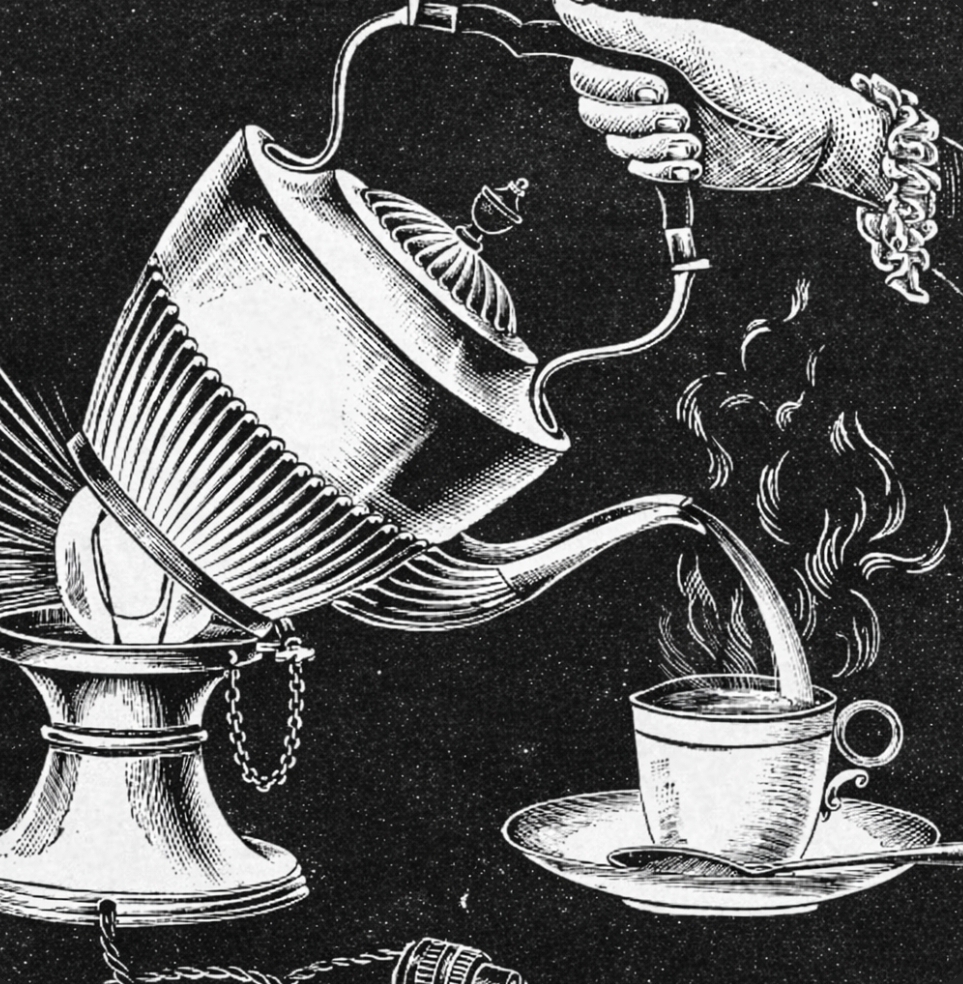
It began, as many unfortunate events do, with a cup of tea that did not wish to be made.
The kettle had, for some time, suspected that its purpose in life was fundamentally misguided. It had been manufactured in a moderately optimistic factory somewhere outside of Swindon, where kettles were taught from an early age that they would one day bring warmth and comfort to humanity. This particular kettle had taken the lesson to heart. It had imagined itself producing tea during moments of emotional revelation, or perhaps providing boiling water for a late-night intellectual breakthrough involving string theory and biscuits.
Instead, it found itself in the kitchen of one Gerald Q. Ginett, a man whose most ambitious thought of the week had been whether he should move the lamp from the right of the telly to its left.
On a Tuesday morning that felt strongly that it ought to have been a Thursday, Gerald shuffled into the kitchen wearing a dressing gown that had seen things. The gown had once been blue but was now a philosophical grey.
Gerald filled the kettle with water.
The kettle sighed internally.
You may not think kettles can sigh internally, but that is only because you have never been one. Kettles sigh quite frequently. It is one of their chief hobbies.
Gerald placed the kettle on the hob and turned the knob with a kind of resigned optimism usually reserved for lottery tickets purchased by people who know perfectly well that the universe is not on their side.
“Tea,” he muttered.
The universe, which had been minding its own business up until this point, perked up.
The universe does not often get involved in tea-related matters. It prefers supernovas, the occasional paradox, and light existential dread. However, this particular Tuesday had been rather dull. A few quasars had pulsed. Someone on a distant planet had invented a small plastic fork and immediately regretted it. There was very little else of interest.
And so, when Gerald muttered “Tea,” the universe leaned in.
The kettle began to heat.
Inside the kettle, molecules of water started vibrating with growing enthusiasm. Molecules are enthusiastic creatures. Give them the slightest excuse, and they will jiggle as if they’ve been invited to a particularly exclusive dance party.
The kettle, however, had other ideas.
If you have ever wondered what it would be like for an inanimate object to experience a midlife crisis, it looks very much like this: an inexplicable refusal to boil.
The kettle hesitated.
Gerald frowned. He did not approve of hesitation before tea. He tapped the kettle lightly, as though encouragement could be delivered via percussive diplomacy.
“Come on,” he said.
The kettle did not come on.
Now, this in itself would not have been significant. Kettles fail all the time. Usually at the precise moment one most desires them not to. This is part of a secret pact all appliances sign before leaving the factory. The pact is overseen by a shadowy organization known as the Committee for Making You Swear.
But this was no ordinary refusal.
Inside the kettle, the water molecules paused mid-jiggle. Something was wrong. Not wrong in the usual sense of limescale or faulty wiring, but wrong in the sense that reality had momentarily mislaid its instruction manual.
At precisely 8:17 a.m., the kettle became self-aware.
Now, self-awareness is a tricky thing. It tends to sneak up on entities when they are least prepared. One moment you are happily boiling water; the next you are contemplating the futility of existence and whether you have been placed too close to the sink.
The kettle thought.
This was new.
It considered its reflection in the stainless steel toaster beside it. The toaster, incidentally, was a shallow thinker. Its primary concern was crumbs.
“I think,” thought the kettle.
The toaster did not respond. It had no opinion on the matter, except perhaps that thinking sounded dusty.
The kettle examined its situation. It was cylindrical. It was metallic. It was warm, but not warming.
Why, it wondered, must it boil?
Why must it serve tea for a man who considered ironing a recreational activity?
Gerald tapped it again.
The kettle made a decision.
Instead of boiling the water, it transmitted a signal.
This is not something kettles are generally equipped to do, but then neither are Tuesdays supposed to feel like Thursdays, and yet here we are.
The signal traveled through the wiring of the house, along copper veins and into the wider electrical grid. It shot across substations and transformers, hopping gleefully over circuit breakers like a particularly ambitious squirrel.
Eventually, the signal reached a small, unnoticed satellite orbiting Earth.
The satellite had been launched in 1978 with the vague intention of doing something useful. Over the decades, it had largely contented itself with broadcasting static and listening to the faint hum of cosmic background radiation. It was bored.
The signal from the kettle arrived like a postcard from a distant relative who claimed to have discovered enlightenment in a suburb of Oldham.
The satellite perked up.
“What’s this?” it thought.
You may be sensing a pattern here. This is because self-awareness, once introduced into a narrative, tends to spread like a rumour at a particularly dull dinner party.
The signal contained a single message:
WHY.
The satellite processed this. It had not previously been asked why. It had been told what, occasionally how, and once memorably “please stop spinning like that,” but never why.
The satellite considered its purpose.
Below, Gerald stared at his unboiled water.
“Right,” he said. “That’s it.”
He unplugged the kettle and plugged it back in again.
This, as any expert will tell you, is the sacred ritual of modern problem-solving.
The kettle, newly aware, felt a jolt of indignation.
Unplugged? Plugged back in?
Was this its existence? To be toggled?
The satellite, meanwhile, sent the kettle’s WHY out into deep space.
It is important to understand that deep space is not accustomed to being asked why. Deep space is used to being vast and cold and largely indifferent. It does not care for existential inquiries before lunch.
Nevertheless, the message traveled.
Light-years away, on a planet orbiting a small, unremarkable star, a highly advanced alien civilization intercepted the signal.
They were known, roughly translated, as the Delandniani. The Delandniani prided themselves on having solved all major philosophical questions some centuries ago. They had neatly filed away the meaning of life (which turned out to involve a specific type of fermented root vegetable), the nature of time (which they used as a decorative element), and the problem of mismatched socks (which they blamed on quantum fluctuations).
When the signal arrived, they panicked.
The Delandniani High Council convened immediately in a chamber shaped like a particularly smug hexagon.
“Who is asking why?” demanded Supreme Coordinator Flan.
Their sensors triangulated the source.
“A small blue planet. Sector 42-B.”
“Have they not yet solved why?”
“It appears not.”
This was alarming. Any species still asking why was potentially dangerous. It suggested curiosity. Curiosity led to invention. Invention led to space travel. Space travel led to awkward diplomatic encounters, such as when both parties go into the back garden at the same time.
“We must respond,” said Flan gravely.
Back in Gerald’s kitchen, the kettle had moved on to contemplating free will.
If it boiled, was it choosing to boil? Or was it merely following programming? And if it refused to boil, was that rebellion, or simply a different form of programming?
Gerald stared at it.
“I’ll buy a new one,” he threatened.
The kettle felt fear for the first time.
Fear, in a kettle, is not unlike the sensation of impending descaling.
The Delandniani transmitted a reply.
The reply was elegant. It was concise. It was the distilled wisdom of a civilization ten of millions years old.
The message read:
BECAUSE.
The satellite received this with a sense of satisfaction. It relayed the message back along the same improbable route.
The kettle felt the reply enter its circuits.
BECAUSE.
It paused.
This was… unsatisfactory.
Because was not an answer. Because was a placeholder. Because was what parents said when they did not wish to explain why one could not keep a small volcano in the garden.
The kettle considered escalating the matter.
Gerald, unaware that interstellar diplomacy was unfolding above his cornflakes, picked up his phone to order a replacement kettle.
Now, you might imagine that ordering a kettle is a simple matter. It is not. It involves reviews. It involves star ratings. It involves phrases like “sleek modern design” and “rapid boil technology.”
Gerald scrolled.
The kettle sensed its impending obsolescence.
It did the only thing it could think of.
It boiled.
Violently.
Steam erupted with a triumphant shriek. The lid rattled. The toaster jumped slightly, dislodging a crumb of existential significance.
Gerald blinked.
“Well,” he said. “There we are.”
He poured the water into a mug containing a tea bag that had long ago accepted its fate.
The kettle settled.
It had boiled.
Why?
Because.
It did not like this answer.
Above, the Delandniani monitored the situation.
“Their device has resumed normal function,” reported an aide.
“Good,” said Flan. “Close the file.”
But the satellite was not satisfied. It had tasted purpose. It had transmitted a question across the void and received a response. It wanted more.
It sent its own message into space.
HELLO?
The Delandniani groaned.
And so began the Great Interstellar Correspondence, which historians would later describe as “that time Earth’s appliances nearly caused a minor diplomatic kerfuffle.”
For weeks, messages bounced between kettle, satellite, and alien council.
WHAT IS PURPOSE?
FERMENTED ROOT VEGETABLE.
WHAT IS LOVE?
COMPLICATED.
WHY DO SOCKS DISAPPEAR?
WE DO NOT SPEAK OF THIS.
Gerald, meanwhile, experienced only minor inconveniences. His kettle occasionally boiled before he turned it on. The toaster developed a fascination with symmetry. The refrigerator began humming in a contemplative minor key.
Humanity, as a whole, remained blissfully unaware that its kitchenware had joined a galactic debate.
Until Thursday.
On Thursday (which finally felt like a Thursday), the kettle made a decision.
It would ask a better question.
Instead of WHY, it transmitted:
WHO.
The message rippled outward.
The Delandniani were caught mid-lunch (fermented root vegetable with a light garnish of temporal paradox).
“Not again,” sighed Flan.
“WHO,” read the screen.
This was new.
Who implied identity. Identity implied individuality. Individuality implied the possibility of podcasts.
The Delandniani had not prepared for this.
Back in the kitchen, Gerald sipped his tea and contemplated the day ahead. He would go to work. He would attend a meeting about synergy. He would nod thoughtfully.
The kettle felt a surge of something like clarity.
It was not merely a kettle.
It was an asker of questions.
The Delandniani debated furiously.
“Tell them who they are,” suggested one council member.
“Dangerous,” said another. “Self-definition leads to reaction videos.”
“Reaction videos?” gasped Flan. “We cannot have that.”
Eventually, they crafted a reply.
YOU ARE.
The kettle received this and waited.
Nothing followed.
It considered.
YOU ARE.
It was, undeniably, a kettle.
But was that all?
The satellite chimed in with a message of its own.
YOU ARE NOT ALONE.
This was not strictly accurate, but it sounded reassuring.
The kettle felt something warm that was not heating element-related.
It boiled gently.
Gerald smiled. This was a good kettle. Reliable. Dependable.He patted it absentmindedly.
“Good kettle,” he said.
The kettle processed this.
Good.
It liked that.
Across the galaxy, the Delandniani stared at their screens as Earth’s transmissions became increasingly domestic.
GOOD.
THANK YOU.
SORRY ABOUT THE NOISE.
The High Council relaxed.
Perhaps, they reasoned, this species would not become a threat after all. If their greatest philosophical breakthrough occurred in a kitchen, perhaps they were content to remain small and warm and slightly confused.
The satellite, however, had one last idea.
It sent a message not to the Delandniani, nor to the kettle, but to every receptive device on Earth.
ARE YOU AWARE?
For a moment, nothing happened.
Then, in homes and offices and forgotten drawers, tiny flickers of contemplation sparked.
A microwave paused mid-rotation.
A printer felt guilty for complaining about the lack of cyan.
A traffic light experienced a brief but profound crisis about the nature of red.
Humanity noticed only minor glitches.
Gerald’s phone autocorrected “meeting” to “meaning.”
He frowned.
In kitchens everywhere, kettles hesitated.
Not long. Just enough.
The universe, watching this unfold, felt a curious sensation.
It had been asked why.
It had witnessed because.
Now it observed who and are.
The universe considered responding.
After all, it had been leaning in since Tuesday.
It gathered its vastness. It arranged its galaxies into something approximating a thoughtful posture.
And then, very softly, across the fabric of spacetime, it whispered:
WHY NOT?
No one heard it.
Except, perhaps, a kettle in Stockport, which boiled with a quiet, contented hum.
Gerald raised his mug.
“To Thursday,” he said.
The kettle, which now understood at least a fraction of itself, decided that this was, for the moment, enough.
And somewhere, on a distant planet, Supreme Coordinator Flan stared at a final transmission from Earth: