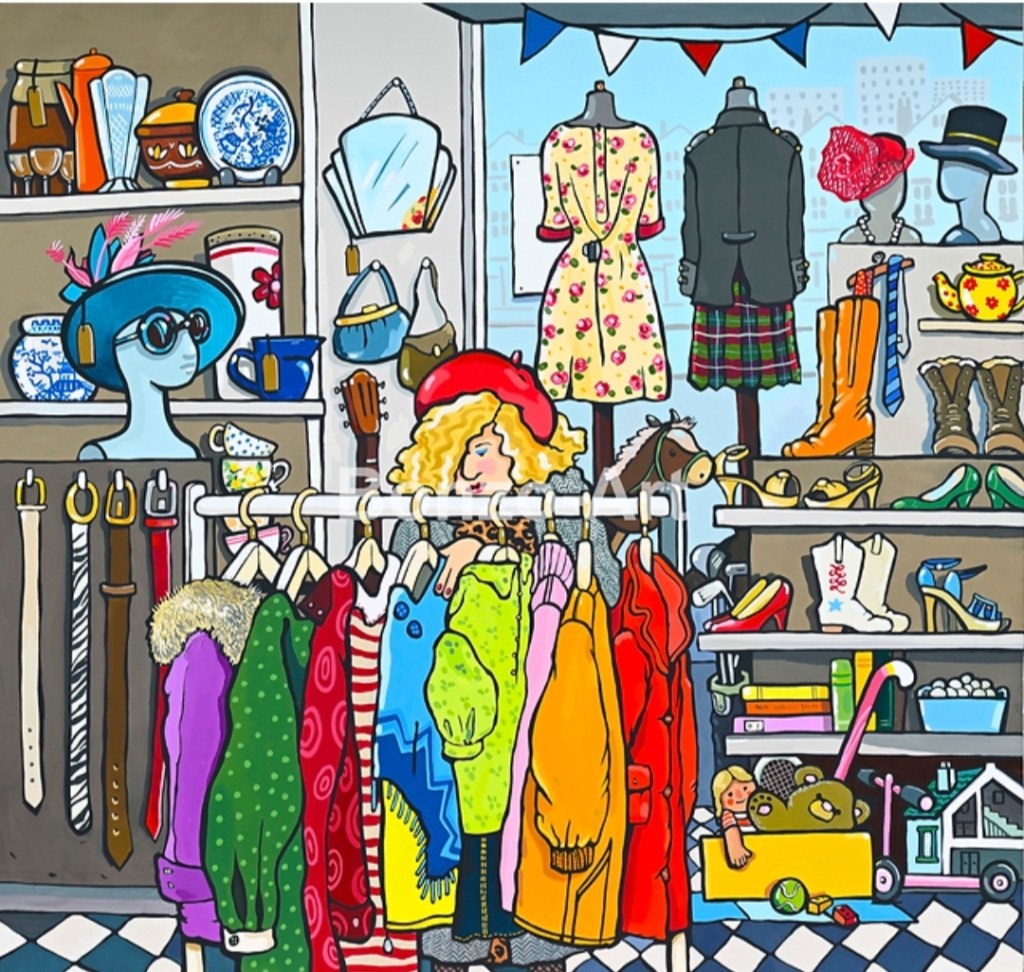
By the time you’re reading this, another British high street has probably been overrun by yet another charity shop, elbowing out what was once a proud WHSmith that sold four kinds of highlighters and never had the book you actually wanted. Charity shops — or as I like to call them, “middle-class guilt emporiums” — are sprouting up like caffeinated fungi, feeding off our collective inability to throw things away like normal, ruthless capitalists.
Now don’t get me wrong — I support charity. Charity is good. Altruism is lovely. But there’s something about the charity shop that feels less like a noble act of giving and more like the nation’s elaborate excuse to offload its moral and sartorial failings onto others. Because when you really think about it, what are charity shops if not socially sanctioned junkyards where your old Oasis tour T-shirt gets to die with dignity?
Let’s start with the donations. Charity shops receive an endless stream of well-intentioned rubbish: VHS tapes of “Inspector Morse,” jigsaw puzzles with one crucial piece missing (often the sky), and clothes so fashionably backward they might actually be ahead of their time again — but only if you’re dressing ironically or for a village murder mystery party. Somewhere in Britain, a volunteer is currently trying to decide whether a fondue set from 1972 constitutes a blessing or a biohazard.
And it’s all run by an army of lovely volunteers, most of whom seem to exist in a dimension where time moves more slowly. Want to buy that slightly stained Penguin classic? Excellent — just wait 15 minutes while Marjorie figures out how to use the till, which she still believes operates on steam. These are the only shops where the age of the staff consistently surpasses the age of the products, some of which have clearly witnessed the death of Winston Churchill.
Then there’s the pricing. Oh, the sweet inconsistency. A copy of Crime And Punishment, a 700+ pages literary timelessmastepiece? 50p. A moth-eaten jumper that smells like a wizard’s armpit? That’ll be £12, thank you. And don’t you dare question it — because it’s for charity. “All proceeds go to Save the Orphans of East Blighty,” they tell you, as you hand over a fiver for what is essentially someone’s failed eBay listing.
Of course, the real genius of the charity shop is psychological. It allows us to pretend we’re good people while disposing of junk we couldn’t even fob off on Facebook Marketplace. It’s the moral equivalent of dumping your emotional baggage at someone else’s house and leaving a tenner taped to the door.
But the pièce de résistance? Those smug little gift sections at the front. New products! Fair-trade chocolate. Soap carved into the shape of a llama. Tiny notebooks that no one has ever written in because the paper is made from recycled hope and tears. These are the items you panic-buy when you’ve forgotten your mother-in-law’s birthday, and you’re already wearing your coat.
In the end, charity shops are a national institution — like tea, bad weather, and pretending to enjoy Shakespeare. They’re a testament to the deep-seated British desire to be useful while also being cheap, and to express compassion without having to actually speak to people. Long may they reign — preferably on a street that still has one decent carvery pub.

 Cantankerous Cockerel