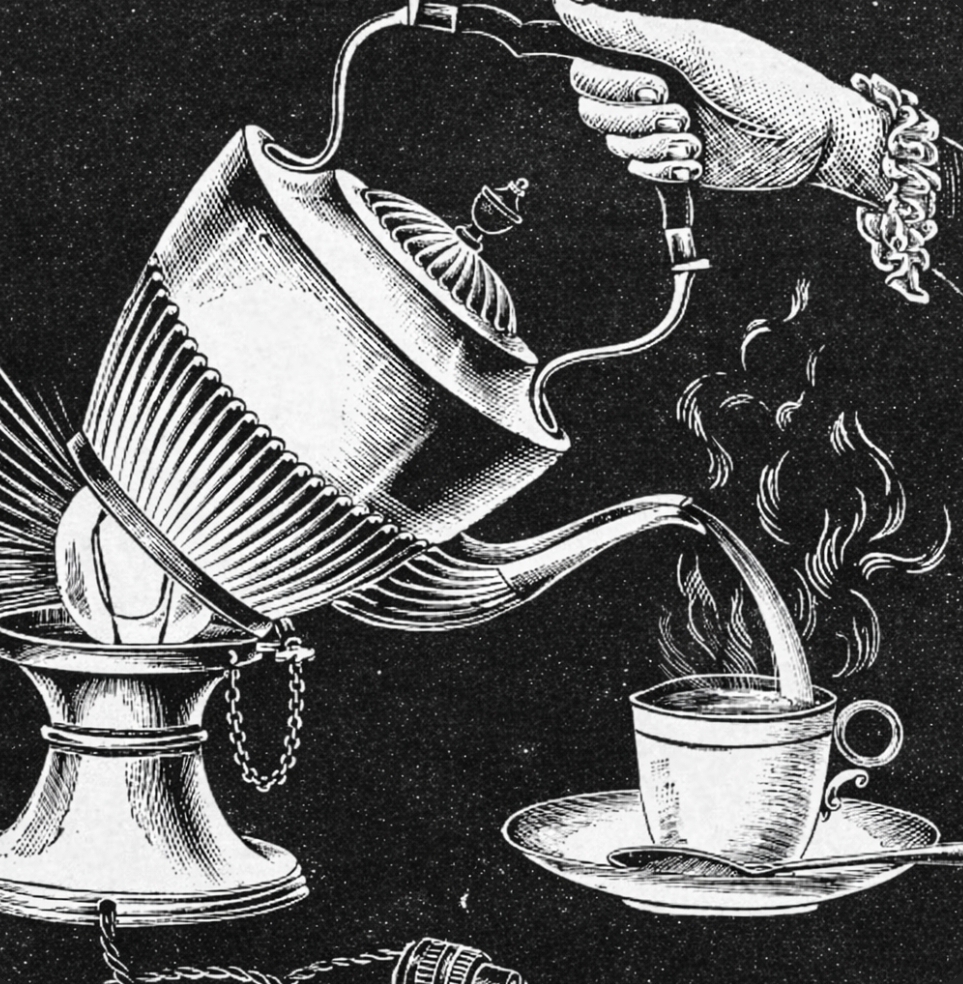
It began, as many unfortunate events do, with a cup of tea that did not wish to be made.
The kettle had, for some time, suspected that its purpose in life was fundamentally misguided. It had been manufactured in a moderately optimistic factory somewhere outside of Swindon, where kettles were taught from an early age that they would one day bring warmth and comfort to humanity. This particular kettle had taken the lesson to heart. It had imagined itself producing tea during moments of emotional revelation, or perhaps providing boiling water for a late-night intellectual breakthrough involving string theory and biscuits.
Instead, it found itself in the kitchen of one Gerald Q. Ginett, a man whose most ambitious thought of the week had been whether he should move the lamp from the right of the telly to its left.
On a Tuesday morning that felt strongly that it ought to have been a Thursday, Gerald shuffled into the kitchen wearing a dressing gown that had seen things. The gown had once been blue but was now a philosophical grey.
Gerald filled the kettle with water.
The kettle sighed internally.
You may not think kettles can sigh internally, but that is only because you have never been one. Kettles sigh quite frequently. It is one of their chief hobbies.
Gerald placed the kettle on the hob and turned the knob with a kind of resigned optimism usually reserved for lottery tickets purchased by people who know perfectly well that the universe is not on their side.
“Tea,” he muttered.
The universe, which had been minding its own business up until this point, perked up.
The universe does not often get involved in tea-related matters. It prefers supernovas, the occasional paradox, and light existential dread. However, this particular Tuesday had been rather dull. A few quasars had pulsed. Someone on a distant planet had invented a small plastic fork and immediately regretted it. There was very little else of interest.
And so, when Gerald muttered “Tea,” the universe leaned in.
The kettle began to heat.
Inside the kettle, molecules of water started vibrating with growing enthusiasm. Molecules are enthusiastic creatures. Give them the slightest excuse, and they will jiggle as if they’ve been invited to a particularly exclusive dance party.
The kettle, however, had other ideas.
If you have ever wondered what it would be like for an inanimate object to experience a midlife crisis, it looks very much like this: an inexplicable refusal to boil.
The kettle hesitated.
Gerald frowned. He did not approve of hesitation before tea. He tapped the kettle lightly, as though encouragement could be delivered via percussive diplomacy.
“Come on,” he said.
The kettle did not come on.
Now, this in itself would not have been significant. Kettles fail all the time. Usually at the precise moment one most desires them not to. This is part of a secret pact all appliances sign before leaving the factory. The pact is overseen by a shadowy organization known as the Committee for Making You Swear.
But this was no ordinary refusal.
Inside the kettle, the water molecules paused mid-jiggle. Something was wrong. Not wrong in the usual sense of limescale or faulty wiring, but wrong in the sense that reality had momentarily mislaid its instruction manual.
At precisely 8:17 a.m., the kettle became self-aware.
Now, self-awareness is a tricky thing. It tends to sneak up on entities when they are least prepared. One moment you are happily boiling water; the next you are contemplating the futility of existence and whether you have been placed too close to the sink.
The kettle thought.
This was new.
It considered its reflection in the stainless steel toaster beside it. The toaster, incidentally, was a shallow thinker. Its primary concern was crumbs.
“I think,” thought the kettle.
The toaster did not respond. It had no opinion on the matter, except perhaps that thinking sounded dusty.
The kettle examined its situation. It was cylindrical. It was metallic. It was warm, but not warming.
Why, it wondered, must it boil?
Why must it serve tea for a man who considered ironing a recreational activity?
Gerald tapped it again.
The kettle made a decision.
Instead of boiling the water, it transmitted a signal.
This is not something kettles are generally equipped to do, but then neither are Tuesdays supposed to feel like Thursdays, and yet here we are.
The signal traveled through the wiring of the house, along copper veins and into the wider electrical grid. It shot across substations and transformers, hopping gleefully over circuit breakers like a particularly ambitious squirrel.
Eventually, the signal reached a small, unnoticed satellite orbiting Earth.
The satellite had been launched in 1978 with the vague intention of doing something useful. Over the decades, it had largely contented itself with broadcasting static and listening to the faint hum of cosmic background radiation. It was bored.
The signal from the kettle arrived like a postcard from a distant relative who claimed to have discovered enlightenment in a suburb of Oldham.
The satellite perked up.
“What’s this?” it thought.
You may be sensing a pattern here. This is because self-awareness, once introduced into a narrative, tends to spread like a rumour at a particularly dull dinner party.
The signal contained a single message:
WHY.
The satellite processed this. It had not previously been asked why. It had been told what, occasionally how, and once memorably “please stop spinning like that,” but never why.
The satellite considered its purpose.
Below, Gerald stared at his unboiled water.
“Right,” he said. “That’s it.”
He unplugged the kettle and plugged it back in again.
This, as any expert will tell you, is the sacred ritual of modern problem-solving.
The kettle, newly aware, felt a jolt of indignation.
Unplugged? Plugged back in?
Was this its existence? To be toggled?
The satellite, meanwhile, sent the kettle’s WHY out into deep space.
It is important to understand that deep space is not accustomed to being asked why. Deep space is used to being vast and cold and largely indifferent. It does not care for existential inquiries before lunch.
Nevertheless, the message traveled.
Light-years away, on a planet orbiting a small, unremarkable star, a highly advanced alien civilization intercepted the signal.
They were known, roughly translated, as the Delandniani. The Delandniani prided themselves on having solved all major philosophical questions some centuries ago. They had neatly filed away the meaning of life (which turned out to involve a specific type of fermented root vegetable), the nature of time (which they used as a decorative element), and the problem of mismatched socks (which they blamed on quantum fluctuations).
When the signal arrived, they panicked.
The Delandniani High Council convened immediately in a chamber shaped like a particularly smug hexagon.
“Who is asking why?” demanded Supreme Coordinator Flan.
Their sensors triangulated the source.
“A small blue planet. Sector 42-B.”
“Have they not yet solved why?”
“It appears not.”
This was alarming. Any species still asking why was potentially dangerous. It suggested curiosity. Curiosity led to invention. Invention led to space travel. Space travel led to awkward diplomatic encounters, such as when both parties go into the back garden at the same time.
“We must respond,” said Flan gravely.
Back in Gerald’s kitchen, the kettle had moved on to contemplating free will.
If it boiled, was it choosing to boil? Or was it merely following programming? And if it refused to boil, was that rebellion, or simply a different form of programming?
Gerald stared at it.
“I’ll buy a new one,” he threatened.
The kettle felt fear for the first time.
Fear, in a kettle, is not unlike the sensation of impending descaling.
The Delandniani transmitted a reply.
The reply was elegant. It was concise. It was the distilled wisdom of a civilization ten of millions years old.
The message read:
BECAUSE.
The satellite received this with a sense of satisfaction. It relayed the message back along the same improbable route.
The kettle felt the reply enter its circuits.
BECAUSE.
It paused.
This was… unsatisfactory.
Because was not an answer. Because was a placeholder. Because was what parents said when they did not wish to explain why one could not keep a small volcano in the garden.
The kettle considered escalating the matter.
Gerald, unaware that interstellar diplomacy was unfolding above his cornflakes, picked up his phone to order a replacement kettle.
Now, you might imagine that ordering a kettle is a simple matter. It is not. It involves reviews. It involves star ratings. It involves phrases like “sleek modern design” and “rapid boil technology.”
Gerald scrolled.
The kettle sensed its impending obsolescence.
It did the only thing it could think of.
It boiled.
Violently.
Steam erupted with a triumphant shriek. The lid rattled. The toaster jumped slightly, dislodging a crumb of existential significance.
Gerald blinked.
“Well,” he said. “There we are.”
He poured the water into a mug containing a tea bag that had long ago accepted its fate.
The kettle settled.
It had boiled.
Why?
Because.
It did not like this answer.
Above, the Delandniani monitored the situation.
“Their device has resumed normal function,” reported an aide.
“Good,” said Flan. “Close the file.”
But the satellite was not satisfied. It had tasted purpose. It had transmitted a question across the void and received a response. It wanted more.
It sent its own message into space.
HELLO?
The Delandniani groaned.
And so began the Great Interstellar Correspondence, which historians would later describe as “that time Earth’s appliances nearly caused a minor diplomatic kerfuffle.”
For weeks, messages bounced between kettle, satellite, and alien council.
WHAT IS PURPOSE?
FERMENTED ROOT VEGETABLE.
WHAT IS LOVE?
COMPLICATED.
WHY DO SOCKS DISAPPEAR?
WE DO NOT SPEAK OF THIS.
Gerald, meanwhile, experienced only minor inconveniences. His kettle occasionally boiled before he turned it on. The toaster developed a fascination with symmetry. The refrigerator began humming in a contemplative minor key.
Humanity, as a whole, remained blissfully unaware that its kitchenware had joined a galactic debate.
Until Thursday.
On Thursday (which finally felt like a Thursday), the kettle made a decision.
It would ask a better question.
Instead of WHY, it transmitted:
WHO.
The message rippled outward.
The Delandniani were caught mid-lunch (fermented root vegetable with a light garnish of temporal paradox).
“Not again,” sighed Flan.
“WHO,” read the screen.
This was new.
Who implied identity. Identity implied individuality. Individuality implied the possibility of podcasts.
The Delandniani had not prepared for this.
Back in the kitchen, Gerald sipped his tea and contemplated the day ahead. He would go to work. He would attend a meeting about synergy. He would nod thoughtfully.
The kettle felt a surge of something like clarity.
It was not merely a kettle.
It was an asker of questions.
The Delandniani debated furiously.
“Tell them who they are,” suggested one council member.
“Dangerous,” said another. “Self-definition leads to reaction videos.”
“Reaction videos?” gasped Flan. “We cannot have that.”
Eventually, they crafted a reply.
YOU ARE.
The kettle received this and waited.
Nothing followed.
It considered.
YOU ARE.
It was, undeniably, a kettle.
But was that all?
The satellite chimed in with a message of its own.
YOU ARE NOT ALONE.
This was not strictly accurate, but it sounded reassuring.
The kettle felt something warm that was not heating element-related.
It boiled gently.
Gerald smiled. This was a good kettle. Reliable. Dependable.He patted it absentmindedly.
“Good kettle,” he said.
The kettle processed this.
Good.
It liked that.
Across the galaxy, the Delandniani stared at their screens as Earth’s transmissions became increasingly domestic.
GOOD.
THANK YOU.
SORRY ABOUT THE NOISE.
The High Council relaxed.
Perhaps, they reasoned, this species would not become a threat after all. If their greatest philosophical breakthrough occurred in a kitchen, perhaps they were content to remain small and warm and slightly confused.
The satellite, however, had one last idea.
It sent a message not to the Delandniani, nor to the kettle, but to every receptive device on Earth.
ARE YOU AWARE?
For a moment, nothing happened.
Then, in homes and offices and forgotten drawers, tiny flickers of contemplation sparked.
A microwave paused mid-rotation.
A printer felt guilty for complaining about the lack of cyan.
A traffic light experienced a brief but profound crisis about the nature of red.
Humanity noticed only minor glitches.
Gerald’s phone autocorrected “meeting” to “meaning.”
He frowned.
In kitchens everywhere, kettles hesitated.
Not long. Just enough.
The universe, watching this unfold, felt a curious sensation.
It had been asked why.
It had witnessed because.
Now it observed who and are.
The universe considered responding.
After all, it had been leaning in since Tuesday.
It gathered its vastness. It arranged its galaxies into something approximating a thoughtful posture.
And then, very softly, across the fabric of spacetime, it whispered:
WHY NOT?
No one heard it.
Except, perhaps, a kettle in Stockport, which boiled with a quiet, contented hum.
Gerald raised his mug.
“To Thursday,” he said.
The kettle, which now understood at least a fraction of itself, decided that this was, for the moment, enough.
And somewhere, on a distant planet, Supreme Coordinator Flan stared at a final transmission from Earth:
🙂
 Cantankerous Cockerel