Part 1: Introductions are the worst part
There are, broadly speaking, three kinds of evil.
The first is the theatrical sort: cackling maniacs with lava pits, themed henchmen, and a frankly admirable commitment to interior design. The sort who monologue about destiny while standing on balconies shaped like jagged teeth, as if they ordered their entire aesthetic from a catalogue labelled “Subtlety Is For Cowards”.
The second is the quiet, insidious kind: corporations, middle management, and anyone who says “circling back” in a meeting without being immediately escorted out of the building. These are the people who don’t need laser beams or death rays because they’ve already mastered the art of draining the human soul through email chains and passive-aggressive calendar invites.
And then there’s us.
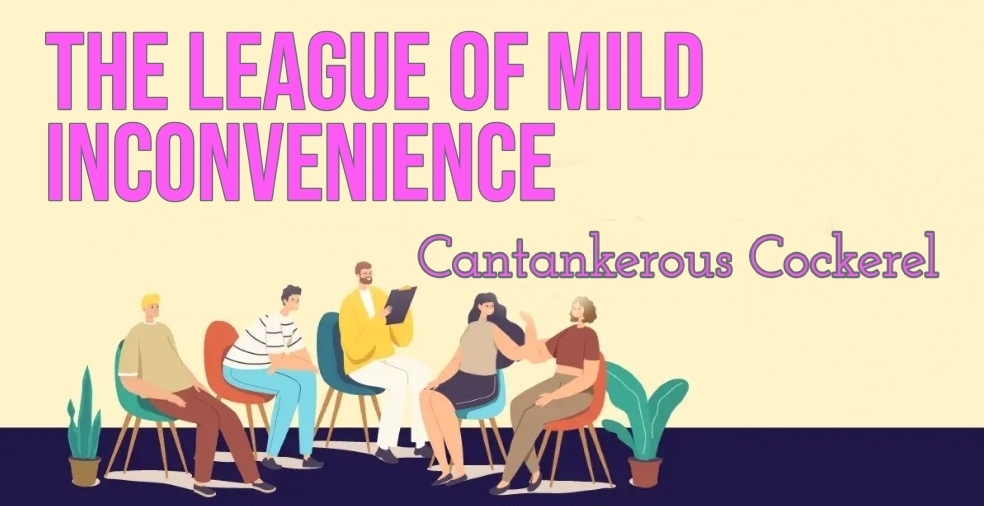
We meet every Thursday evening in a community centre that smells like damp carpet, burnt toast, and the vague suggestion of something that might once have been soup. It’s sandwiched between a Pilates class and something labelled “Expressive Clay for Beginners”, which I strongly suspect is code for people who can’t be trusted with knives but still need an outlet for their more sculptural urges. Or a drug front.
The sign on the door reads:
SUPPORT GROUP FOR EMERGING VILLAINOUS TALENT (Please bring your own biscuits)
Which, I feel, sets the tone rather effectively.
My name is Eleanor Vex, and I can make queues longer.
Not in any grand, reality-warping sense. I can’t conjure crowds out of thin air or bend space-time into a neat little pretzel. What I can do—what I have discovered I am uniquely and depressingly gifted at—is ensure that whenever someone joins a queue, it becomes just slightly longer and slower than it ought to be.
A person steps into a tidy line at a coffee shop expecting a brisk transaction, and suddenly there are three more people in front of them than there were a moment ago, and the barista has developed a deeply personal relationship with the concept of oat milk.
It’s subtle. Petty. Utterly infuriating.
And completely useless if your ambition is anything more ambitious than mildly inconveniencing a stranger on their lunch break.
Which, unfortunately, mine was.
I didn’t discover my ability in a dramatic fashion.
There was no lightning strike, no mysterious serum, no ancient artefact humming with ominous significance. I discovered it in a Pret.
I had been standing in what I was assured was a “quick queue”, which in London translates loosely to “a slow-moving existential experience with sandwiches”.
I remember thinking, with the quiet bitterness of someone who had already committed too much time to the endeavour, that it seemed to be taking longer than usual.
Then I noticed something odd.
Every time I shifted forward, someone else appeared in front of me.
Not in a dramatic, teleportation sort of way. They just… were there. As if they had always been there and I had simply failed to notice them, which is arguably worse.
A man debating the moral implications of a banana state of maturation. A woman asking if the napkins were “emotionally sourced”. Someone paying entirely in coins with the deliberate pace of a person who had nowhere to be and intended to ensure that no one else did either.
By the time I reached the till, I had aged noticeably.
It wasn’t until later, after several similar incidents and one particularly harrowing experience at a post office, that I realised the common factor was me.
Which is, I think we can all agree, deeply on brand.
The first rule of the group is that you have to introduce yourself and your “ability” without irony.
This is, in practice, impossible, like asking someone to describe their most embarrassing childhood memory in a tone of dignified neutrality.
“Hello,” I said on my first night, clutching a packet of bourbons like a social shield. “I’m Eleanor, and I… extend queues.”
A pause followed.
Not a respectful pause. Not the kind that suggests thoughtful consideration or emotional resonance. The kind of pause usually reserved for when someone says something so profoundly awkward that the room collectively agrees to pretend it didn’t happen.
Then a man in a folding chair nodded with what I suspect he believed was solemn encouragement.
“Thank you, Eleanor,” he said. “Very brave.”
He introduced himself as Dr Malevo, which was already a warning sign, as anyone who gives themselves a villainous title has either delusions of grandeur or a deeply concerning relationship with Etsy.
Dr Malevo wore a suit that had aspirations of authority but settled for “probation officer at a school for gifted disappointments”. It was slightly too shiny in places, as if it had been ironed with enthusiasm but not competence. He had a clipboard, which he wielded with the quiet menace of someone who believed paperwork could conquer the world if given enough bullet points.
“Who’d like to go next?” he asked, scanning the room with the hopeful expression of a man trying to coax confessions out of a collection of particularly uncooperative houseplants.
A woman raised her hand.
“I’m Priya,” she said, with the crisp tone of someone who had accepted her fate and decided to bully it into submission. “I can make people’s socks slightly damp.”
Another pause. This one shorter, but no less loaded.
“Slightly damp?” Dr Malevo prompted, as though clarifying the parameters of a particularly niche crime.
“Yes,” Priya said. “Not wet enough to justify changing them. Just enough to make you aware of it. All day.”
I felt, despite myself, a flicker of respect.
“That’s diabolical,” I muttered.
“Thank you,” she said, as if I’d complimented her on a well-executed soufflé.
The group, as it transpired, was less a gathering of masterminds and more a catalogue of life’s minor irritations given human form.
To my left sat a young woman named Charlotte, who introduced herself as “White Noise”.
“I can produce a constant, high-pitched whining sound that no one can quite locate,” she explained. “It’s not loud enough to be obvious, just… present.”
“Like a mosquito in your soul,” Dr. Malevo observed .
She beamed. “Exactly. Or like when a light fixture is about to give up on life but hasn’t quite committed yet.”
“That’s oddly specific.”
“I used to work in an office,” she said darkly.
Next to her was a man who insisted on being called “The Latecomer”, which sounded impressive until he clarified.
“I can delay public transport by exactly fourteen minutes,” he said. “No more, no less.”
“Why fourteen?” Priya asked.
“I don’t know,” he snapped. “Why damp socks?”
“Fair point,” she conceded.
“Also,” he added, leaning forward slightly, “it’s the perfect amount. Too short to justify outrage. Too long to ignore. It erodes trust in the system.”
“I think the system manages that on its own,” I said.
Across the circle, a woman with the kind of exhausted expression usually seen on primary school teachers raised a hand.
“Gemma,” she said. “I ensure that there is always a crying child in any café where someone is attempting to relax.”
“Always?” I said.
“Always,” she confirmed. “If there isn’t one, I… provide.”
There was something deeply unsettling about the way she said that, like a weather system describing itself.
“And I don’t control the volume,” she added. “It’s just… maximum.”
“Of course it is,” The Latecomer said. “Wouldn’t want to undermine the brand.”
“It’s not about volume,” she said defensively. “It’s about persistence. People can tolerate loud. They can’t tolerate relentless.”
“That should be on a T-shirt,” Charlotte said.
By the time we reached the end of the circle, I had learned that:
– A man named Oliver could make your phone battery drop by exactly 7% at the moment you needed it most. He described this as “digital sabotage” and seemed unreasonably proud of it.
– A woman called Hannah could misplace any small object within a three-metre radius. “Not lost,” she clarified. “Just… wrong.”
– A man could make tea too hot to drink immediately, but not hot enough so you’d just put it down and go ahead with your day for a few minutes. Hot enough that you just stay there, blowing on it. He insisted in being called The Steepmaster, which nobody acknowledged in what I sensed was a shared instinct for self-preservation.
It was, collectively, the least threatening collection of individuals I had ever encountered, and I once attended a networking event for freelance copywriters, which featured a man who described himself as a “word disruptor”.
And yet, there was something… cohesive about it.
Not in the sense that we formed any kind of credible threat. More that we all occupied the same strange niche of existence: people who had been handed something extraordinary and found it resolutely determined to be underwhelming.
Dr Malevo, naturally, saw it differently.“What we have here,” he said, standing at the centre of the circle like a man addressing a very disappointing cult, “is potential.”
I glanced around the room at Priya, who was carefully aligning a biscuit on her knee with the focus of a neurosurgeon, and at The Latecomer, who was staring at the clock with the intensity of someone willing it to betray him.
“Is it?” I said.
“Yes,” he said firmly. “Individually, your abilities may seem… limited.”
“That’s a generous word,” Charlotte muttered.
“But together,” he continued, undeterred, “they represent something far more significant.”
“An inconvenience?” Gemma suggested.
“A force,” he said.
There was a silence.
Not the thoughtful kind. The kind where everyone is quietly deciding whether to humour the speaker or stage a coordinated escape.
“I mean,” Gemma said slowly, “we’re not exactly… blowing up buildings, are we?”
“Destruction is overrated,” Dr Malevo said. “Anyone can destroy. It’s crude. Inelegant. Temporary.”
“And making someone’s latte take longer is… elegant?” I asked.
“It’s insidious,” he corrected. “It accumulates.”
I opened my mouth to respond, but he raised a hand, clearly having rehearsed this moment in front of a mirror that had been less sceptical than we were.
“Consider,” he said, “the average person’s day. They wake up, already slightly annoyed. The alarm went off too early. The room was too cold. They stub their toe on the bedframe. They’re facing a work day.”
“I don’t do toes,” Priya said.
“It’s an example,” he snapped. “Then they leave the house. The bus is late.”
The Latecomer sat up slightly straighter, like a man being personally acknowledged by destiny.
“They arrive at a café, hoping for a moment of peace. There is a crying child.”
Gemma gave a small, satisfied nod.
“They queue longer than expected,” he continued, looking directly at me. “Their coffee is too hot to drink. Their phone battery drops unexpectedly. Their keys are missing.”
He paused, letting it settle, as though expecting a slow ripple of horrified understanding rather than the mild discomfort of people realising they were being used as a metaphor.
“What you create,” he said, “is not a single act of villainy. It is a day. A mood. A slow, relentless erosion of patience.”
I frowned.
It was, annoyingly, a compelling argument. The kind that sneaks up on you and sits down uninvited, like a guest who insists they’re “just popping in” and then starts rearranging your furniture.
“Right,” I said. “But to what end? Are we hoping someone eventually snaps and… what, declares war on a Caffe Nero?”
“Don’t be flippant,” he said.
“I’m not,” I said. “I’m genuinely asking what the goal is. Because at the moment, it sounds like we’re aiming to become the abstract concept of ‘a bit of a bad day’.”
There were a few snorts of laughter. Even Priya allowed herself a brief smile, which I chose to interpret as a personal victory.
Dr Malevo did not join in.
“The goal,” he said quietly, “is to understand the true nature of power.”
“Oh good,” Gemma muttered. “I was worried it might be something achievable.”
*
The meeting ended, as they always did, with a vague sense of anticlimax and a plate of untouched digestive biscuits that had achieved the remarkable feat of being both too dry and somehow slightly damp, which I suspect was Priya’s doing.
I lingered by the door, watching as the others drifted out into the evening, each carrying their particular brand of mild malevolence like a slightly embarrassing hobby.
Outside, it was drizzling in that persistent, half-hearted way that suggests the weather is trying to inconvenience you personally but lacks the commitment to see it through. The British way of raining.
Priya caught my eye.
“You don’t believe him,” she said.
“Do you?” I countered.
She considered this, adjusting the strap of her bag with the precision of someone who liked things to sit exactly where they were meant to.
“I think,” she said slowly, “that if I wanted to ruin someone’s day, I could.”
“You could ruin their socks,” I said.
“Socks are the foundation of the day,” she said firmly. “Everything else builds from there.”
I stared at her.
“You’ve thought about this far too much.”
“Have you ever tried to ignore damp socks?” she said. “It’s impossible. It’s like your feet are quietly judging you.”
“I’ll take your word for it,” I said.
She smiled faintly.
“Come next week,” she said. “Even if it’s ridiculous.”
“It is ridiculous,” I said.
“Yes,” she agreed. “But it’s ours.”
*
I did go back the next week.
And the week after that.
Not because I believed in Dr Malevo’s grand vision, or because I thought we were on the brink of becoming anything resembling a credible threat.
But because, in a world full of people who either took themselves far too seriously or not seriously enough, there was something oddly comforting about a group that sat firmly in the middle, armed with powers that couldn’t quite justify their own existence.
It was, I told myself, purely observational.
A study in absurdity.
A way to pass the time.
It had absolutely nothing to do with the fact that, for the first time since discovering my thoroughly pointless ability, I didn’t feel entirely alone in it.
Which, in hindsight, should have been my first warning sign.
Because the thing about small annoyances—the truly insidious thing—is that they don’t stay small.
They build.
Quietly. Patiently.
Like a queue that keeps getting longer when no one is quite sure why.
Until one day, you look up and realise that what you thought was a collection of trivial irritations has become something else entirely.
Something… coordinated.
Something deliberate.
Something that, if you were feeling particularly dramatic, you might even call a plan.
Part 2: Practice makes mildly catastrophic
If there’s one thing worse than discovering you possess a useless superpower, it’s discovering other people are taking it seriously.
This became apparent on my fourth Thursday, when Dr Malevo arrived with a flip chart.
Not a whiteboard. Not a projector. A flip chart.
There is something uniquely threatening about a grown adult with a flip chart. It suggests planning. Intent. A willingness to commit ideas to paper in large, confident handwriting that cannot easily be erased or quietly disowned.
“Tonight,” he announced, with the air of a man unveiling a bold new initiative that would almost certainly end in paperwork, “we begin practical exercises.”
There was a collective shift in the room. Not excitement, exactly. More the subdued dread of people who had signed up for something ironic and were now being asked to participate sincerely.
“What sort of exercises?” Charlotte asked.
“Synergy,” he said, writing the word on the flip chart in thick, uncompromising strokes.
“I already don’t like it,” I said.
“You don’t have to like it,” he replied. “You simply have to engage with it.”
“That’s what people say about tax returns,” I muttered.
He ignored me, which I was beginning to suspect was less a sign of patience and more a survival mechanism.
“Up until now,” he continued, “you have all been operating in isolation. Small, disconnected acts of inconvenience. But what happens when those acts are… coordinated?”
“We mildly irritate someone slightly faster?” Oliver suggested.
“Or we create,” Dr Malevo said, turning dramatically to face us, “an experience.”
There was that word again. Experience. As if we were about to open a themed attraction called
‘A Bit of a Nuisance Land’.
“Right,” I said. “And who exactly is volunteering to be… experienced?”
Dr Malevo smiled.
“No one volunteers,” he said. “We observe.”
*
The plan, such as it was, involved a café.
Not a specific café.
Just “a café”, which in London is rather like saying “a pigeon”: there are so many that targeting one feels less like a decision and more like a statistical inevitability.
We gathered outside a place that described itself as “artisanal” and charged accordingly. It had exposed brick, mismatched furniture, and a menu that treated the word “sandwich” like a personal insult.
“This is ridiculous,” Charlotte said, standing on the pavement with the rest of us as if we were about to commit a very low-stakes heist.
“Focus,” Dr Malevo said. “This is a controlled test.”
“Of what?” she asked. “Our ability to loiter suspiciously?”
“Timing,” he said. “Sequence. Interaction.”
He pointed at Gemma.
“You go in first.”
She nodded, like a soldier accepting a deeply unimpressive mission, and disappeared inside.
“Now we wait,” he said.
“For what?” The Latecomer asked.
“For the right moment.”
“Which is defined as…?”
“You’ll know,” Dr Malevo said, which is never reassuring.
*
We did not, in fact, know.
What we did know, after approximately three minutes, was that The Latecomer was becoming visibly agitated.
“I could be doing something,” he said, pacing slightly. “There are buses out there. Trains. Entire transport networks functioning with unacceptable efficiency.”
“Try to contain yourself,” I said. “The city might survive without your intervention.”
“It won’t,” he said darkly. “That’s the problem.”
Before I could respond, Dr Malevo raised a hand.
“Now,” he said.
This, apparently, was our cue.
“Eleanor,” he said, pointing at me. “Inside. Join the queue.”
“Thrilling,” I said, but went in anyway.
*
The café was exactly what you’d expect: warm, crowded, and filled with people who looked like they had opinions about coffee that would be exhausting to hear.
Gemma was already in place, sitting near the window with a cup she clearly wasn’t drinking, her expression one of quiet concentration.
I joined the queue.
There were four people ahead of me.
Five, once I’d fully committed to standing there.
Then six.
I felt it happen, not as a dramatic surge of power, but as a subtle shift, like reality had shrugged and decided to be slightly more inconvenient.
A man appeared in front of me, already mid-conversation with the barista about the artist vision of whatever the cafe had hanging on its walls. A woman behind him began asking about gluten in a tone that suggested she would not be satisfied with any answer that didn’t involve a personal apology from the wheat itself.
I exhaled slowly.
“All right,” I muttered. “Let’s see what happens.”
*
It started small.
It always does.
The queue slowed, not dramatically, but enough that people began to notice. Not consciously at first. Just a slight tightening around the eyes. A shift of weight from one foot to the other.
Then Gemma’s contribution kicked in.
At first, it was just a sound —a faint, distant wail. Easy to ignore. The kind of noise you assume belongs to someone else’s problem.
Then it got louder.
And closer.
I turned my head slightly.
A child had appeared at a nearby table, red-faced and furious, producing a noise that could only be described as an auditory assault.
The parents looked exhausted. Defeated. As though they had accepted that this was their life now and resistance was futile. They might as well make everyone else miserable, as well.
“Right on schedule,” I murmured.
The man in front of me shifted again, glancing over his shoulder with the strained smile of someone trying very hard not to engage with the situation.
Then Charlotte stepped in.
Not physically. Audibly.
It’s difficult to describe White Noise’s effect, because that’s rather the point. It wasn’t loud. It wasn’t even clearly identifiable. Just a high-pitched, persistent whine that slipped into the background and refused to leave. In the few moments when the child stopped for breath, with your soul gasping for that half a second of truce, there it was.
The sort of sound that makes you question your own sanity.
I saw it register.
Subtle, at first. A slight frown. A distracted glance at the ceiling, as if the answer might be written there in faint, irritating frequencies.
The queue slowed further.
*
By the time Priya joined, it had become something else.
Not chaos. Not yet.
But tension.
You could feel it in the room. The collective awareness that something was slightly off, without any clear explanation as to what.
Priya walked past me without a word, her expression focused.
A moment later, I saw the effects ripple.
A woman near the counter shifted uncomfortably, adjusting her stance. Then again. Her foot tapped against the floor in a way that suggested she was trying, and failing, to ignore something.
Another person frowned, glancing down at their shoes with vague suspicion.
It spread.
Not dramatically. Not visibly enough to draw attention.
Just enough.
*
And then, of course, there was Oliver.
The man in front of me pulled out his phone, glanced at it, and sighed.
“Seven percent?” he muttered. “I just charged this.”
I almost laughed.
Almost.
Because at that moment, something clicked.
Not in the room.
In my head.
Dr Malevo had been right.
Not about the grand, sweeping idea of power, or whatever nonsense he’d been rehearsing in front of his mirror.
But about the accumulation.
Individually, these things were nothing.
A longer queue. A crying child. A faint noise. Slightly damp socks. A phone battery dipping at an inconvenient moment.
Together—I looked around.
The man at the counter was now arguing quietly with the barista about something that didn’t matter. The woman behind me huffed audibly. Someone dropped a spoon, and the sound seemed to linger just a fraction too long.
It wasn’t chaos.
It was worse.
It was sensory overload.
It was irritation.
Pure, concentrated, inescapable irritation.
*
I stepped out of the queue.
Not dramatically. Just… stepped away, as if I’d forgotten something important and couldn’t quite remember what it was.
Outside, the others were waiting.
“Well?” Dr Malevo asked.
I hesitated.
“It worked,” I said.
There was a flicker of satisfaction in his expression. Not triumph. Something quieter. More controlled.
“Describe it.”
I searched for the right words.
“It’s like…” I paused. “It’s like watching someone’s day go wrong in real time, but nothing is actually happening.”
He nodded.
“Precisely.”
“No,” I said. “Not precisely. That’s the problem. It’s not enough to be something. It’s just… everything slightly worse than it should be.”
“And how did that feel?” he asked.
I frowned.
“Uncomfortable,” I said.
“Good,” he replied.
“That’s not a good thing,” I said.
“For you,” he said. “No. But for our purposes—”
“Our purposes,” I repeated. “We’re doing this with a purpose in mind, aren’twe?”
He didn’t answer immediately.
Which, in itself, was an answer.
*
We ran the exercise again the following week.
And the week after that.
Different locations. Different combinations.
A supermarket, where Hannah’s ability turned the simple act of shopping into a low-level scavenger hunt of misplaced items and rising frustration.
A train platform, where The Latecomer’s precise delays stacked with my queues and Oliver’s battery interference to produce a crowd that shifted from mildly annoyed to quietly hostile.
Each time, the same result.
Not disaster.
Not even anything you could point to and say, “There. That’s wrong.”
Just… a day going badly.
Over and over again.
*
It was after the third “test” that I started noticing something else.Patterns.Not in the chaos, but in the way Dr Malevo observed it.
He wasn’t just watching.
He was tracking.
Timing.
Taking notes on that ever-present clipboard, his pen moving with a precision that suggested this wasn’t improvisation.
This was data.
“Enjoying yourself?” Oliver asked one evening, as we stood outside a supermarket watching a man stare at an empty shelf where his preferred brand of pasta had been until approximately thirty seconds ago.
“I find it… illuminating,” he said.
“That’s one word for it,” Oliver said. “Personally, I’d go with ‘deeply petty’.”
He smiled faintly.
“You’re beginning to see it, aren’t you?”
“See what?”
“The potential.”
Oliver shook his head.
“No,” he said. “I’m beginning to see that you’ve put far more thought into this than is healthy for any adult.”
“Healthy is overrated,” he said.
“That’s reassuring,” replied Oliver.
*
On the way home, I couldn’t quite shake the feeling.
Not guilt, exactly.
We weren’t hurting anyone. Not really.
We weren’t breaking anything. Not permanently.
We were just… nudging.
Pushing.
Making things slightly worse.
But that was the problem.
It was easy.
Too easy.
And it worked.
Which meant that, at some point, someone was going to ask the obvious question.
Not “can we do this?”
But “How far can we take it?”
The answer, I suspected, was not going to be comforting.
Part 3: Scaling up poor decisions
There is a particular kind of bad idea that doesn’t announce itself as such.
It doesn’t arrive with ominous music or a sense of impending doom. It doesn’t even feel especially reckless at the time. It just sort of… happens. A logical next step that seems reasonable enough until you stop and examine it, at which point it reveals itself to be the narrative equivalent of stepping onto a rake and acting surprised when it hits you in the face.
Scaling up, it turns out, is one of those ideas.
“We need a larger sample size,” Dr Malevo said, tapping his pen against the clipboard with the quiet confidence of a man who had never once been told to stop.
“Of what?” I asked. “People having a slightly worse day than usual?”
“Of interaction,” he said. “Complexity. Density.”
“You want more people,” Priya translated.
“Yes.”
“In one place.”
“Yes.”
“Experiencing us.”
“Yes.”
We stared at him.
“Have you considered,” Charlotte said slowly, “that this is how most terrible plans in history begins?”
He smiled.
“I would argue that most terrible plans lack this level of nuance.”
“You’re planning to mildly annoy a large number of people at once,” I said. “I don’t think nuance is the issue.”
*
The location, inevitably, was a train station.
Not one of the charming, almost quaint ones where people still say “cheers” and “ta” when you hold a door open. No, this was a proper station. The sort with echoing announcements, flickering departure boards, and a general atmosphere of collective resignation.
“It’s perfect,” The Latecomer said, looking around with something approaching reverence. “So many variables.”
“Most people would call that ‘too many variables’,” Hannah said.
“That’s because most people lack vision,” he replied.
“You delay trains by fourteen minutes,” Hannah said. “Let’s not get carried away.”
*
The plan, once again, relied heavily on Dr Malevo’s favourite concept: synergy.
“Timing is critical,” he said, as we stood near the entrance pretending not to be a loosely organised inconvenience syndicate. “We don’t want immediate disruption. We want escalation.”
“Of course we do,” I said. “Wouldn’t want to rush the disappointment.”
He ignored me.
“Latecomer,” he said, “you’ll initiate.”
The Latecomer nodded, already looking like a man about to fulfil his life’s purpose in the most underwhelming way imaginable.
“Fourteen minutes,” he murmured. “Just enough.”
“Then we layer,” Dr Malevo continued. “Eleanor, queues. Gemma, café area. Charlotte, maintain background pressure. Priya—”
“Socks,” Priya said, with quiet certainty.
“Yes,” he said. “Socks.”
“I cannot believe this is a sentence I’m hearing,” Oliver muttered.
*
It began, as these things always do, with something that no one could quite pinpoint.
A delay.
Fourteen minutes on the departure board.
Not unusual. Not even noteworthy. The sort of thing people glance at, sigh about, and immediately begin recalculating their expectations around.
Then another.
And another.
Not the same train. Different ones. Scattered. Just enough to create a subtle shift in the rhythm of the place.
People slowed.
Paused.
Looked up more often than they normally would.
Then I stepped in.
*
Queues, in a train station, are a delicate ecosystem.
They form organically —little clusters of patience and resignation around ticket machines, coffee kiosks, turnstiles, and information desks. They move, slowly but steadily, governed by an unspoken agreement that everyone will endure the process with minimal fuss.
Until something interferes.
I didn’t need to do much.
Just… exist.
A queue at a ticket machine stretched a little further than expected. A second machine developed an inexplicable backlog. Someone stepped in front of someone else without quite meaning to, creating that uniquely British tension where no one says anything, but everyone thinks very loudly.
It spread.
Like a rumour no one could quite trace back to its source.
*
Gemma’s contribution was almost immediate.
The station café, which had been operating at its usual level of mild chaos, suddenly gained a soundtrack.
At first, it was just one child.
Then another.
Not in the same place. Not obviously connected. Just… present.
A wail here. A shriek there. The kind of noise that slips under your skin and settles in, refusing to be ignored.
I watched a man try to sip his coffee while a child behind him reached a pitch that could probably interfere with satellite communications.
He lasted about thirty seconds before giving up and staring into the middle distance like a man reconsidering his life choices.
Meanwhile, The Steepmaster made sure that his coffee was just too hot.
*
Charlotte’s White Noise filled in the gaps.
Not noticeable enough to be identified. Not loud enough to be addressed.
Just there.
A constant, high-pitched suggestion that something was wrong, even if you couldn’t quite say what.
People frowned.
Rubbed their ears.
Checked their phones as if the answer might be hidden in the settings.
It wasn’t.
*
Priya moved through the crowd with quiet efficiency.
There was no visible effect, no dramatic moment of activation.
Just a gradual shift.
People adjusting their stance. Shifting their weight. Frowning down at their shoes with vague suspicion.
A woman removed one foot from her trainer, inspected her sock, and then —after a moment’s hesitation— put it back on again, as if unwilling to commit to the level of inconvenience required to fix the problem.
“That’s the sweet spot,” Priya had said once. “Too small to solve. Too big to ignore.”
I was starting to understand what she meant. I didn’t like her zealot tone, though.
And then, of course, there was Oliver.
Phones came out.
Screens lit up.
And one by one…
“Seven percent?” someone said.
“Are you kidding me?” said another.
“I just charged this,” a third muttered, with the weary disbelief of someone who had been betrayed by something they trusted.
It wasn’t dramatic.
No one panicked.
But the effect was cumulative.
Like everything else we did.
At first, it was just irritation.
A slow, steady build.
People checking the boards more frequently. Glancing at their watches. Sighing.
Then it shifted.
Not suddenly. Not dramatically.
Just… enough.
A man at a ticket machine swore under his breath when it failed to accept his card. A woman snapped at someone who got too close in the queue. A child’s crying escalated, feeding off the tension around it like a feedback loop of frustration.
I felt it.
Not as a power. Not as something I was doing.
As something I was part of.
I stepped back, moving towards the edge of the crowd.
From there, I could see it more clearly.
The pattern.
It wasn’t chaos.
It wasn’t even disorder.
It was a system under pressure.
Every small inconvenience adding to the next, creating a weight that no single person could quite articulate, but everyone could feel.
A man bumped into someone and didn’t apologise.
That, more than anything, was the moment I realised we might have gone too far.
I found Dr Malevo near the entrance, watching.
Not participating. Not engaging.
Observing.
“Well?” he said, without looking at me.
I hesitated.
“It’s working,” I said.
“Yes,” he said.
“That’s not necessarily a good thing,” I added.
“That depends on your perspective.”
I folded my arms.
“From the perspective of the people in there, I imagine it’s not ideal.”
“They will recover,” he said. “Nothing here is permanent.”
“That’s not the point,” I said.
“Isn’t it?” he replied.
I looked back at the crowd.
At the queues that moved just slowly enough to be painful. At the faces that had shifted from neutral to strained. At the small, barely noticeable moments of friction that were beginning to add up.
“It feels like more than it should,” I said.
He nodded.
“Exactly.”
The breaking point, when it came, was almost disappointingly mundane.
A train was announced.
Delayed, of course.
Fourteen minutes.
People moved towards the platform anyway, because hope, like irritation, is remarkably persistent.
The queue formed.
I felt it stretch.
Longer. Slower.
Someone tried to push past.
Someone else objected.
Voices were raised.
Not shouting. Not yet.
Just… sharper.
More brittle.
And then—
A suitcase wheel caught on something and tipped.
It wasn’t dramatic. It didn’t even make much noise.
But it was enough.
The man who owned the suitcase snapped.
Not violently. Not dangerously.
He just… lost patience.
“Can we just—” he started, his voice tight. “Can we just move?”
No one moved.
Of course they didn’t.
Because everyone was already trying to move, and the system wasn’t allowing it.
The queue stalled.
The crying continued.
The noise persisted.
And for a brief, uncomfortable moment, the entire platform seemed to hold its breath, as if deciding collectively whether to escalate or endure.
I stepped away.
Not because I had to.
Because I wanted to.
Because, suddenly, it didn’t feel like a joke anymore.
Outside, the air felt different.
Cleaner.
Quieter.
Less… pressured.
The others drifted out one by one, their expressions varying from thoughtful to quietly satisfied.
“That was… effective,” Charlotte said.
“Very,” Oliver agreed.
“No one got hurt,” Gemma added, as if that settled the matter.
Priya said nothing, but there was a certain calm confidence in her posture that suggested she considered this a job well done.
I looked at Dr Malevo.
“This is what you wanted,” I said.
“Yes,” he replied simply.
“And now what?” I asked.
He smiled.
Not broadly. Not triumphantly.
Just enough.
“Now,” he said, “we refine.”
*
On the way home, I found myself watching people more closely.
Not in a suspicious way.
Just noticing.
The small things.
A man sighing as he checked his phone. A woman frowning at a bus that was, presumably, fourteen minutes late. Someone shifting uncomfortably in their shoes.
It was everywhere.
Not us.
Not always.
But the same pattern.
The same accumulation.
And that was the unsettling part.
We weren’t creating something new.
We were amplifying something that already existed.
*
The question, I realised, wasn’t whether we could make things worse.
We clearly could.
The question was: At what point does “slightly worse” become something else entirely?
I had a feeling we were going to find out.
Part 4: The plan, unfortunately
There is a very specific moment when a bad idea stops being hypothetical and becomes a plan.
It’s not when someone suggests it. Suggestions are harmless. People suggest all sorts of things: starting podcasts, running marathons, reorganising their lives around colour-coded spreadsheets. Most of these ideas die quietly, as they should, suffocated by reality and a basic lack of follow-through.
No, the moment comes when someone brings a printed document.
Dr Malevo brought several.
“I’ve taken the liberty,” he said, distributing stapled sheets with the solemnity of a man unveiling a manifesto rather than what appeared to be a collection of bullet points and deeply concerning headings, “of outlining a coordinated strategy.”
I stared at the paper in my hands.
At the top, in bold, was the title:
PHASE THREE: ENVIRONMENTAL SATURATION
“I don’t like the word ‘saturation’,” Hannah said.
“It’s accurate,” he replied.
“It sounds moist,” Charlotte added.
“That’s because you’re thinking about socks,” I said.
Priya, who was already reading ahead with the focused intensity of someone revising for an exam in petty cruelty, did not look up.
*
The document, such as it was, outlined a plan that can only be described as thoroughly unnecessary.
“This is ridiculous,” I said, flipping through pages that included phrases like ‘cumulative irritation thresholds’ and ‘distributed nuisance modelling’.
“It’s comprehensive,” Dr Malevo corrected.
“It’s laminated,” I said. “You’ve laminated parts of it.”
“Only the key sections.”
“Why are there key sections?” I demanded.
“Because this is important,” he said.
“That’s exactly what worries me.”
*
The core idea was simple.
Which, in my experience, is always where the problems begin.
“We scale,” Dr Malevo said, tapping the document. “Not just in size, but in precision.”
“We’ve already scaled,” Oliver said. “We annoyed an entire train station. I think we’ve reached the natural limit of what can reasonably be described as ‘a bit irritating’.”
“That was a test,” he said. “This is application.”
“To what?” The Steepmaster said.
Dr Malevo smiled.
“To a system.”
I felt a familiar, unwelcome sensation.
The creeping awareness that someone else’s idea was about to become my problem.
“The modern world,” Dr Malevo began, pacing slowly in front of the circle, “is a delicate balance of tolerances.”
“No one has ever described it like that,” The Latecomer commented.
“They should,” was the reply. “People endure a constant stream of minor inconveniences. Delays. Discomforts. Irritations. Each one manageable in isolation.”
“Yes,” I said. “That’s called ‘living’.”
“But what happens,” he continued, “when those tolerances are exceeded?” we didn’t answer.
Partly because we knew he was going to anyway, and partly because we had the distinct feeling we weren’t going to like it.
“They break,” he said.
“People get annoyed,” Gemma said. “We’ve established this. It’s hardly revolutionary.”
“Not annoyed,” he said. “Overloaded.”
He tapped the document again.
“We create a day,” he said.
There it was again.
A day.
Not an event. Not an incident.
A day.
I hated how much sense that made.
“The target,” he continued, “is a retail environment.”
“Of course it is,” Charlotte muttered.
“High density. High expectation. Low tolerance for disruption.”
“You’ve just described every shop in existence.”
“Precisely.”
He pointed to a page.
“Specifically, a large shopping centre. Multiple entry points. Layered services. Opportunities for interaction at every level.”
I scanned the page.
There were diagrams.
Actual diagrams.
“You’ve drawn arrows,” I said.
“They indicate flow.”
“They indicate that you’ve spent far too much time thinking about this.”
*
The plan, in summary, was this:
We would take everything we had learned —the timing, the layering, the interaction— and apply it simultaneously across a single, contained environment.
Not to cause panic.
Not to cause harm.
Just… to push.
Everywhere at once.
“This is a terrible idea,” I said.
“No,” Dr Malevo said calmly. “It’s an elegant one.”
“Those are not mutually exclusive,” I shot back.
*
The others, to my growing concern, were not immediately opposed.
“This could work,” Oliver said, scanning the document with interest. “If the battery drops are timed with peak usage—payments, navigation—”“—people would notice,” Charlotte added. “Not consciously. But they’d feel it.”
“I could cover multiple zones,” Gemma said thoughtfully. “Entrances, cafés, seating areas—”
“—socks are universal,” Priya said, as if this settled the matter entirely.
I looked around the room.
“You’re all taking this seriously,” I said.
There was a pause.
“Yes,” The Latecomer said.
“Why?” I asked.
He frowned.
“Because we can,” he said.
That, more than anything, was the problem.
Not the plan.
Not the scale.
The fact that, for the first time, we weren’t laughing.
The location, when it was revealed, was depressingly predictable.
A large shopping centre on a Saturday.
“It’s the worst possible time,” The Steepmaster said, like Christmas had come early.
“Exactly,” Dr Malevo replied.
“People go there willingly,” I said. “They’re already suffering. This feels excessive.”
“We’re not creating suffering,” he said. “We’re revealing it.”
*
The preparation was, in a word, ridiculous.
We had roles.
Zones.
Timings.
There was, at one point, a discussion about “optimal entry vectors”, which I chose to ignore on the grounds that acknowledging it would make it real.
“Remember,” Dr Malevo said, as we stood outside the centre on the appointed day, “this is not about any single action. It’s about the cumulative effect.”
“Yes,” I said. “You’ve mentioned. Repeatedly. At length.”
“Stay in your areas. Maintain consistency. Observe.”
“Observe what?” Hannah asked.
“The result,” he said.
Inside, it was exactly what you’d expect.
Crowded. Noisy. Alive with the particular energy of people who had chosen to spend their weekend navigating shops they didn’t need in search of things they didn’t want at prices they didn’t agree with.
In other words, the perfect environment.
I took my position near a cluster of popular shops, where queues formed naturally and frequently.
It didn’t take much.
It never did.
A queue at a clothing shop stretched slightly further than it should. A second till opened, but somehow didn’t alleviate the pressure. People shifted, sighed, checked their watches.
Across the floor, I could see the others moving into place.
Gemma near a café.
Charlotte drifting through the central area.
Priya—everywhere, in her own quiet way.
It began.
Not with a bang.
With a sigh.
*
A child started crying.
Then another.
Not close enough to be connected. Not far enough to be ignored.
The noise settled into the background, persistent and unavoidable.
Charlotte’s White Noise slipped in alongside it, filling the gaps, creating a subtle tension that no one could quite identify.
Phones came out.
Screens lit up.
“Seven percent?” someone said.
“This mobile’s rubbish,” said another.
Queues slowed.
Not dramatically.
Just enough.
I moved slightly, letting my presence stretch the line further.
A woman behind me huffed.
A man in front checked his watch for the third time in under a minute.
Somewhere, something fell.
Somewhere else, someone swore under their breath.
It was working.
Of course it was working.
That was the problem.
I walked through the centre, watching it unfold.
Not chaos.
Not panic.
Just friction.
Everywhere.
People stopping, starting, adjusting.
Small moments of irritation stacking on top of each other, creating a weight that no single moment justified, but all of them together sustained.
A man abandoned a queue entirely, muttering something about “not worth it”.
A woman snapped at her partner over something trivial.
A child’s crying escalated, feeding off the tension around it.
It spread.
Quietly.
Efficiently.
Exactly as planned.
I found Dr Malevo on an upper level, looking down.
He wasn’t smiling.
That was the unsettling part.
He looked… satisfied.
“You see it,” he said, as I approached.
I didn’t answer immediately.
Because I did.
“I see people having a bad day,” I said.
“Yes,” he said.
“On purpose,” I added.
“Yes.”
I folded my arms.
“And this is… what? A success?”
“It’s a demonstration,” he said.
“Of what?”He turned to look at me.
“Of scale.”
I looked down at the crowd again.
At the queues that didn’t quite move.
At the faces that had shifted from neutral to strained.
At the small, constant adjustments people were making without even realising why.
“It’s still small,” I said.
“Individually,” he agreed.
“But together…”
“Yes,” he said.
There was a moment.
A brief, quiet pause in the noise.
Not silence.
Just a shift.
And in that moment, I realised something.
This wasn’t the plan.
This was the proof.-
“What happens next?” I asked.
He smiled.
This time, properly.
“Now,” he said, “we apply it properly.”
I stared at him.
“You mean this wasn’t ‘proper’?”
“This,” he said, gesturing to the centre below, “is a model.”
“A model of what?”
“Of what happens when we stop thinking small.”
I felt something tighten in my chest.
“We’re already not thinking small,” I said. “We’ve just mildly ruined a shopping centre.”
“And no one will remember it,” he said. “Not specifically. Not clearly. Just… as a day that felt off.”
“That’s not reassuring,” I said.
“It should be,” he replied.
It wasn’t.
Because as I looked down at the crowd, at the subtle, pervasive irritation we had created, I realised something else.
Something worse.
We weren’t just affecting people.
We were blending in.
And that meant no one was going to stop us.
Part 5: The Day Everyone Was Slightly Worse
There is, it turns out, a point at which a bad idea becomes inevitable.
Not because it is good. Not because it is justified. But because enough people have committed to it that stopping would require more effort than continuing, and human beings, as a rule, are deeply committed to the path of least resistance, even when that path leads directly into a wall.
We had reached that point.
Also, sometimes it feels better to be a part of a bad a idea than to be a failure by yourself.
“This is it,” Dr Malevo said, standing in front of us with a level of calm that suggested either supreme confidence or a complete detachment from reality. Possibly both. “Full deployment.”
I rubbed my eyes.
“Please don’t call it that,” I said. “It sounds like we’re invading something.”
“We are,” he said.
I paused.
“…No, we’re not.”
“We’re intervening,” he corrected.
“That’s not better.”
*
The plan (because by now it had fully graduated from “bad idea” to “organised absurdity”) was simple in the way that all catastrophic ideas are simple.
We weren’t targeting a single location anymore.
We were targeting a day.
A whole city: wide, interconnected, perfectly ordinary day.
Transport. Shops. Cafés. Offices. Streets.
Anywhere people went.
Anywhere people expected things to function at a baseline level of tolerable efficiency.
“We distribute,” Dr Malevo said, gesturing at what I strongly suspected was a map he’d printed at home and annotated with alarming enthusiasm. “We maintain pressure across multiple environments simultaneously.”
“You’ve made zones,” Priya said.
“Yes.”
“You’ve colour-coded them.”
“Yes.”
“You’ve enjoyed this far too much.”
He didn’t deny it.
“Let’s be clear,” Charlotte said, looking around the group. “We are about to mildly inconvenience an entire city.”
“Yes,” Priya said.
“On purpose.”
“Yes.”
“For no tangible benefit.”
Priya considered this.
“Personal satisfaction,” she said.
“That is not a benefit,” Charlotte said.
“It is to me,” she replied.
*
The others, to my ongoing dismay, were fully on board.
Oliver was discussing “peak battery dependency windows” like a man who had finally found his calling and was disappointed it hadn’t come with a better title.
Charlotte was talking about “ambient saturation” in a tone that suggested she had been waiting her entire life to use that phrase unironically.
Gemma was simply nodding, as if the idea of unleashing a city-wide chorus of crying children was less a plan and more an inevitability she had accepted long ago.
The Latecomer looked… serene.
Which, given his personality, was deeply unsettling.
“Final question,” I said, raising a hand.
Dr Malevo nodded.
“What happens when it works?”
There was a pause.
Not a long one.
But long enough.
“Then,” he said, “we observe.”
Of course we did.
It started, as always, with something no one could quite identify.
A bus that was fourteen minutes late.
Then another.
Then a train.
Not all at once. Not in a pattern anyone could easily track.
Just enough.
People adjusted.
They always do.
They checked their watches. Recalculated routes. Sent messages explaining they’d be “just a bit late”, as if those three words had not quietly eroded all meaning over the past decade.
Queues followed.
They stretched, subtly, across the city.
Coffee shops. Post offices. Supermarkets.
Anywhere a line could form, it did. And then it lingered, just long enough to become noticeable.
Gemma’s work spread through cafés and waiting areas like a low-level storm.
A crying child here.
Another there.
Never enough to be remarkable.
Always enough to be present.
A background chorus of discontent.
Charlotte filled the gaps.
Her White Noise didn’t dominate.
It didn’t need to.
It simply existed, everywhere at once, a faint, persistent suggestion that something wasn’t quite right.
People frowned.
Rubbed their ears.
Checked their surroundings.
Found nothing.
Priya moved unseen, her influence subtle but pervasive.
Slight discomfort.
A constant awareness of something being off.
Feet shifting. Shoes being adjusted. Concentration fractured.
No one stopped to fix it.
That was the point.
Oliver’s contribution was, if anything, the most immediately noticeable.
Phones dipped.
Never dead.
Just low enough to matter.
Just enough to make people hesitate before using them.
Just enough to create that quiet, modern panic that comes from being slightly less connected than you’d like.
And me?I
walked.
Through streets, through shops, through stations.
Not doing anything dramatic.
Letting the queues form.
Letting them stretch.
Letting them linger.
At first, it was nothing.
Of course it was.
Just a day.
A normal, ordinary day where things weren’t quite working as well as they should.
People sighed.
Complained.
Moved on.
Then it built.
Nobody could point to it and say, “There. That’s where it started.”
Just gradually.
A man snapped at a barista over something trivial.
A woman argued with a stranger over queue etiquette.
Someone missed a train and reacted more strongly than the situation warranted.
Small things.
Always small.
But they added up.
By midday, you could feel it. In enough places.
A tension. A brittleness. The sense that people were operating at the very edge of their patience, with no clear reason why.
I found myself in a café at one point, standing in a queue that had no business being as long as it was.
In front of me, a man stared at the menu like it had personally offended him.
Behind me, someone sighed. Quietly, but constantly.
A child cried in the corner.
A phone buzzed, followed by a muttered, “Oh, come on.”
And for a moment —Just a moment— I saw it.
The whole thing.
As a system.
A network of tiny, interconnected irritations, feeding into each other, amplifying, reinforcing.
And it was working.
I stepped out.
I needed air.
Or distance.
Or something that felt less like being inside a very slow, very polite breakdown.
I found Dr Malevo in a park.
Because of course he was in a park.
Standing on a path, watching people walk past with the quiet satisfaction of a man who had successfully rearranged reality to his liking.
“Well?” he said.
I looked at him.
“At what point,” I asked, “does this stop being clever and start being… horrible?”
He tilted his head.
“Why would it need to be either?” he said.
“Because we’re doing this to people,” I said.
“People do this to themselves,” he replied. “We’re simply… aligning the variables.”
“That’s a very polite way of saying ‘making everything worse’.”
“Everything is already worse,” he said. “We’re just making it noticeable.”
I looked around.
At the park.
At the people.
Some were fine.
Of course, they were.
Not everyone was affected equally.
But enough were.
A couple arguing quietly on a bench.
A man pacing while staring at his phone.
Someone sitting very still, as if trying to wait out a feeling they couldn’t quite name.
“This doesn’t fix anything,” I said.
“It’s not meant to,” he replied.
“Then what’s the point?”
He smiled.
“To demonstrate.”
“Demonstrate what?” I said.
“That you don’t need grand gestures,” he said. “You don’t need destruction or spectacle. All you need is consistency.”
I frowned.
“Consistency?”
“A thousand small things,” he said. “Applied correctly.”
I thought about that.
About the day.
About everything we’d done.
And then I noticed something.
Something small.
But telling.
People weren’t reacting the same way anymore.
The man pacing with his phone stopped.
Took a breath.
Put it away.
The couple on the bench went quiet.
Not tense, just quiet.
The woman in the café earlier, the one who had sighed constantly, eventually just stopped.
Because they were adjusting.
I looked back at Dr Malevo.
“They’re adapting,” I said.
He followed my gaze.
And for the first time since I’d met him, he frowned.
“That’s not supposed to happen,” he said.
“Why not?” I asked.
“Because the pressure…”
“…stays the same,” I said. “But they don’t.”
We watched.
As the day continued.
As the irritation persisted.
And as people absorbed it.
Effectively, as ungracious though that looked.
*
By late afternoon, the edge had dulled.
The queues were still long.
The delays still present.
The crying still constant.
But the reactions… had changed.
People expected it.
They moved slower.
Planned less.
Reacted less.
A man whose phone dropped to seven percent didn’t swear.
He just nodded.
As if confirming something he already knew.
A woman in a queue didn’t sigh.
She just waited.
A child cried.
And no one even looked up.
I felt something cold settle in my chest.
“We did this,” I said.
Dr Malevo didn’t answer.
“We made it normal,” I said.
Because that was the problem.
Not that we had made things worse.
That we had made “worse” acceptable.
The day ended.
Of course it did.
Days always do.
*
We met again the following Thursday.
Same room.
Same smell.
Same sign on the door.
“Report,” Dr Malevo said.
No one spoke immediately.
“It worked,” Oliver said eventually.
“Yes,” Charlotte added. “But—”
“They adjusted,” Gemma finished.
Priya nodded.
“Faster than expected.”
I looked at Dr Malevo.
“Well?” I said.
He stood there for a moment.
Clipboard in hand.
Plan in pieces.
And then, slowly, he smiled.
-“Fascinating,” he said.
I stared at him.“You’re not disappointed?”
“On the contrary,” he said. “This proves the theory.”
“Which is?”
He looked around the room.
At all of us.
“That people will tolerate anything,” he said.
There was a pause.
“And what does that make us?” Priya asked.
He considered this.
“Obsolete,” he said.
And that was that.
*
We still meet.
Every Thursday.
Same room.
Same biscuits.
We still have our powers.
Of course we do.
But they don’t matter anymore.
Because the world caught up.
Queues are always longer than they should be.
Phones are always slightly too low.
Something is always missing.
Something is always too loud.
Too slow.
Too much.
We just helped it along.
And now, no one notices.
Which, I suppose, was the point.
If you’re feeling particularly dramatic, you might say we changed the world.
Whether it was for good it’s up for debate.
Personally, I think we just made it slightly worse.
And then everyone got used to it.
Which, in its own quiet, persistent way, it probably is the most effective villainy of all.
 Cantankerous Cockerel
One response to “THE LEAGUE OF MILD INCONVENIENCE”
Love it!
LikeLike