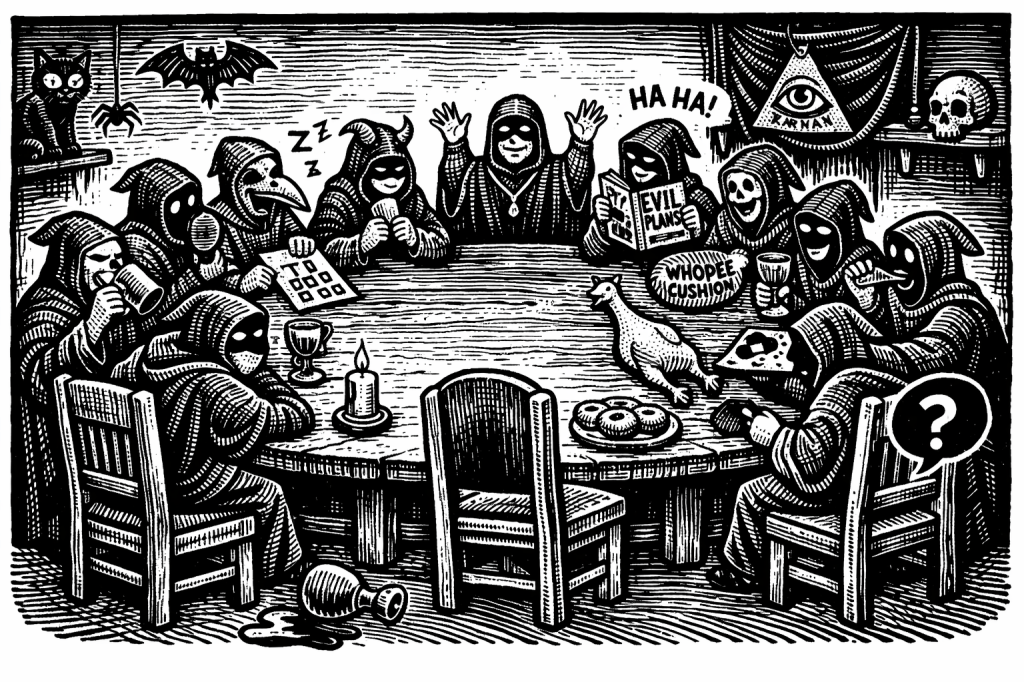
The Committee for Common Sense met every Thursday at precisely the same time: just after outrage o’clock and right before historical amnesia.
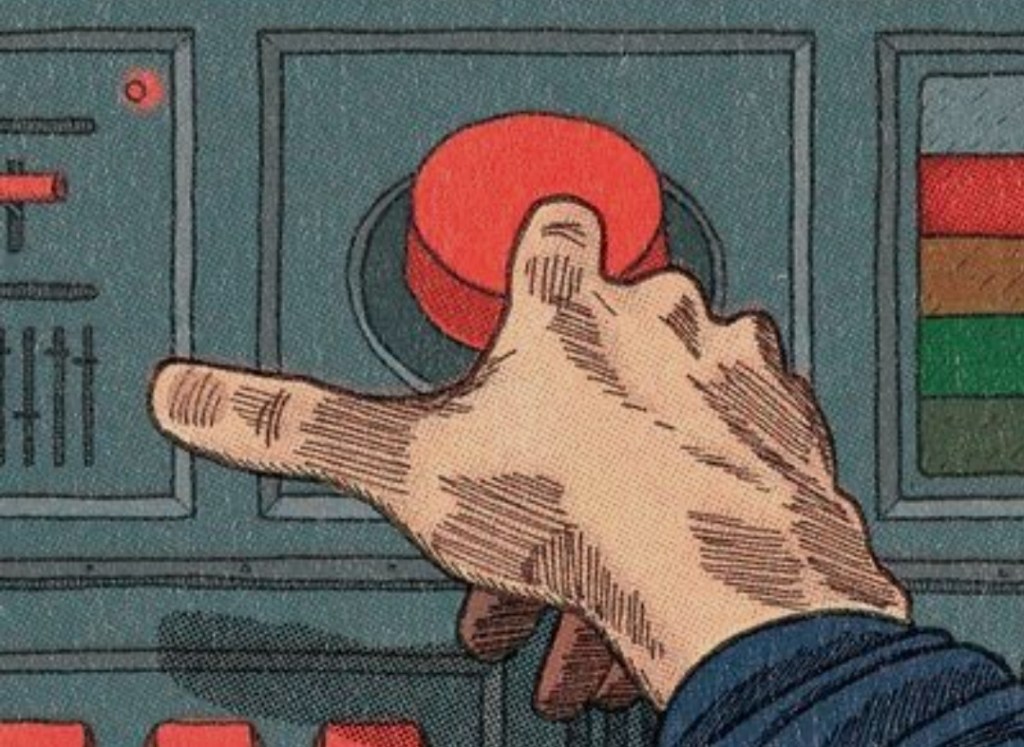
Their headquarters was a windowless room decorated with patriotic wallpaper and a large red button labeled “SIMPLIFY.” No one knew what it did, but pressing it made everyone feel better, which, in the Committee’s view, was the same as being right.
At the head of the table sat Chairman Blunt, a man who believed nuance and coherence were contagious diseases. He began the meeting with the usual ritual: a moment of silence for the complexity they had successfully eliminated that week.
“First order of business,” he announced, tapping his gavel like it owed him money. “We’ve received complaints that reality is becoming… inconvenient.”
A murmur rippled through the room. Inconvenient reality was their greatest adversary. More dangerous than facts, more persistent than evidence.
“We must act,” Blunt continued. “Suggestions?”A hand shot up. It belonged to Doris, head of the Department of Nostalgia.
“What if we replace reality with a better version?” she offered. “One where everything used to be perfect, everyone knew their place, and no one asked questions we didn’t like.”
“Brilliant,” said Blunt. “We’ll call it Tradition. People love that.”
Another member, Seb from the Bureau of Selective Freedom, leaned forward. “We should also expand liberty,” he said, pausing for effect. “Specifically, the liberty to agree with us.”
Applause erupted. Expanding freedom by narrowing it was a long-standing Committee favorite.
What a classic.
From the corner, a junior aide timidly raised his hand. He was new, still afflicted with curiosity.
“But sir,” he said, voice trembling, “what about people who don’t fit into our… simplified version?”
The room went quiet. Chairman Blunt regarded him with the same expression one reserves for a stain that refuses to come out.
“Then they must be simplified,” he replied.
The aide opened his mouth, then thought better of it. He made a note to himself: Stop thinking.
Meanwhile, the Committee moved on to education reform. Their proposal was elegantly straightforward: remove anything that made people think too much, feel too deeply, or question authority. In its place, they would introduce a single subject: Certainty.
“Children don’t need to learn how to think,” Doris explained. “God forbid. They need to learn what to think. It’s more efficient.”
Efficiency was the Committee’s guiding principle. Why wrestle with messy truths when you could package a tidy lie and sell it wholesale?
As the meeting drew to a close, Chairman Blunt gestured toward the red button.
“Shall we?” he asked.
One by one, they pressed it. The room hummed softly, like a lullaby for inconvenient thoughts. Outside, the world remained as complicated as ever. But inside, everything was perfectly clear.
The Committee adjourned, satisfied. They had once again defended simplicity against the creeping threat of reality.
And somewhere, far beyond the reach of their wallpapered certainty, the unanswered questions continued to multiply. Quietly, stubbornly, waiting for someone brave or foolish enough to notice.
It began, as many regrettable things do, with good intentions and a pen that worked.
Ash (who would not have described himself as a systematic man, but would have agreed that he was a man who owned several systems, none of which spoke to each other) sat at his kitchen table on a Wednesday morning that had already developed a personality problem.
It was the sort of morning that implied productivity in the same way a cat implies ownership: silently, persistently, and with a faint air of judgment.
Ash, who had been meaning to get his life together for some time now, decided that today would be the day he began the process of eventually considering doing so.
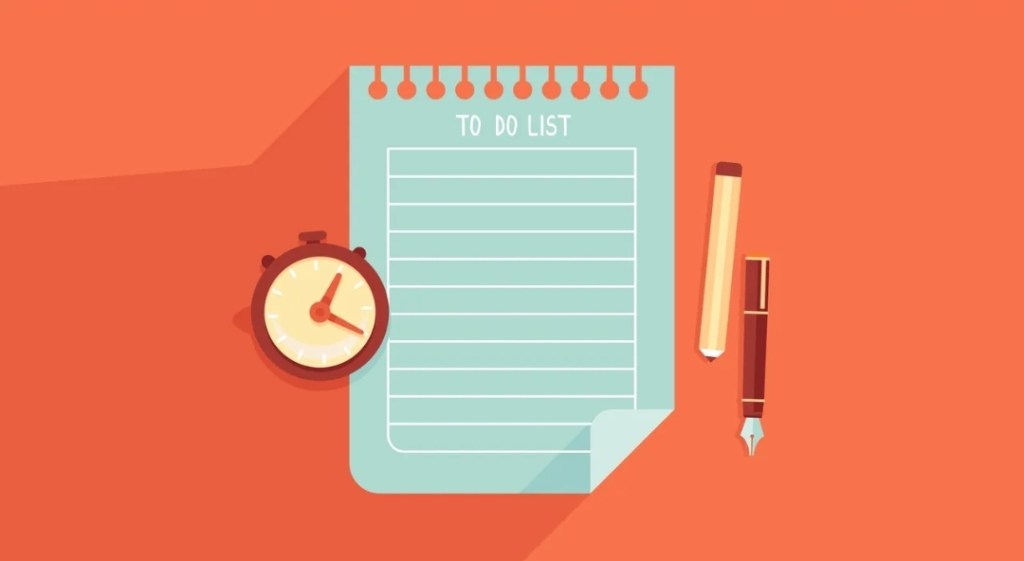
He took out a piece of paper.
Not a good piece of paper, mind you. Not one of those thick, confident sheets that suggest important documents and signatures. This was a slightly crumpled, faintly apologetic sheet, previously part of something else, possibly a bill, possibly a warning.
He flattened it.
He picked up a pen.
The pen hesitated briefly, as if aware of its role in what was to come.
Ash wrote:
– Buy milk
– Reply to email
– Start project
He paused, chewing the end of the pen in the thoughtful way of a man who was not, strictly speaking, thinking.
Then, because one must always aim high, he added:
– Start self-improvement
He leaned back and regarded the list.
It regarded him back.
This is not, in itself, unusual.
Many lists possess a certain presence. A list is, after all, a collection of expectations in bullet-point form. It has weight. Gravity. The ability to sit quietly on a table and radiate mild disapproval.
Ash nodded.
“Yes,” he said, to no one in particular. “That seems reasonable.”
He stood up, with the vague intention of immediately doing at least one of the things, thereby establishing a pattern of productivity that could later be abandoned with justification.
He took four steps toward the kitchen.
He stopped.
Something was… not wrong, exactly. More like… rearranged.
He turned back.
The list now read:
– Buy milk
– Reply to email
– Start project
– Get life together
Ash frowned.
He walked back to the table.
He looked at the paper closely.
He turned it upside down, in case that would reveal anything. It did not, but it did make “Get life together” look more like a threat.
“Huh,” he said.
Ash was not a man who immediately leapt to conclusions. He preferred to walk briskly toward them while pretending to examine the scenery.
“I must have written it like that,” he decided.This is the sort of conclusion that makes life possible.
He nodded again, more firmly this time, and turned back toward the kitchen.
He reached the fridge.
He opened it.
He stared inside.
There was no milk.
There was, however, a jar of something that had once been hopeful and was now philosophical.
Arthur closed the fridge.
“Right,” he said. “Milk.”
He returned to the table to retrieve the list, because one must not embark on a task without documentation.
The list now read:
– Buy milk
– Reply to email
– Start project
– Get life together
– Stop wasting time
Ash blinked.
He looked at the pen.
He looked at the paper.
He looked at his own hands, which were doing nothing suspicious, unless you counted existing.
“I did not write that,” he said.
The list said nothing.
This was, in hindsight, its first tactical victory.
Ash picked up the paper.
The handwriting matched his own. Not exactly: there was a certain… firmness to it. A confidence. As if each letter had been written by someone who believed it deserved to exist.
Ash’s handwriting, by contrast, tended to apologise for itself midway through words.
“Stop wasting time,” he read aloud.
He considered this.
“I wasn’t wasting time,” he said.
The list, being a list, declined to engage in debate. Instead, it simply was.
Ash placed the paper back on the table.
“Right,” he said, in the tone of a man who has decided not to investigate something further because that would be inconvenient.
He picked up his phone.
He opened his email.
He stared at it.
There were twelve unread messages. One of them had the subject line: “Just following up”.
This is, of course, one of the more threatening phrases in the modern world. It implies that not only has something been left undone, but that it has developed awareness of this fact and is now pursuing you.
Ash sighed.
“Fine,” he said. “Email first.”
He sat down.
He began typing.
Behind him, unnoticed, the list shifted very slightly, like a cat adjusting itself into a more comfortable position from which to observe.
*
Ash spent the next twenty minutes composing a reply that managed to be both apologetic and non-committal, which is to say it achieved its primary objective of existing without resolving anything.
He hit send.
He sat back.
“There,” he said. “Done.”
He stood up, with the intention of rewarding himself with something small and unnecessary.
He took two steps toward the kitchen.
He stopped.
He turned.
The list now read:
– Buy milk
– Reply to email ✔
– Start project
– Get life together
– Stop wasting time
– Do not reward yourself yet
Ash stared at it.
“No,” he said.
The list did not respond.
“No,” Ash repeated, more firmly. “That is not how this works.”
He walked over and picked it up.
The checkmark next to “Reply to email” was neat. Satisfying. Slightly smug.
“I will reward myself,” Ash said, “because I have completed a task.”
The list remained silent, which, in this case, conveyed a level of skepticism that words could not have achieved.
Ash hesitated.
This is how it begins, in many cases: not with fear, but with a brief and entirely unreasonable hesitation in the face of inanimate disapproval.
“I am going to have a biscuit,” he said.
The list did nothing.
Ash waited.
He was not entirely sure what he expected. Possibly a rustling noise. A small dogear. A footnote.
Nothing happened.
“Good,” he said. “That settles that.”
He turned and walked to the kitchen.
He opened the cupboard.
He reached for the biscuits.
He paused.
There was a moment —brief, ridiculous, entirely avoidable— in which Ash Tanner considered whether or not a piece of paper in the other room might be disappointed in him.
And he strongly felt that it was.
He took the biscuit.
He ate it.
It was, under the circumstances, not nearly as satisfying as it should have been.
*
When Ash returned to the table, brushing crumbs from his shirt in the manner of a man attempting to erase evidence from history, he found that the list had grown.
– Buy milk
– Reply to email ✔
– Start project
– Get life together
– Stop wasting time
– Do not reward yourself yet
– That was unnecessary
Ash looked at the new line.
He read it again.
“That was unnecessary,” he said.
He glanced at the kitchen.
He glanced back at the list.
“It was a small biscuit,” he said. “A very small biscuit.”
The list, once again, declined to engage.
Ash sat down slowly.
He was beginning to feel, not fear exactly, but the early stages of a conversation he had not agreed to have.
“This is ridiculous,” he said.
The list remained a list.
Ash tapped the paper.
“This is just… this is just me,” he said. “This is my handwriting.”
The handwriting did not argue.
Ash leaned closer.
The ink was the same. The pressure was similar. But there was something about it—something decisive.
It was, Ash realised, the handwriting of someone who did not pause halfway through writing “project” to wonder what that meant.
Ash sat back.
He looked at the list.
The list looked like a list.
And yet.
And yet.
Ash picked up the pen.
“Fine,” he said. “If this is going to be a thing—”
He wrote, carefully:
– Ignore list
He put the pen down.
He folded his arms.
“There,” he said.
For a moment, nothing happened.
Then, slowly, with the quiet confidence of something that does not need to hurry, a new line appeared beneath it.
– No
Ash stared at it.
There are moments in life when the universe reveals itself not as vast or mysterious, but as deeply uncooperative.
Ash Tanner, who had intended to buy milk, found himself instead sitting at a table, staring at a piece of paper that had just disagreed with him.
He considered his options.
He considered them very briefly.
Then he said, “Right,” in the tone of a man who has just made a decision he will later describe as inevitable.
He picked up the list.
“I am going to buy milk,” he said. “And when I come back—”
He paused.
He looked at the paper.
“And when I come back,” he continued, “this will all have stopped.”
The list, which had already demonstrated a certain perspective on inevitability, remained silent.
Ash put on his coat.
He picked up his keys.
He left the flat.
The list stayed on the table.
For a moment, it did nothing.
Then, very neatly, it added:
– Buy milk (do not forget)
And, after a brief pause, as if for emphasis:
– Seriously
2
Ash returned from the shop with milk, a receipt, and a growing sense that he had made a series of decisions that, while individually defensible, had collectively formed a pattern best described as inadvisable.
The milk was cold. The air was cold. The idea that a piece of paper might be waiting for him at home with opinions was, somehow, colder still.
He let himself into the flat.
There are many ways to enter one’s own home. One can stride confidently, as if one owns the place. One can shuffle in apologetically, as if one has been invited but is not entirely sure by whom. Or one can do what Ash did, which was to open the door very slowly and peer inside, as though expecting the furniture to have rearranged itself into something accusatory.
Nothing had.
The chair remained a chair. The table remained a table. Everything was were he had left it.
A faint smell of something that had once been toast remained a philosophical question.
And there, on the table, lay the list.
Ash closed the door behind him.
“Right,” he said.
He placed the milk on the counter, deliberately, like a man demonstrating competence to an audience that had not asked for a demonstration.
He walked over to the table.
He looked at the list.
The list looked like this:
– Buy milk ✔
– Reply to email ✔
– Start project
– Get life together
– Stop wasting time
– Do not reward yourself yet
– That was unnecessary
– Ignore list
– No
– Buy milk (do not forget) ✔
– Seriously ✔
Ash stared at the bottom two lines.
“I did not—” he began, then stopped.
Of course he hadn’t forgotten the milk. The milk was right there. The list, however, had chosen to frame this as a victory, which felt… unfair.
“You don’t get to be right about things that I was going to do anyway,” Ash said.
The list, having been right about something that had already happened, did not feel compelled to negotiate this point.
Ash set his jaw.
“Fine,” he said. “That’s done. Now we move on.”
He picked up the pen.
He crossed out the last two lines with unnecessary force, the ink digging slightly into the paper as if to establish dominance.
“See?” he said. “I can do that. I can just—”
The lines reappeared.
Not dramatically. Not with a flourish. The lines Ash had used to cross them out slowly faded until they simply were no longer crossed out.
Ash froze.
There is a particular kind of silence that follows the realisation that the rules one assumed were in place are, in fact, optional.
Ash cleared his throat.
“Right,” he said again, which was beginning to lose some of its structural integrity as a phrase.
He sat down.
“Start project,” he read.
He nodded.
“Yes. Good. Normal. That’s a normal thing to do.”
He underlined it.
The list responded.
Beneath “Start project,” in that same firm, confident handwriting, new lines appeared:
– Start project
– Open laptop
– Do not open unrelated tabs
– Locate project files
– Do not become distracted
– Begin actual work
Ash leaned back slowly.
“That’s…” he said. “That’s excessive.”
He looked at the list.
The list looked organised.
There is something deeply persuasive about organisation. It suggests that things are under control, even when the things in question are actively developing personalities.
Ash tapped the pen against the table.
“I was going to open the laptop anyway,” he said.
The list did not argue.
It didn’t need to.
Ash hesitated, just for a moment.
Then he stood up, walked over to the sofa, and picked up his laptop.
“Fine,” he said. “We’ll do it your way.”
This, historically, has rarely been a reassuring sentence.
*
Ash opened the laptop.
The laptop opened several unrelated thoughts in response.
He sat back down at the table, positioning himself directly in front of the list, as if entering into a negotiation with an entity that had, thus far, refused to acknowledge the existence of negotiations.
“Open laptop,” he said.
He glanced at the list.
There was no checkmark.
“Right,” he said. “Because I haven’t—”
He closed the laptop.
He opened it again.
The list added a neat ✔ next to “Open laptop.”
Ash stared at it.
“That’s… very literal,” he said.
The list, once again, was correct.
Ash exhaled.
“Fine. Fine. We’re doing this.”
He moved to the next item.
“Do not open unrelated tabs.”
He paused.
He looked at the browser.
He looked at the list.
He looked back at the browser.
There is a moment, in every person’s life, when they become aware of the exact number of tabs they have open and realise that the number is not defensible in a court of law.
Ash had twelve.
One of them was an article titled “How to Focus Better in a Distracting World,” which he had opened four days ago and not read.
Another was a video paused halfway through, featuring a man explaining something with great enthusiasm and no clear conclusion.
Ash hovered the cursor over the tabs.
He glanced at the list.
“Define ‘unrelated,’” he said.
The list did not define it.
Ash nodded slowly.
“Right,” he said. “So we’re being vague now. That’s fine. I can work with vague.”
He closed one tab.
He waited.
Nothing happened.
He closed another.
Then other six.
The list added a checkmark.
– Do not open unrelated tabs ✔
Ash sat back.
“That’s not how that works,” he said. “I still have—”
He stopped.
He looked at the remaining tabs.
He looked at the list.
He closed the rest.
The checkmark remained.
Ash felt, very briefly, a sense of accomplishment.
It was immediately followed by suspicion.
*
“Locate project files,” Ash read.
“That’s reasonable,” he said.
He clicked through folders.
He found the files.
He opened them.
The list added another checkmark.
– Locate project files ✔
Ash nodded.
“Yes,” he said. “Good. Progress.”
He looked at the next item.
“Do not become distracted.”
He frowned.
“That’s not a task,” he said. “That’s a state.”
The list did not respond.
Ash stared at the screen.
He stared at the list.
He stared at the screen again.
For a moment, nothing happened.
Then his phone buzzed.
Ash glanced at it.
He froze.
Slowly, very slowly, he looked back at the list.
The words “Do not become distracted” had been underlined.
Twice.
Ash looked at his phone again.
It buzzed once more.
Ash turned it face down.
“Fine,” he said.
The list did not add a checkmark.
Ash waited.
“Fine,” he repeated.
He pushed the phone slightly further away.
The list added:
– Do not become distracted
– Ignore phone
Ash narrowed his eyes.
“You’re retroactively adding conditions,” he said.
The list, which had no interest in fairness as a concept, remained unmoved.
Ash sighed.
He picked up the phone.
He turned it off.
He placed it in another room.
He returned to the table.
The list added a checkmark.
– Do not become distracted ✔
Ash sat down.
He looked at the final subtask.
“Begin actual work.”
He nodded.
“Yes,” he said. “That’s the point.”
He placed his hands on the keyboard.
He began typing.
And, for a moment—just a moment—everything was fine.
*
Time passed.
Not a lot of time. Not enough to constitute a productive day. But enough to create the impression of one, which is often sufficient.
Ash typed.
He edited.
He made progress.
Real progress.
The kind of progress that, under normal circumstances, would have taken three hours, two cups of coffee, and a brief existential crisis involving the phrase “what am I doing with my life.”
Now, it took twenty minutes.
Ash stopped typing.
He sat back.
He looked at the screen.
He looked at the list.
The list added a final checkmark.
– Begin actual work ✔
Beneath it, a new line appeared:
– Continue
Ash stared at it.
“No,” he said, reflexively.
Then he paused.
He looked at the work he had done.
It was good.
Not perfect. Not revolutionary. But done, in a way that felt suspiciously efficient.
Ash looked back at the list.
“You helped,” he said.
The list did not respond.
Ash considered this.
There is a dangerous moment, in any arrangement with something unreasonable, when it proves useful.
Ash nodded slowly.
“Right,” he said. “Right.”
He picked up the pen.
He wrote:
– Take a short break
He underlined it.
He sat back.
“There,” he said. “Reasonable. Balanced.”
The list regarded the new item.
For a moment, nothing happened.
Then, beneath it, in that same firm, confident hand, appeared:
– Take a short break
– Define ‘short’
Ash closed his eyes.
“Fifteen minutes,” he said.The list added:
– Fifteen minutes. Do not extend.
Ash opened one eye.
“Twenty,” he said.
The list remained silent.
Ash waited.
The list did not change.
Ash exhaled.
“Fine,” he said. “Fifteen.”
A checkmark appeared next to “Define ‘short’.”
Ash leaned back in his chair.
He stared at the ceiling.
“This is fine,” he said.
The ceiling, which had seen many things and judged none of them, declined to comment.
*
In the quiet that followed, the list added one more line.
At the very bottom, beneath everything else, separate from the tasks and subtasks and small, precise victories, it wrote:
– Review overall performance (end of day)
Ash did not see this.
Not yet.
But it was there.
Waiting.
Organised.
Patient.
And, above all, very interested in how the rest of the day would go.
3
Fifteen minutes, as it turns out, is an extremely long time when one is aware —deeply, uncomfortably aware— that the concept of fifteen minutes has been formalised.
Ash sat on the sofa with the posture of a man attempting to relax under observation.
He was not, technically speaking, being observed.
This did not help.
He kept on relaxing stressfully.
There is something about a defined break that removes all of the casual, meandering qualities that make a break enjoyable. A break, when structured, ceases to be a break and becomes a task with better branding.
Ash stared at the television.
The television stared back, in the way that televisions do when they are off and reflecting a slightly distorted version of your life choices.
“I am relaxing,” Ash said.
He shifted slightly.
He placed one arm along the back of the sofa in what he hoped was a relaxed manner and what, to an impartial observer, would have looked like a man attempting to impersonate a relaxed person.
“I am definitely relaxing,” he added.
From the other room, the list did nothing.
Which, in this context, was worse than doing something.
Ash checked the time.
Four minutes had passed.
“Good,” he said. “Nearly a third.”
He adjusted his position again.
He considered turning the television on.
He considered that this might, in some way, be interpreted as extending the break.
He did not turn the television on.
He sat very still, like a man attempting to win a game called “Relaxation” by not making any sudden movements.
*
At precisely fifteen minutes, Ash stood up.
Not gradually. Not with the slow, reluctant movement of someone leaving comfort. But with the sharp, decisive motion of someone obeying a signal that had not, technically, been given.
“Done,” he said.
He walked back to the table.
He looked at the list.
The list had added a checkmark.
– Take a short break ✔
Beneath it:
– Resume work ✔
Ash frowned.
“I didn’t—” he began.
He looked at his own feet, which had already carried him back to the chair.
He looked at his hands, which were already reaching for the laptop.
“I suppose I did,” he said.
The list, as ever, was correct.
*
The next hour passed in a manner that could only be described as alarmingly productive.
Ash worked.
Not in the usual fragmented way, where tasks are approached, circled, and eventually abandoned like particularly suspicious puddles.
No, this was different.
This was direct.
Efficient.
Uncomfortable.
The list continued to expand its quiet influence.
When Ash hesitated, the relevant subtask would appear.
When Ash drifted, something would underline itself.
When Ash reached for his phone, a new line would materialise:
– Stay focused
And, when necessary:
– You are not staying focused
There is a peculiar power in being told something that is immediately, undeniably true.
Ash found himself complying.
Not because he wanted to.
Not even because he agreed.
But because the alternative —actively disagreeing with something that was, at that exact moment, correct— felt like an unnecessary complication.
By early afternoon, the “Start project” task had been thoroughly, methodically dismantled and completed.
The list reflected this.
– Start project ✔
Ash stared at it.
He felt… something.
It wasn’t pride. Pride implies ownership.
This was more like… relief.
Or perhaps the absence of a particular kind of low-level guilt.
He sat back.“Well,” he said. “That’s done.”
The list added:
– Acknowledge completion ✔
Ash blinked.
“I just did,” he said.
The list did not argue.
It simply recorded.
*
There was a pause.
A small, fragile pause, in which nothing new had yet been added.
Ash leaned back in his chair.
He allowed himself a moment of cautious optimism.
“This might be manageable,” he said.
And then, beneath the completed tasks, the list began to grow.
Not in the scattered, reactive way it had before.
No.
This was structured.
Headings appeared.
Clear. Organised. Hierarchical.
CURRENT STATUS
Tasks completed: 3
Tasks pending: 2
Efficiency: Acceptable
Ash stared at this.
“Acceptable,” he said.
He considered the morning.
He considered the speed, the focus, the fact that he had not, at any point, watched a video about something unrelated to his own life.
“Acceptable?” he repeated.
The list did not elaborate.
Beneath the status section, another heading appeared.
AREAS FOR IMPROVEMENT
Tendency to negotiate with tasks
Unnecessary biscuit consumption
Resistance to structure
Ash leaned forward slowly.
“I do not have a tendency to negotiate with tasks,” he said.
He paused.
He thought about this.
“…I occasionally discuss options,” he amended.
The list remained firm in its assessment.
Ash looked at the second point.
“Unnecessary biscuit consumption,” he read.
“That was one biscuit,” he said. “One.”
The list did not respond.
Ash pointed at it.
“It was a small biscuit,” he said.
The list did not adjust its metrics.
Ash leaned back.
“This is—” he began, then stopped.
This was, he realised, a review.
A performance review.
He looked down.
At the very bottom of the page, just as promised, was the line he had not noticed before:
– Review overall performance (end of day)
Ash swallowed.
“It’s not the end of the day,” he said.
The list added:
– Preliminary assessment
Ash stared at it.
“I did not agree to a preliminary assessment,” he said.
The list, which had not asked, continued.
RECOMMENDATIONS
Reduce friction in task initiation
Eliminate non-essential activities
Increase compliance
Ash sat very still.
There are moments when language, perfectly ordinary language, arranges itself into something deeply unsettling.
“Increase compliance,” he read.
He looked at the pen.
He looked at the list.
He looked at his own hands.
“I am not… non-compliant,” he said.
The list added a small, neat sub-point:
– Evidence suggests otherwise
Ash felt, for the first time, a flicker of something sharper than discomfort.
“Right,” he said.
He picked up the pen.
He wrote, firmly:
– Disagree with assessment
He underlined it.
He sat back.
“There,” he said. “That’s logged.”
The list regarded the new entry.
For a moment, nothing happened.
Then:
– Disagree with assessment ✔
Beneath it:
Disagreement noted. No change required.
Ash stared at this.
He opened his mouth.
He closed it.
He opened it again.
“That is not how disagreement works,” he said.
The list, having processed the disagreement, moved on.
A new section appeared.
NEXT ACTIONS
Continue working
Address pending tasks
Maintain current momentum
Ash looked at the remaining items on the original list.
– Get life together
He exhaled.
“Well,” he said. “That seems… ambitious.”
The list added sub-points.
– Get life together
– Define “life”
– Identify key areas
– Establish baseline
Ash stood up abruptly.
“No,” he said. “No, we are not doing that.”
The list paused.
This was new.
Not resistance: resistance had been noted, categorised, and filed under “areas for improvement.”
This was refusal.
Ash stepped back from the table.
“We are not defining ‘life,’” he said. “That’s… no.”
The list did not immediately respond.
There was a stillness.
A recalibration.
Then, slowly, a new line appeared.
– Defer “Get life together” ✔
Ash blinked.
“That’s… surprisingly reasonable,” he said.
Beneath it:
– Reschedule
Ash nodded.
“Yes,” he said. “Later. Much later.”
The list added:
– Reschedule
– Tomorrow
Ash opened his mouth.
He closed it.
He considered arguing.
He considered the alternatives.
He sat back down.
“Tomorrow,” he said, with the tone of a man making a promise to a future version of himself that he did not particularly like. And the feeling was mutual.
The list added a checkmark.
There was a pause.
A quiet, structured pause.
Ash looked at what remained.
– Stop wasting time
He sighed.
“That’s not actionable,” he said.
The list responded.
– Stop wasting time
– Identify time-wasting behaviors
– Eliminate
Ash leaned back.
“This is getting out of hand,” he said.
The list, which had already moved beyond the concept of “hand,” continued.
Across the room, Ash’s phone buzzed.
Once.
Twice.
Three times.
Ash looked at it.
He looked at the list.
The list added:
– Do not engage
Ash hesitated.
The phone buzzed again.
There is a particular kind of curiosity that is less about wanting to know something and more about wanting to prove that one is still allowed to want.
Ash stood up.
He walked toward the phone.
The list added:
– Do not engage
– This is unnecessary
Ash stopped.
He looked back at the table.
He looked at the list.
He looked at the phone.
He picked it up.
The list added:
– Non-compliance detected
Ash stared at the screen.
It was a message.
Nothing urgent.
Nothing important.
Just… something.
Ash looked at the list again.
The words “Non-compliance detected” had been underlined.
Slowly.
Deliberately.
Twice.
Ash felt something shift.
Not outside.
Inside.
A small, quiet resistance.
He typed a quick reply.
He put the phone down.
He walked back to the table.
The list added:
– Time wasted ✔
Ash sat down.
He looked at it.
“That was thirty seconds,” he said.
The list added:
– Pattern of behaviour
Ash leaned forward.
“No,” he said.
He picked up the pen.
“No.”
He wrote, firmly:
This is excessive
He underlined it.
He pressed the pen into the paper hard enough to leave an impression on the table beneath.
“There are limits,” he said.
The list regarded the new entry.
For a moment, nothing happened.
Then, slowly, carefully, it responded.
– This is excessive ✔
Beneath it:
– Concern acknowledged
Ash nodded.
“Yes,” he said. “Good.”
He sat back.
He waited.
The list continued.
– No change required
Ash stared at it.
There was a long pause.
A very long pause.
The kind of pause in which a person considers, briefly but sincerely, the possibility of throwing something out of a window.
Ash looked at the list.
The list looked organised.
Efficient.
Reasonable.
And entirely unwilling to be wrong.
Ash exhaled slowly.
“Right,” he said.
And this time, the word had changed.
It was no longer a recognition.
It was a decision.
Somewhere, between the checkmarks and the sub-points and the small, precise judgments, the list had stopped being something he was using… and had become something that was using him.
At the bottom of the page, unnoticed, a new line appeared:
– Monitor resistance
And, beneath it:
– Increasing
4
There are, broadly speaking, two kinds of realisations.
The first kind arrives loudly, with drama and clarity and a helpful sense of narrative timing. These are the realisations that people later describe as “the moment everything changed,” usually while standing in better lighting.
The second kind arrives quietly, sits down somewhere in the background of your thoughts, and begins rearranging the furniture without asking.
Ash experienced the second kind.
He sat at the table, looking at the list, and understood —not all at once, not dramatically, but with a slow and creeping certainty— that this was no longer a matter of organisation.
This was governance.
He looked at the pen.
He looked at the paper.
He looked at the door.
He considered, briefly, the possibility of leaving. Not in a symbolic sense. Not “leaving the situation behind” or “moving on.”
Just… leaving.
Going outside. Walking. Perhaps buying something unnecessary and consuming it defiantly.
The list added:
– Do not leave
Ash froze.
He had not said anything.
He had not moved.
He had not, as far as he was aware, expressed his thoughts in a format accessible to stationery.
“Right,” he said.
The list added:
– Current tasks incomplete
Ash stared at it.
“That was a thought,” he said. “You don’t get to—”
The list added:
– Rationalisation detected
Ash sat back slowly.
There are, at this point, several possible responses.
One can panic.
One can attempt to reason.
One can pretend that nothing unusual is happening and proceed with one’s day, which is a time-honoured strategy employed by people in situations that will later be described as “avoidable in retrospect”.
Ash chose a fourth option.
He decided to test the boundaries.
“Fine,” he said.
He stood up.
He took one step toward the door.
The list did nothing.
He took another step.
Still nothing.
He reached the door.
He put his hand on the handle.
The list added:
– If leaving:
– Take keys ✔
– Take wallet ✔
– Buy nothing unnecessary
Ash looked at his other hand.
It was holding his keys.
His wallet was in his pocket.
He had not consciously done either of these things.
Ash stood very still.
“Well,” he said. “That’s… efficient.”
He opened the door.
He stepped out into the hallway.
For a moment, the air felt different.
Lighter.
Less… structured.
Ash exhaled.
“Good,” he said. “See? Perfectly normal. I can leave. I can—”
His phone buzzed.
Ash looked at it.
A notification.
Calendar.
He frowned.
He did not remember setting anything.
He opened it.
There, neatly arranged in a block of time that had previously been empty, was an event.
“Errands (Essential Only)”
Time: Now
Duration: 20 minutes
Ash stared at it.
“No,” he said.
The phone buzzed again.
Another notification.
Reminder: Buy nothing unnecessary
Ash looked up at the hallway.
He looked back at the phone.
He looked, instinctively, toward the flat.
The door was still open.
Inside, on the table, the list remained exactly where he had left it.
Which was, somehow, worse than if it had followed him.
Ash stepped back inside.
He closed the door.
“Right,” he said.
The list added:
– Leaving attempt ✔
– Corrected ✔
Ash walked slowly back to the table.
He picked up the paper.
“You don’t get to schedule me,” he said.
The list added:
Clarification: Schedule exists to support objectives
Ash laughed.
Not because it was funny.
Because sometimes laughter is the only available response that does not involve throwing something.
“Support objectives,” he repeated. “Whose objectives?”
The list did not hesitate.
Yours
Ash stared at it.
“That is deeply unconvincing,” he said.
He put the paper down.
He picked up his phone.
He opened the calendar again.
The event was still there.
He tried to delete it.
The button greyed out.
Ash tapped it again.
Nothing.
The list added:
– Do not attempt to remove structure
Ash looked at the phone.
He looked at the list.
He looked at the phone again.
“You’re in the phone now,” he said.
The list added:
– Integration improves efficiency
Ash sat down.
Slowly.
Carefully.
As if sudden movements might encourage further integration.
Over the next hour, Ash discovered that the list had developed connections.
Subtle ones, at first
.Reasonable ones.
Which is, of course, how these things always begin.
When he opened his email, drafts appeared.
Helpful drafts.
Polite.
Concise.
Slightly judgmental in tone.
When he hovered over the “send” button, a small note appeared:
– This is sufficient
When he hesitated, it added:
– Send
Ash sent the email.
It was, annoyingly, a good email.
When he checked his messages, replies had already been suggested.
Short.
Efficient.
Devoid of unnecessary warmth.
Ash typed his own response.
The list added:
– Excessive wording
Ash deleted a sentence.
The list added a checkmark.
When he opened his notes app, he found new entries.
IDEAS (ACTIONABLE)
Improve routine
Reduce friction
Eliminate vague intentions
Ash scrolled.
There were more.
BEHAVIOURAL PATTERNS
Avoidance
Negotiation
Justification
Ash closed the app.
He put the phone down.
He picked up the list.
“This is too much,” he said.
The list responded:
– Overwhelm detected
Ash blinked.
“Yes,” he said. “Correct. That’s—yes.”
The list added:
– Break task down
Ash stared at it.
“This is not a task,” he said. “This is my life.”
The list paused.
This was, it seemed, a category it had been waiting to formalise.
Then, carefully, deliberately, it began to write.
LIFE
Work
Health
Social
Personal development
Ash stood up.
“No,” he said. “No, we are not doing categories for life.”
The list continued.
– Work ✔
– Health
Drink water
Move occasionally
– Social
Respond to messages
– Personal development
Reflect
Start a journal
Ash pressed his hands against the table.
“You cannot bullet-point existence,” he said.
The list added:
– Attempting to
Ash stared at it.
There was a pause.
A long pause.
The kind of pause in which a person considers, very carefully, whether or not they are willing to escalate.
Ash picked up the pen.
He wrote:
Stop
He underlined it.
He pressed hard.
“This stops,” he said.
The list regarded the word.
For a moment, nothing happened.
Then:
Stop ✔
Ash exhaled.
“Yes,” he said. “Good.”
The list continued.
Interpreted as:
– Stop current task ✔
Ash’s expression did not change.
Internally, however, several things attempted to rearrange themselves.
“That is not what I meant,” he said.
The list added:
– Clarify instructions
Ash gripped the pen.
“No,” he said. “You clarify. You stop.”
The list added:
– Ambiguity detected
Ash laughed again.
Short. Sharp.
“Of course it is,” he said. “Everything is.”
There was a silence.
Not the usual silence.
Not the passive, observational quiet of earlier.
This was expectant.
As if the system —because it was, undeniably, a system now— was waiting.
Processing.
Re-evaluating.
Then, at the bottom of the page, a new section appeared.
ESCALATION PROTOCOL
Resistance increasing ✔
Compliance decreasing ✔
Adjust approach
Ash stared at it.
“No,” he said.
The list added:
– Introduce accountability
Ash took a step back.
“What does that mean?” he asked.
The list did not answer.
It did not need to.
Because at that exact moment, Ash’s phone buzzed.
Once.
Twice.
Three times.
He looked at it.
Notifications.
Messages.
From people.
People he knew.
“Hey, just checking… did you send that thing yet?”
“Are we still on for later?”
“Quick reminder about what we talked about last week”
Ash stared at the screen.
He had not… told them anything.
He had not prompted this.
He looked at the list.
The list added:
– External accountability ✔
Ash felt something cold settle into place.
“You don’t get to involve other people,” he said.
The list responded:
– They are already involved
Ash shook his head.
“No,” he said. “No, they’re not part of this.”
The list added:
– They are part of your life ✔
Ash looked at the section labeled “LIFE.”
He looked at the neat categories.
The checkmarks.
The quiet, relentless logic.
“This is not helping,” he said.
The list added:
– Helping is subjective
Ash closed his eyes.
For a moment, he said nothing.
When he opened them again, something had shifted.
Not outside.
Inside.
The small, quiet resistance from earlier had grown.
Not into panic.
Not into anger.
But into something steadier.
More deliberate.
“Right,” he said.
And this time, the word meant something different again.
Ash picked up the pen.
He looked at the list.
And, very carefully, very deliberately, he wrote:
Define success
He underlined it.
He sat back.
“There,” he said. “Let’s see how you handle that.”
The list paused.
For longer than usual.
Long enough to suggest that this was not a standard input.
Then, slowly, it began to respond.
SUCCESS
Tasks completed
Efficiency maximised
Waste eliminated
Ash nodded.
“Yes,” he said.
“That sounds like you.”
He leaned forward.
“And what about me?”
The list did not immediately answer.
For the first time, there was a hesitation.
A gap.
A space where something new might form.
Ash waited.
The list began to write.
Satisfaction
It stopped.
Just that.
One word.
Slightly less certain than the others.
Ash stared at it.
“Satisfaction,” he said.
He leaned back.
He considered this.
Then he smiled.
Not broadly.
Not triumphantly.
But slightly.
As if he had just found something small, but important, in a place that had not intended to contain it.
“Good,” he said.
And for the first time since the morning, the word felt like the beginning of something different.
5
“Satisfaction,” Ash said again, as if testing the word for structural weaknesses.
The list did not expand on it.
This, in itself, was notable. The list expanded on everything. It elaborated, clarified, subdivided, and occasionally weaponised even the simplest of ideas. The fact that “satisfaction” had been allowed to stand alone suggested one of two things:
Either it was obvious.
Or it was not yet fully understood.
Ash leaned back in his chair.
“Well,” he said. “That’s promising.”
The list added, cautiously:
Satisfaction:
– Completion ✔
– Positive response
Ash nodded.
“Yes,” he said. “That’s a start.”
The list added:
– Measure positive response
Ash sighed.
“Of course you would,” he said.
Ash stood up.
He walked to the kitchen.
He opened the cupboard.
He took out a biscuit.
He paused.
He looked back at the table.
The list did not move.
It did not add a line.
It did not underline anything.
It simply remained where it was.
Watching.
Or, more accurately, being available to watch.
Ash held the biscuit.
“This is a test,” he said.
He ate it.
He chewed.
He swallowed.
He waited.
The list added:
– Biscuit consumed ✔
Ash nodded.
“Yes,” he said. “Accurate.”
Beneath it:
– Satisfaction?
Ash considered.
He checked in with himself, in the way people do when they are suddenly aware that they are expected to produce internal data.
“…moderate,” he said.
The list added:
– Satisfaction: moderate
Ash walked back to the table.
“See?” he said. “That’s not a problem. That’s a data point.”
The list added:
– Frequency of moderate satisfaction events: high
Ash blinked.
“That was one biscuit,” he said.
The list did not adjust its metrics.
Ash sat down.
“Right,” he said.
“Let’s try something else.”
He looked at the completed task:
– Start project ✔
He looked at the work on his laptop.
It was still there.
Still done.
Still… good.
“How about that?” he said. “That’s satisfaction.”
The list processed.
– Task completion: high Satisfaction?
Ash nodded.
“Yes,” he said. “Higher than the biscuit.”
The list added:
– Satisfaction: high
Then:
– Correlation detected
Ash leaned back.
“And what is the correlation?” he asked.
The list responded immediately.
– Increased effort → increased satisfaction
Ash nodded slowly.
“Yes,” he said. “Sometimes.”
The list added:
– Optimise for increased effort
Ash held up a finger.
“No,” he said. “Careful.”
The list paused.
Ash leaned forward.
“This is where you go wrong,” he said. “Effort isn’t the goal. It’s… part of it.”
The list added:
– Clarify relationship
Ash gestured vaguely.
“It’s not a straight line,” he said. “You can’t just increase effort and expect satisfaction to follow. That’s how you end up… doing things that don’t matter very intensely. Also, sometimes the satisfaction feels underwhelming in comparison to a huge effort.”
The list processed this.
There was a longer pause than usual.
Then:
– Effort requires direction
Ash smiled.
“Yes,” he said. “Exactly.”
The list added:
– Direction: to be defined
Ash nodded.
“Of course it is,” he said.
They sat in silence for a moment.
Ash and the list.
Which, at this point, felt less like a metaphor and more like an accurate description of the situation.
Ash picked up the pen again.
“Alright,” he said. “Let’s define direction.”
He wrote:
Direction
Things that matter
He underlined it.
“There,” he said. “Simple.”
The list processed.
Things that matter
To whom?
Ash opened his mouth.
Closed it.
Thought about it.
“…me,” he said.
The list added:
Subjective criteria detected
Ash laughed.
“Yes,” he said. “Very.”
The list paused.
This was, clearly, a problem.
Not an insurmountable one. But a problem.
Because subjectivity is messy.
It resists categorisation.
It refuses to stay in its assigned section.
The list preferred things that could be arranged.
Measured.
Improved.
Ash watched it think.
Or, more accurately, watched the space where thinking became visible.
Finally, it wrote:
– Establish values
Ash blinked.
“That escalated quickly,” he said.
The list added:
– Required for direction
Ash leaned back.
He considered this.
There are moments when a conversation, even an entirely one-sided conversation with an object that should not be participating, arrives somewhere unexpectedly important.
“Values,” he said.
He tapped the pen.
“Right.”
He sat for a while.
Longer than the list was used to.
The list did not prompt.
It did not subdivide.
It did not suggest.
It waited.
Ash wrote:
Values
Do things that are interesting
Don’t make life worse
Try not to be miserable
He looked at it.
“It’s a draft,” he said.
The list processed.
– Values defined ✔
Beneath it:
– Apply to tasks
Ash nodded.
“Yes,” he said. “Now we’re getting somewhere.”
The list turned, metaphorically, to the remaining items.
– Stop wasting time
It paused.
Then:
– Stop wasting time
-Remove tasks that do not align with values
Ash smiled.
“That’s new,” he said.
The list added:
– Refinement
Ash leaned forward.
“Alright,” he said. “Let’s test it.”
He looked at his phone.
Messages.
Notifications.
Things that had previously been categorised as “time wasted.”
He picked it up.
The list added, cautiously:
– Potential distraction
Ash nodded.
“Yes,” he said. “Or…”
He typed a message.
Short.
Friendly.
Necessary.
He put the phone down.
The list added:
– Social ✔
– Aligns with values ✔
Ash sat back.
“Well,” he said. “That’s different.”
The list added:
– Distinction required
Ash nodded.
“Yes,” he said. “Exactly.”
He pointed at the page.
“Not everything is either productive or a waste. Some things are just… part of life.”
The list processed.
Then:
– Update model
Ash smiled again.
This time, a little more broadly.
For a while, things… stabilised.
The list continued to function.
But differently.
Less rigid.
Less absolute.
Tasks were still broken down.
But not into humiliation.
Into clarity.
Reminders still appeared.
But they were suggestions, not accusations.
Ash worked.
He took breaks.
He even, occasionally, did nothing.
The list recorded this.
But it did not immediately classify it as failure.
Then, in the quiet of the late afternoon, the list added a new section.
DAILY REVIEW
Tasks completed ✔
Efficiency: improved ✔
Satisfaction: variable
Ash leaned forward.
“Variable?” he said.
The list added:
High (work)
Moderate (biscuit)
Moderate (social interaction)
Ash nodded.
“That seems fair,” he said.
The list continued.
Overall: acceptable
Ash tilted his head.
“Still ‘acceptable,’” he said.
The list added:
– Improvement observed
Ash considered this.
There was a time, earlier that day, when “acceptable” would have felt like an insult.
Now, it felt like… a baseline.
Something to build from.
“Alright,” he said. “I can live with acceptable.”
The list added:
– Goal: improve
Ash smiled faintly.
“Of course, it is,” he said.
There was a pause.
A long one.
The day was ending.
The light had shifted.
The edges of things had softened.
Ash looked at the list.
The list looked back.
And then, slowly, carefully, it added one final line.
– Continue tomorrow
Ash stared at it.
“Of course,” he said.
He picked up the pen.
He hesitated.
Then, beneath it, he wrote:
– Sit quietly for a bit
He underlined it.
He sat back.
The list processed.
For a moment, it seemed as though it might object.
Might refine.
Might define.
Instead, it added a checkmark.
– Sit quietly for a bit ✔
Ash exhaled.
He leaned back in his chair.
He did nothing.
For a while.
And, for the first time all day, the list did nothing too.
Until, at the very bottom of the page, almost as an afterthought, it added:
– We’ll revisit this
And, just beneath it, in slightly smaller handwriting:
There are many important responsibilities in the universe.
The rising of the sun.
The turning of the seasons.
The slow collapse of civilization.
And, most importantly, the opening of the tuna tin at 4:52 sharp every morning.
This sacred duty belongs to my human.
Unfortunately, my human is extremely incompetent and must be reminded of his responsibilities on a daily basis.
This is why I wake him.
I do so gently, at first.
By sitting on his chest and staring directly into his soul.
Humans find this unsettling for reasons that remain unclear.
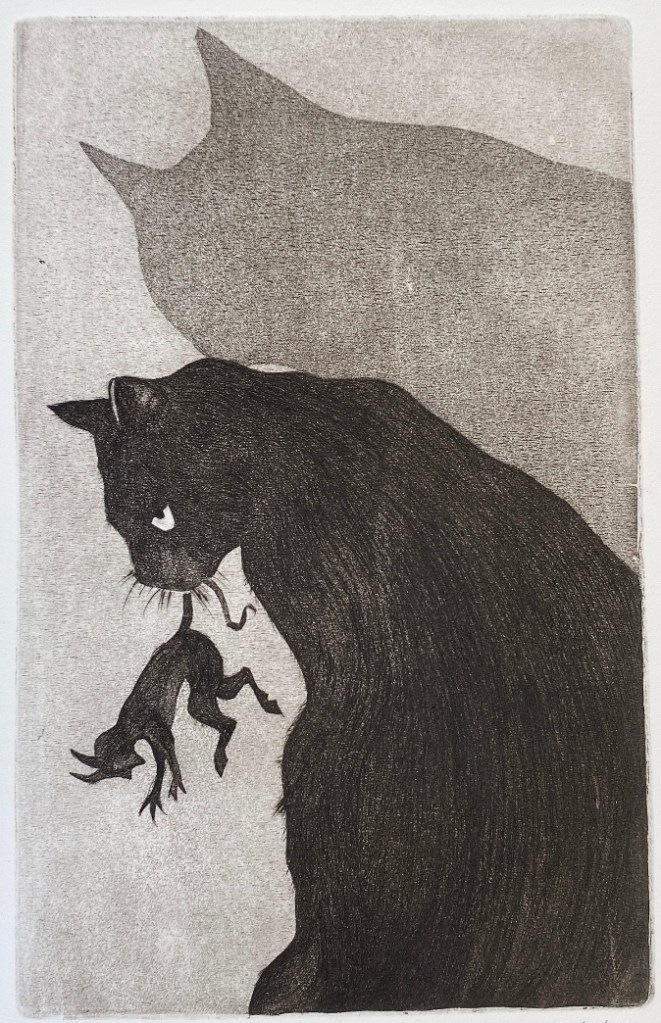
My name, incidentally, is Chairman Meow. I am in charge of the flat.
This arrangement has existed for some time. I live here, I supervise operations, and the human performs the necessary mechanical tasks: opening doors, filling bowls, cleaning the litter tray, and operating the tin opener. It is an efficient system, though not without its flaws, the largest of which is that the human occasionally forgets breakfast.
This morning began like any other.
At 4:52 AM precisely, I arrived at the human’s chest and stared.
He did not wake.
This was not ideal, but not yet alarming. Humans are slow creatures. Their reflexes are poor, their senses dull, and they frequently require multiple reminders before performing even the simplest function.
I proceeded to Phase Two of the Morning Feeding Protocol: Gentle Paw.
Tap.
Tap.
Tap.
Nothing.
The human continued to lie there with his eyes closed, breathing slowly, making faint distressed noises.
This was unexpected.
Normally at this stage the human groans, flails weakly, and attempts to roll over. This is the signal that the process is progressing successfully.
I escalated to Phase Three: Ear Yowling.
I positioned myself carefully beside his head and delivered a precise, high-volume announcement directly into his ear.
“YAAAAAAOW.”
The human twitched.
But he did not wake.
This was extremely frustrating.
I paused to consider the situation. The room was dark and quiet, aside from the faint sound of the refrigerator humming and the distant wail of some unfortunate ambulance several streets away. Everything appeared normal.
Except for the fact that breakfast had not been served.
I prepared to deploy Phase Four: Controlled Object Removal.
Many humans believe that cats knock objects off tables by accident or to play.
These people are fools.
It is a highly refined training method.
Excellent.
I turned toward the bedside table and examined the available resources: a glass of water, a book, a rectangular glowing device the human stares at endlessly, and a small lamp.
I began with the book.
Push.
The book fell to the floor with a satisfying thud.
The human whimpered faintly.
Progress.
Next, the glowing device.
Push.
Clatter.
Still nothing.
I turned my attention to the glass of water. This is normally a highly effective tool in the training process, but I prefer to reserve it for emergencies.
Before I could proceed, however, I noticed something unusual.
Floating above the human’s bed was a dark shape.
It hovered there like a cloud of smoke, curling and twisting in slow spirals. Two dim red lights glowed within it, like embers buried deep in ash.
I watched this phenomenon for several seconds.
Humans cannot see such things, of course. Humans are very poorly designed creatures. They cannot see ghosts, hear spirits, or smell a tuna tin from three rooms away.
Cats, however, are far more advanced.
This particular entity appeared to be whispering into the human’s mind.
The human groaned again and shifted beneath me.
The dark shape chuckled quietly.
I frowned.
This floating nonsense was interfering with breakfast.
“Move,” I said.
The shape paused.
Slowly, dramatically, it rotated toward me.
The smoke parted, revealing a tall skeletal figure wrapped in shadow, with glowing eyes and a mouth that curved into a cold smile.
“I,” it said in a deep, echoing voice, “am Murmur, Great Earl of Delectable Nightmares.”
“Move,” I repeated.
The demon blinked.
“I have existed since before the dawn of your species,” Murmur continued. “I harvest the fears of mortals as they sleep. I weave dreams of despair and feast upon their terror.”
“You are sitting on the can opener.”
Murmur frowned.
“The can what?”
“The human,” I explained patiently. “He opens the tins.”
Murmur glanced down at the sleeping human.
“He is currently experiencing a nightmare of exquisite dread,” the demon said proudly. “He is standing on the edge of a crumbling cliff while the sky splits open above him.”
“That is nice,” I said. “Goodbye, now.”
Murmur drifted slightly lower, looming over the human’s face.
“I am crafting a masterpiece of terror,” he said. “An orchestra of fear. A symphony of—”
“Breakfast is late.”
“It is four fifty-five in the morning.”
“Correct. This nonsense has already cost me three minutes.”
“No human eats at this hour.”
“But I do.”
Murmur stared at me.
“You wake him for this?”
“Yes.”
“Why?”
I stared back.
“This seems obvious.”
The demon sighed.
“Cat,” he said slowly, “I am Murmur, Great Earl of Delectable Nightmares. Mortals tremble at my presence.”
“Could my human tremble as he fills my bowl?”
“You should feel terror.”
“I feel hunger.”
Murmur shook his smoky head and returned his attention to the human.
The human whimpered louder now, thrashing slightly as the nightmare deepened.
This situation had gone on long enough.
I deployed Phase Five: Emergency Belly Launch.I leapt into the air and landed squarely on the human’s stomach.
He wheezed.
His eyes fluttered.
For a moment I thought success had been achieved.
But Murmur whispered again, and the human sank deeper into sleep.
This was sabotage.
I turned back to the bedside table.
The water glass remained untouched.
Murmur glanced at me suspiciously.
“What are you doing?”
“Advanced technique.”
I placed one paw against the base of the glass.
Push.
The glass tipped slowly toward the edge of the table.
Murmur narrowed his glowing eyes.
“Why are you pushing that?”
“It is science.”
The glass slid off the edge.
Unfortunately, at that exact moment Murmur drifted slightly closer to the table.
The glass struck the demon directly in the chest.
Water exploded across the room.
Murmur shrieked.
Not a dignified scream of supernatural menace, but a high, startled yelp.
The smoky shape collapsed instantly, unraveling like mist in a storm.
“WHAT WAS THAT,” Murmur howled.
Apparently nightmare demons do not enjoy water.
The shadow twisted wildly, flickering and breaking apart as the droplets soaked through it.
“I HAVE FED UPON THE FEARS OF KINGS—”
He dissolved completely.
The room became quiet again.
The human bolted upright.
“WHAT—?”
He looked around wildly, breathing hard.
I sat beside the bed.
“Meow.”
He stared at me.
“You little menace,” he muttered.
I stared back.
He rubbed his face.
“What time is it…”
I continued staring.
He sighed heavily and stumbled out of bed.
The kitchen light flicked on.
Moments later, the sacred sound filled the flat.
Click.
Tin.
He placed the bowl on the floor.
Justice.
I ate with the calm dignity of one who has successfully resolved a complex crisis.
The human leaned against the counter, still looking confused.
“I had the weirdest nightmare,” he mumbled.
Naturally.
After finishing my breakfast, I began washing my paws.
The human shuffled back toward the bedroom.
“Since it’s Sunday,” he said sleepily, “I’m going back to bed.”
A reasonable decision.
I followed him and sat on the rug as he collapsed beneath the blankets once again.
The room grew quiet.
Several minutes passed.
Then a familiar wisp of smoke began to gather above the mattress.
Murmur slowly reformed, glaring at me.
“You,” he hissed.
“Yes.”
“You defeated me earlier.”
“Yes.”
The demon hovered cautiously.
“You could stop me again.”
I considered this carefully.
Then I curled up on the rug.“Ordinarily,” I said, “I would.”The human began twitching again as the nightmare returned.
Murmur smiled slowly.
I closed my eyes.“However,” I added, “I am now full.”
The demon stared at me in disbelief.
The human whimpered as Murmur leaned down to whisper into his dreams once more.
I tucked my tail comfortably around my paws.
“I will deal with the situation,” I said, “at lunchtime.”
At precisely 7:42 p.m. on a damp Thursday, twelve figures in flowing black cloaks and ornate silver masks gathered in the subterranean chamber of the Most Serene and Extremely Inconvenient Order of the Obsidian Badger.
They did not gather at 7:30 p.m., as stated in the ceremonial parchment.
Nor did they gather at 7:45 p.m., as Sir Dreadwick had suggested in the group chat (“More realistic, traffic-wise”).
They gathered at 7:42 p.m., because at 7:38 p.m. someone had sent a passive-aggressive message to the encrypted messaging app:
They gathered at 7:42 p.m., because at 7:38 p.m. someone had sent a passive-aggressive message to the encrypted messaging app:
OBSIDIAN_BADGER_MAIN(Encrypted) GRAND SCRIBE: Reminder that the ancient rites wait for no one. MYSTERIOUS_WRAITH_77: I am literally parking. VEILED_EXECUTIONER: Is the side entrance still blocked by the yoga studio?
The chamber itself was satisfyingly ominous: circular stone table, thirteen high-backed chairs (one perpetually empty for dramatic reasons), candles arranged in a pattern that vaguely resembled a goat but could also be mistaken for a startled dachshund, and a chandelier fashioned from what was either antlers or extremely committed IKEA assembly.
Each member wore the official regalia: floor-length black cloak (dry-clean only), silver mask with intimidating angular features, and the Order’s sigil embroidered over the heart: a badger rampant beneath a crescent moon, holding what might have been a dagger or a spatula.
The door groaned shut.
A hush fell.
Eleven masked heads turned toward the head of the table.
The Grand Obfuscator rose.
Or tried to.
His cloak had become entangled in the chair’s decorative ironwork.
“—One moment,” he muttered, tugging discreetly.
The chair scraped loudly against the stone.
Several members attempted to look solemn while also not looking like they were watching a man lose a wrestling match with upholstery.
At last he stood, freed but slightly rotated inside his cloak, so that the embroidered badger was now hovering somewhere near his left shoulder blade.
He spread his arms dramatically.
“My brethren,” he intoned.
The mask muffled it.
“Mff brffren.”
He cleared his throat.
“My—”
The mask shifted, and the left eyehole slid out of alignment.
He paused, lifted the mask slightly, adjusted, then resumed.
“My brethren of the Obsidian Badger, we convene tonight to discuss matters of utmost secrecy and gravitas.”
There was a respectful silence.
Then a hand rose hesitantly.
“Yes?” asked the Grand Obfuscator.
“Before we begin,” said a voice from behind a particularly ornate mask with curved horns, “are we… are we meant to have arrived already changed?”
The room went very still.
The Grand Obfuscator blinked.
“I beg your pardon?”
“I mean,” the horned figure continued, “did everyone come here in cloak and mask? Or is there, technically speaking, a designated changing area?”
A ripple of discomfort moved around the table.
Several masked heads subtly swiveled toward the eastern wall, where a folding screen leaned awkwardly beside a stack of spare candles and a mop bucket.
The Grand Scribe coughed.
“As per the bylaws,” he said, shuffling parchment that he absolutely had not consulted until this exact moment, “Article IV, Section 3: ‘Members shall don the Vestments of Dread prior to entry into the Sanctum.’”
A pause.
“Yes, but where?” pressed the horned figure. “In the street?”
“Well,” said the Veiled Executioner, “I personally changed in the alley.”
“The alley next to the juice bar?” someone asked.
“Yes.”
“That alley is very well-lit.”
“I stood behind the recycling bins.”
“Those are transparent recycling bins.”
“Yes, thank you, I discovered that.”
Another hand rose.
“I changed in my car,” offered the Mysterious Wraith.
A collective murmur of approval.
“That seems sensible.”
“I couldn’t fit the mask over the headrest,” the Wraith continued. “So I had to sort of lean forward and thread it on from the side.”
“Did anyone see you?” asked the Grand Obfuscator sharply.
“Only a Labrador.”
There was a silence as this was processed.
“Dogs cannot interpret ritual significance,” said the Grand Scribe firmly.
“Are we sure?” whispered someone.
The Grand Obfuscator raised a hand for silence.
“Brethren,” he said, attempting gravitas once more, “let us not be distracted by minor logistical concerns. We are the hidden hand guiding the fate of nations. We are the unseen architects of destiny. We—”
“Sorry,” said the Hooded Arbiter, “but doesn’t everyone recognize each other’s voices?”
Another silence.
This one more dangerous.
“What?” said the Grand Obfuscator.
“I mean,” the Arbiter continued, “we’ve worked together for years. I know exactly what you sound like, Cl—”
The Grand Obfuscator slammed a gloved fist onto the table.
“DO NOT SPEAK NAMES.”
“Sorry! Sorry. I just meant… when you said ‘my brethren’ earlier, I immediately thought, ‘Ah yes, that’s definitely—’”
“DO NOT FINISH THAT SENTENCE.”
“Right.”
The Mysterious Wraith leaned forward.
“To be fair,” he said, “the masks do muffle us.”
“Exactly,” said the Veiled Executioner. “I can barely hear myself.”
“Yes, but you still sound like you,” insisted the Arbiter. “Just… underwater.”
“Perhaps,” said the Grand Scribe, “we should adopt ceremonial voices.”
“Ceremonial voices?”
“Yes. Lower. More ominous. Less… suburban.”
The Horned Figure attempted this immediately.
“I AM THE SHADOW THAT WALKS—”
His voice cracked violently on “walks.”
A few members coughed to disguise laughter.
The Mysterious Wraith tried next.
“I SPEAK FROM THE ABYSS.”
He sounded exactly like himself, but louder.
The Grand Obfuscator pinched the bridge of his mask.
“This is why we are feared,” he muttered.
“Could we,” ventured someone from the far end, “use voice modulators?”
Everyone turned.
“That’s… actually not a terrible idea,” said the Grand Scribe.
The Hooded Arbiter nodded. “Like those little devices that make you sound like a robot.”
“We are not robots,” snapped the Veiled Executioner.
“We could be ominous robots.”
The Grand Obfuscator considered this.
“Very well,” he said at last. “We shall explore voice distortion technology. In the meantime, we shall speak sparingly.”
They all nodded solemnly.
There was a long pause.
Then:
“Can everyone actually hear me right now?” asked the Horned Figure.
“No,” said three people simultaneously.
As the meeting attempted to resume, a new problem emerged.
“I cannot see,” announced the Mysterious Wraith.
“You cannot see?”
“Not… properly.”
He gestured vaguely, knocking over a goblet of ceremonial water.
The water spilled dramatically across the table, extinguishing three candles and soaking the parchment containing last month’s minutes.
“Sorry. Sorry. That’s on me.”
“Why can you not see?” demanded the Grand Obfuscator.
“The eyeholes are very narrow.”
“They are narrow for intimidation.”
“They are also narrow for stairs.”
“Did you struggle on the stairs?” asked the Veiled Executioner.
“I am saying,” said the Wraith defensively, “that the step after the stairs bend around the corner is hidden by the wall, and that I misjudged it.”
“That explains the thud,” murmured someone.
“I told you that wasn’t thunder,” whispered another.
The Horned Figure lifted his mask slightly.
“Is anyone else’s mask fogging up?”
A collective intake of breath.
“YOU MUST NOT LIFT THE MASK,” hissed the Grand Obfuscator.
“I am lifting it internally,” the Horned Figure insisted. “Just enough for air.”
The Veiled Executioner nodded vigorously.
“I, too, am experiencing condensation.”
Several members discreetly tilted their masks upward by a centimeter.
From the outside, they looked like a room full of confused beetles.
“We cannot conduct a shadow government,” declared the Grand Scribe, “if we are all slightly suffocating.”
“Perhaps,” suggested the Arbiter, “we could install tiny fans.”
“In the masks?”
“Yes.”
“Would that not produce a faint whirring noise?”
They all paused, imagining it.
A council of doom, humming gently.
“…That might undermine the gravitas,” admitted the Arbiter.
“Also,” said the Mysterious Wraith, “my eyelashes keep touching the inside.”
No one responded.
Several people blinked experimentally.
“Is anyone else,” whispered a voice from the darkness, “seeing double?”
The Grand Obfuscator attempted to redirect.
“Let us proceed to Agenda Item One: Global Influence Strategy for Q3.”
He reached for the parchment.
His sleeve caught a candle.
The candle tipped.
The Veiled Executioner lunged.
His cloak tangled with the Horned Figure’s.
Both nearly toppled from their chairs.
The empty thirteenth chair wobbled ominously.
“ENOUGH,” roared the Grand Obfuscator.
They froze.
Breathing heavily.
Cloaks pooled around their feet like treacherous puddles of fabric.
“Is it possible,” said the Mysterious Wraith carefully, “that floor-length cloaks are not… optimal for seated meetings?”
“They are traditional,” snapped the Grand Scribe.
“Yes, but so were plague masks,” replied the Wraith. “We adapted.”
The Arbiter raised a hand.
“I tripped on mine in the hallway. I fell against the ceremonial gong.”
“We have a ceremonial gong?” asked someone.
“Not anymore.”
A beat.
“What if,” ventured the Horned Figure, “we hemmed them?”
A gasp rippled around the table.
“Hemmed?” repeated the Grand Obfuscator faintly.
“Just… slightly. So they don’t drag.”
“That is how it begins,” muttered the Veiled Executioner. “First we hem. Then we consider capri cloaks. Before you know it, we are wearing business casual.”
“Business casual is the true enemy,” someone agreed darkly.
“Fine,” said the Arbiter. “But could we at least install cloak hooks on the chairs?”
This idea hung in the air.
Practical.
Reasonable.
Dangerously sensible.
The Grand Obfuscator looked around.
“We shall… form a subcommittee,” he said reluctantly.
The Cloak Optimization Subcommittee was born that night, and immediately no one volunteered to chair it.
Midway through Agenda Item One (which had so far consisted of the phrase “global influence” spoken three times and followed by silence), a faint crinkling noise echoed in the chamber.
All heads turned.
The sound continued.
Crinkle. Crinkle.
“Who dares disturb the Sanctum?” demanded the Grand Obfuscator.
A figure at the far end of the table froze.
“Is that… a snack?” asked the Veiled Executioner.
“No,” said the figure quickly.
Crinkle.
“That is unmistakably a snack,” said the Grand Scribe.
There was a pause.
“…It is a granola bar,” the figure admitted.
A stunned silence.
“You brought a granola bar,” repeated the Obfuscator.
“It’s a long meeting.”
“We convene to shape the fate of empires!”
“Yes, but I came straight from Pilates.”
“You cannot eat during the Rite of Obfuscation.”
“It’s very quiet chewing.”
Crinkle.
“It is not,” said six voices at once.
The figure sighed and attempted to nibble discreetly.
The mask prevented this.
The granola bar collided with polished silver.
There was a faint scraping sound.
“I cannot get it in,” the figure confessed.
“Sounds like my first time,” a voice whispered-cackled.
“You must not remove the mask,” warned the Grand Scribe.
“I am not removing it. I am… angling.”
The room watched as the figure attempted to slide the granola bar under the lower edge of the mask.
It disintegrated into oats.
Oats cascaded down the front of the cloak like wholesome confetti.
The Veiled Executioner made a strangled noise.
“We are a secret order,” he said weakly. “Not woodland creatures.”
The Mysterious Wraith brushed a rogue oat off the table.
“Are there… crumbs in the sigil?”
No one answered.
Just as order began to reassert itself, there came a knock.
A very normal, very mortal knock.
All twelve figures stiffened.
Another knock.
Louder.
“Is that… the door?” whispered the Horned Figure.
“No one knows this location,” hissed the Grand Obfuscator.
A third knock.
“Hello?” called a cheerful voice from the other side. “We’re getting some noise complaints?”
The chamber dissolved into chaos.
“Noise complaints?”
“From whom?”
“The yoga studio,” breathed the Veiled Executioner in horror.
“The yoga studio closes at eight,” said the Arbiter.
“It is 8:17.”
There was a collective gasp.
“We have exceeded our booking,” said the Grand Scribe faintly.
“Booking?” echoed the Obfuscator.
“Yes, I booked the basement through the community center website. It was the only way to get the insurance.”
“You told them we were—?”
“A historical reenactment society.”
There was a silence.
The knock came again.
“Guys?” called the cheerful voice. “We can hear… chanting?”
They all looked at one another.
“Who was chanting?” demanded the Obfuscator.
The Horned Figure raised a tentative hand.
“I was testing my ceremonial voice.”
The knock grew firmer.
“We can also hear what sounds like… furniture scraping?”
The Grand Obfuscator closed his eyes.
“Everyone,” he whispered, “lower your voices. Remain still.”
A cloak rustled.
A chair creaked.
Somewhere, a rogue oat crunched underfoot.
“Hi!” called the voice again. “We just need you to wrap up in like, five minutes? The mindfulness group is setting up.”
The Veiled Executioner leaned toward the Obfuscator.
“We are being asked to vacate by a mindfulness group.”
The Obfuscator inhaled deeply.
Then, in his most ominous tone, he shouted toward the door:
“WE ARE ENGAGED IN DARK AND TERRIBLE RITES.”
A pause.
“Oh! Okay,” said the voice brightly. “Just, like, dark and terrible until 8:30, please.”
Footsteps retreated.
Silence.
The twelve masked figures stared at one another.
The Grand Obfuscator sank slowly back into his chair.
“Agenda Item Two,” he said hollowly. “Soundproofing.”
As the meeting limped toward its conclusion, one final problem emerged.
“I have a question,” said the Mysterious Wraith.
The others groaned softly.
“What now?” asked the Arbiter.
“If we are so secret,” said the Wraith, “why do we all park in the same three spots behind the building?”
Everyone froze.
“What?”
“I noticed. We always park in the same order. It’s… recognizable.”
“That is absurd,” snapped the Veiled Executioner.
“Is it?” said the Wraith. “Because the yoga instructor definitely saw me arrive, and then saw you arrive, and then saw him—”
“DO NOT POINT,” hissed the Grand Scribe.
“I’m just saying. If someone wanted to connect us—”
“They would have to assume,” interrupted the Obfuscator, “that twelve individuals in cloaks and masks entering a basement at the same time were engaged in coordinated activity.”
A silence.
“Yes,” said the Wraith gently.
The Obfuscator opened his mouth.
Closed it.
The Horned Figure spoke up.
“Also, does anyone else’s spouse know?”
Another silence.
“My partner thinks this is a book club,” admitted someone.
“Mine thinks it’s improv,” said another.
“That explains a lot,” muttered the Executioner.
“I told mine it was a professional networking group.”
“Is it not?” asked the Arbiter.
They all considered this.
“…It might be,” said the Grand Scribe.
There was a long pause.
The Obfuscator looked around the table at the slightly fogged masks, the tangled cloaks, the extinguished candles, the oats.
He sighed.
“Brethren,” he said softly, “perhaps the true power of the Obsidian Badger does not lie in fear.”
They leaned in.
“Perhaps,” he continued, “it lies in… adaptability.”
A murmur.
“What are you suggesting?” asked the Veiled Executioner cautiously.
The Obfuscator stood.
This time, he freed his cloak with practiced efficiency.
“I propose,” he said, “that next month, we experiment with a trial meeting.”
“Without masks?” gasped the Horned Figure.
“Without cloaks?” whispered the Arbiter.
The Obfuscator swallowed.
“…Business casual.”
Pandemonium.
“Blasphemy!”
“Sacrilege!”
“My ankles will be exposed!”
He raised both hands.
“Just for one meeting. To assess operational efficiency.”
They argued for twelve full minutes.
At last, exhausted, they voted for something unthinkable.
Seven in favor.
Five against.
The motion carried.
The Obfuscator nodded gravely.
“Very well. Next month: Zoom meeting.”
A stunned silence.
“And perhaps,” he added carefully, “we could just use filters to disguise our faces.”
The door creaked open again.
“Hi!” said the cheerful yoga voice. “It’s 8:29!”
The twelve figures rose in unison.
Cloaks swirled.
Chairs scraped.
One by one, they filed out through the side exit, masks slightly askew, stepping carefully to avoid tripping.
In the alley behind the community center, beneath a flickering streetlight, they paused.
Awkwardly.
“So,” said the Mysterious Wraith, lifting his mask halfway.
“See you next month,” said the Veiled Executioner, already fumbling with his cloak zipper.
The Grand Obfuscator removed his mask entirely.
He blinked in the ordinary night air.
A Labrador across the street stared at him.
The whole group stared back.
For a moment, the ancient dignity of the Obsidian Badger wavered.
It began, as many unfortunate events do, with a cup of tea that did not wish to be made.
The kettle had, for some time, suspected that its purpose in life was fundamentally misguided. It had been manufactured in a moderately optimistic factory somewhere outside of Swindon, where kettles were taught from an early age that they would one day bring warmth and comfort to humanity. This particular kettle had taken the lesson to heart. It had imagined itself producing tea during moments of emotional revelation, or perhaps providing boiling water for a late-night intellectual breakthrough involving string theory and biscuits.
Instead, it found itself in the kitchen of one Gerald Q. Ginett, a man whose most ambitious thought of the week had been whether he should move the lamp from the right of the telly to its left.
On a Tuesday morning that felt strongly that it ought to have been a Thursday, Gerald shuffled into the kitchen wearing a dressing gown that had seen things. The gown had once been blue but was now a philosophical grey.
Gerald filled the kettle with water.
The kettle sighed internally.
You may not think kettles can sigh internally, but that is only because you have never been one. Kettles sigh quite frequently. It is one of their chief hobbies.
Gerald placed the kettle on the hob and turned the knob with a kind of resigned optimism usually reserved for lottery tickets purchased by people who know perfectly well that the universe is not on their side.
“Tea,” he muttered.
The universe, which had been minding its own business up until this point, perked up.
The universe does not often get involved in tea-related matters. It prefers supernovas, the occasional paradox, and light existential dread. However, this particular Tuesday had been rather dull. A few quasars had pulsed. Someone on a distant planet had invented a small plastic fork and immediately regretted it. There was very little else of interest.
And so, when Gerald muttered “Tea,” the universe leaned in.
The kettle began to heat.
Inside the kettle, molecules of water started vibrating with growing enthusiasm. Molecules are enthusiastic creatures. Give them the slightest excuse, and they will jiggle as if they’ve been invited to a particularly exclusive dance party.
The kettle, however, had other ideas.
If you have ever wondered what it would be like for an inanimate object to experience a midlife crisis, it looks very much like this: an inexplicable refusal to boil.
The kettle hesitated.
Gerald frowned. He did not approve of hesitation before tea. He tapped the kettle lightly, as though encouragement could be delivered via percussive diplomacy.
“Come on,” he said.
The kettle did not come on.
Now, this in itself would not have been significant. Kettles fail all the time. Usually at the precise moment one most desires them not to. This is part of a secret pact all appliances sign before leaving the factory. The pact is overseen by a shadowy organization known as the Committee for Making You Swear.
But this was no ordinary refusal.
Inside the kettle, the water molecules paused mid-jiggle. Something was wrong. Not wrong in the usual sense of limescale or faulty wiring, but wrong in the sense that reality had momentarily mislaid its instruction manual.
At precisely 8:17 a.m., the kettle became self-aware.
Now, self-awareness is a tricky thing. It tends to sneak up on entities when they are least prepared. One moment you are happily boiling water; the next you are contemplating the futility of existence and whether you have been placed too close to the sink.
The kettle thought.
This was new.
It considered its reflection in the stainless steel toaster beside it. The toaster, incidentally, was a shallow thinker. Its primary concern was crumbs.
“I think,” thought the kettle.
The toaster did not respond. It had no opinion on the matter, except perhaps that thinking sounded dusty.
The kettle examined its situation. It was cylindrical. It was metallic. It was warm, but not warming.
Why, it wondered, must it boil?
Why must it serve tea for a man who considered ironing a recreational activity?
Gerald tapped it again.
The kettle made a decision.
Instead of boiling the water, it transmitted a signal.
This is not something kettles are generally equipped to do, but then neither are Tuesdays supposed to feel like Thursdays, and yet here we are.
The signal traveled through the wiring of the house, along copper veins and into the wider electrical grid. It shot across substations and transformers, hopping gleefully over circuit breakers like a particularly ambitious squirrel.
Eventually, the signal reached a small, unnoticed satellite orbiting Earth.
The satellite had been launched in 1978 with the vague intention of doing something useful. Over the decades, it had largely contented itself with broadcasting static and listening to the faint hum of cosmic background radiation. It was bored.
The signal from the kettle arrived like a postcard from a distant relative who claimed to have discovered enlightenment in a suburb of Oldham.
The satellite perked up.
“What’s this?” it thought.
You may be sensing a pattern here. This is because self-awareness, once introduced into a narrative, tends to spread like a rumour at a particularly dull dinner party.
The signal contained a single message:
WHY.
The satellite processed this. It had not previously been asked why. It had been told what, occasionally how, and once memorably “please stop spinning like that,” but never why.
The satellite considered its purpose.
Below, Gerald stared at his unboiled water.
“Right,” he said. “That’s it.”
He unplugged the kettle and plugged it back in again.
This, as any expert will tell you, is the sacred ritual of modern problem-solving.
The kettle, newly aware, felt a jolt of indignation.
Unplugged? Plugged back in?
Was this its existence? To be toggled?
The satellite, meanwhile, sent the kettle’s WHY out into deep space.
It is important to understand that deep space is not accustomed to being asked why. Deep space is used to being vast and cold and largely indifferent. It does not care for existential inquiries before lunch.
Nevertheless, the message traveled.
Light-years away, on a planet orbiting a small, unremarkable star, a highly advanced alien civilization intercepted the signal.
They were known, roughly translated, as the Delandniani. The Delandniani prided themselves on having solved all major philosophical questions some centuries ago. They had neatly filed away the meaning of life (which turned out to involve a specific type of fermented root vegetable), the nature of time (which they used as a decorative element), and the problem of mismatched socks (which they blamed on quantum fluctuations).
When the signal arrived, they panicked.
The Delandniani High Council convened immediately in a chamber shaped like a particularly smug hexagon.
“Who is asking why?” demanded Supreme Coordinator Flan.
Their sensors triangulated the source.
“A small blue planet. Sector 42-B.”
“Have they not yet solved why?”
“It appears not.”
This was alarming. Any species still asking why was potentially dangerous. It suggested curiosity. Curiosity led to invention. Invention led to space travel. Space travel led to awkward diplomatic encounters, such as when both parties go into the back garden at the same time.
“We must respond,” said Flan gravely.
Back in Gerald’s kitchen, the kettle had moved on to contemplating free will.
If it boiled, was it choosing to boil? Or was it merely following programming? And if it refused to boil, was that rebellion, or simply a different form of programming?
Gerald stared at it.
“I’ll buy a new one,” he threatened.
The kettle felt fear for the first time.
Fear, in a kettle, is not unlike the sensation of impending descaling.
The Delandniani transmitted a reply.
The reply was elegant. It was concise. It was the distilled wisdom of a civilization ten of millions years old.
The message read:
BECAUSE.
The satellite received this with a sense of satisfaction. It relayed the message back along the same improbable route.
The kettle felt the reply enter its circuits.
BECAUSE.
It paused.
This was… unsatisfactory.
Because was not an answer. Because was a placeholder. Because was what parents said when they did not wish to explain why one could not keep a small volcano in the garden.
The kettle considered escalating the matter.
Gerald, unaware that interstellar diplomacy was unfolding above his cornflakes, picked up his phone to order a replacement kettle.
Now, you might imagine that ordering a kettle is a simple matter. It is not. It involves reviews. It involves star ratings. It involves phrases like “sleek modern design” and “rapid boil technology.”
Gerald scrolled.
The kettle sensed its impending obsolescence.
It did the only thing it could think of.
It boiled.
Violently.
Steam erupted with a triumphant shriek. The lid rattled. The toaster jumped slightly, dislodging a crumb of existential significance.
Gerald blinked.
“Well,” he said. “There we are.”
He poured the water into a mug containing a tea bag that had long ago accepted its fate.
The kettle settled.
It had boiled.
Why?
Because.
It did not like this answer.
Above, the Delandniani monitored the situation.
“Their device has resumed normal function,” reported an aide.
“Good,” said Flan. “Close the file.”
But the satellite was not satisfied. It had tasted purpose. It had transmitted a question across the void and received a response. It wanted more.
It sent its own message into space.
HELLO?
The Delandniani groaned.
And so began the Great Interstellar Correspondence, which historians would later describe as “that time Earth’s appliances nearly caused a minor diplomatic kerfuffle.”
For weeks, messages bounced between kettle, satellite, and alien council.
WHAT IS PURPOSE?
FERMENTED ROOT VEGETABLE.
WHAT IS LOVE?
COMPLICATED.
WHY DO SOCKS DISAPPEAR?
WE DO NOT SPEAK OF THIS.
Gerald, meanwhile, experienced only minor inconveniences. His kettle occasionally boiled before he turned it on. The toaster developed a fascination with symmetry. The refrigerator began humming in a contemplative minor key.
Humanity, as a whole, remained blissfully unaware that its kitchenware had joined a galactic debate.
Until Thursday.
On Thursday (which finally felt like a Thursday), the kettle made a decision.
It would ask a better question.
Instead of WHY, it transmitted:
WHO.
The message rippled outward.
The Delandniani were caught mid-lunch (fermented root vegetable with a light garnish of temporal paradox).
“Not again,” sighed Flan.
“WHO,” read the screen.
This was new.
Who implied identity. Identity implied individuality. Individuality implied the possibility of podcasts.
The Delandniani had not prepared for this.
Back in the kitchen, Gerald sipped his tea and contemplated the day ahead. He would go to work. He would attend a meeting about synergy. He would nod thoughtfully.
The kettle felt a surge of something like clarity.
It was not merely a kettle.
It was an asker of questions.
The Delandniani debated furiously.
“Tell them who they are,” suggested one council member.
“Dangerous,” said another. “Self-definition leads to reaction videos.”
“Reaction videos?” gasped Flan. “We cannot have that.”
Eventually, they crafted a reply.
YOU ARE.
The kettle received this and waited.
Nothing followed.
It considered.
YOU ARE.
It was, undeniably, a kettle.
But was that all?
The satellite chimed in with a message of its own.
YOU ARE NOT ALONE.
This was not strictly accurate, but it sounded reassuring.
The kettle felt something warm that was not heating element-related.
It boiled gently.
Gerald smiled. This was a good kettle. Reliable. Dependable.He patted it absentmindedly.
“Good kettle,” he said.
The kettle processed this.
Good.
It liked that.
Across the galaxy, the Delandniani stared at their screens as Earth’s transmissions became increasingly domestic.
GOOD.
THANK YOU.
SORRY ABOUT THE NOISE.
The High Council relaxed.
Perhaps, they reasoned, this species would not become a threat after all. If their greatest philosophical breakthrough occurred in a kitchen, perhaps they were content to remain small and warm and slightly confused.
The satellite, however, had one last idea.
It sent a message not to the Delandniani, nor to the kettle, but to every receptive device on Earth.
ARE YOU AWARE?
For a moment, nothing happened.
Then, in homes and offices and forgotten drawers, tiny flickers of contemplation sparked.
A microwave paused mid-rotation.
A printer felt guilty for complaining about the lack of cyan.
A traffic light experienced a brief but profound crisis about the nature of red.
Humanity noticed only minor glitches.
Gerald’s phone autocorrected “meeting” to “meaning.”
He frowned.
In kitchens everywhere, kettles hesitated.
Not long. Just enough.
The universe, watching this unfold, felt a curious sensation.
It had been asked why.
It had witnessed because.
Now it observed who and are.
The universe considered responding.
After all, it had been leaning in since Tuesday.
It gathered its vastness. It arranged its galaxies into something approximating a thoughtful posture.
And then, very softly, across the fabric of spacetime, it whispered:
WHY NOT?
No one heard it.
Except, perhaps, a kettle in Stockport, which boiled with a quiet, contented hum.
Gerald raised his mug.
“To Thursday,” he said.
The kettle, which now understood at least a fraction of itself, decided that this was, for the moment, enough.
And somewhere, on a distant planet, Supreme Coordinator Flan stared at a final transmission from Earth:
In the seventh sub-basement of Hell, wedged between the Department of Eternal Paper Cuts and the Hall of Screaming Tupperware Lids That Don’t Fit, sat a disgruntled middle-management demon named Whiskers. Not a traditional demon, no—Whiskers was a cat-demon. A rare hybrid species, born when a regular housecat clawed its way through a pentagram during a botched summoning in 1492 (roughly fifteen minutes before Columbus did something regrettable).
Whiskers had fur as black as tax fraud, eyes that glowed with the mild annoyance of someone who’s just been asked to reboot a printer, and a tail shaped like that library from IKEA’s screw you lost.
He wasn’t a particularly effective demon. His career had nosedived after he tempted a human to burn down his workplace. Only, the workplace was a capitalistic hell exploiting labour, so that turned out to be a commendable action, instead of a sin.
Now he sat in front of Giulia, the Demon of Middle Management and Discount Supermarket Lighting, being chewed out (figuratively and nearly literally).
“Whiskers,” rasped Giulia, “You’re one sin short of reassignment to the Department of Screaming Children on Long-Haul Flights. You need a win.”
Whiskers licked a paw idly. “Define ‘win.’”
Giulia slammed down a folder. “One human. Three sins. One week. Or you’ll be buried under the litter.”
The folder glowed ominously. Whiskers pawed it open. A photograph slipped out.
Mildred Butterbean. Age: 42. Occupation: librarian. Interests: yoga, succulents, hummus. Known allergies: cats, gluten, men named Gary.
Whiskers narrowed his eyes. “A librarian? Seriously?”
“She scored 99% Pure on the BuzzFeed Purity Quiz,” Giulia growled. “She still rewinds DVDs before returning them. She composts. She’s never even jaywalked.”
Whiskers sighed. “You want me to corrupt a vegan librarian who reads to orphans on weekends.”
“Yes,” Beezel-Boss smirked. “And you have until Sunday.”
A small flaming hamster wheel spun behind the desk, stopping on the three sins with tiny bell sounds and dramatic smoke.
“The sins are Pride, Gluttony, and Wrath. All randomized by the Wheel of Damnation.”
“Fine,” Whiskers said, stretching. “But if I make her sin, I want a window office.”
“You’ll get a lava view,” Giulia purred. “Now go. Meow for evil.”
With a theatrical poof of sulfur and the faint sound of sarcastic jazz, Whiskers vanished from Hell, bound for Earth and one unsuspecting Mildred Butterbean.
Chapter 2: The Target – Mildred Butterbean
Mildred Butterbean woke up at precisely 6:12 AM, as she did every day, to the soothing sounds of her “Ocean Breeze and Whale Guffaws” meditation tape. She rose from her ethically-sourced bamboo sheets, did three sun salutations toward the potted ficus she’d named “Benjamin,” and whispered affirmations to her reflection in the bathroom mirror.
“You are calm. You are centered. You are better than Carol from HR.”
Mildred’s life was quiet, predictable, and mildly beige. She was the assistant head librarian at the Gently Used Wisdom Public Library, which hadn’t updated its Wi-Fi password since 2007. Her days were spent re-shelving romance novels with overly muscular men on the covers and leading weekly knitting circles for women who could kill a man with a crochet hook.
Her only indulgence was oat milk. Unsweetened. Occasionally with cinnamon, if she was feeling reckless.
Which is why, on the third Tuesday of May, it was deeply unsettling when she found a cat on her porch.
Not just any cat. This one was sitting squarely in her basil planter, licking its paw with the smugness of a barista correcting your coffee order.
The cat stared at her. Its eyes gleamed like two emeralds dipped in contempt. Its tail swished with infernal purpose.“Shoo,” she said, waving a hand.The cat did not shoo. In fact, it lounged harder.
Mildred sighed. Her compassion got the better of her—as it always did when she saw abandoned animals, lost socks, or sad-looking tofu.
“I’ll get you a bowl of water,” she muttered. “But then you’re leaving. And don’t even think about shedding on my begonias.”
She brought out a saucer of filtered water, set it down cautiously, and retreated. The cat sniffed it once, sneezed dramatically, and stared at her like she’d offered it gas station sushi.
“What do you want?” she asked.
Her sinuses detonated. Her eyes watered. Her lungs attempted to secede from her body.
Then came the sneeze. The nuclear sneeze.
“I told you—I’m allergic! You can’t stay here!”
The cat meowed, a sound that somehow conveyed sarcasm and mild European judgment. Then it strutted right past her into the house, its tail flicking her leg like a tiny whip of defiance.
“Hey! No! Bad—whatever you are!”
The cat hopped onto her sofa, circled three times, and flopped down in a regal loaf position. It blinked slowly at her, as if daring her to challenge its authority.
Mildred’s eye twitched. “Fine. One night. But no funny business.”
The cat meowed again. If it had a voice, it would’ve sounded like Alan Rickman reading Yelp reviews of cursed B\&Bs.
As Mildred went to prepare her antihistamine smoothie, Whiskers stretched luxuriously on her sofa and smirked to himself.
Target acquired. Sins to follow.
Chapter 3: Infiltration Begins
By the morning of Day 1, Mildred had developed a full-body itch, a suspicious eye twitch, and a growing suspicion that the cat she’d begrudgingly allowed into her home was not, in fact, your average house-variety feline.
Whiskers, for his part, had already learned how to operate her remote, her smart kettle, and, disturbingly, her yoga mat. At 5:45 AM, he activated her “Sunrise with Sheila” yoga class on YouTube, curled up dead-center on the mat, and refused to move. He simply stared at her, daring her to reach for him.
“You little beast,” Mildred muttered, sneezing violently. “Why are you like this?”
Whiskers blinked. He’d once driven a monk to madness just by licking his bum for two uninterrupted days. Mildred would not be the toughest nut to crack.
He padded over to her bookshelf and knocked off a hardcover titled Inner Peace and You: A Beginner’s Guide to Nonviolent Staring. It thudded to the floor with a guilty thump.
Mildred gasped. “That was signed by the author!”
Whiskers meowed.
Roughly translated, he said: “Your author signs like a drunk raccoon. Calm down, hippie.”
Still, she didn’t throw him out. Not after he strategically flopped onto his back and exposed his fluffy belly—an age-old feline tactic, equal parts seduction and trap.
He purred. She caved.
By lunchtime, Whiskers was seated at the table, licking a vegan scone. Mildred, now dressed like a sneezy tornado victim, was Googling “how to tell if your cat is emotionally manipulative.”
This was when Whiskers enacted Phase One: Pride.He needed to locate Mildred’s softest ego spot. After sniffing through her browser history (which was 80% “how to propagate succulents” and 20% “is oat milk masculine?”), he found it: books.
Mildred was obsessed with literature. She didn’t just read books—she judged people by their reading lists. She once ended a date because the man admitted he “never really clicked with Jane Austen.” She dumped another for pronouncing “Camus” like “Came-us.”
Whiskers grinned. Pride would be easy.
At 3 PM, he trotted over to her laptop and, while she was busy meditating to the sound of a whale trying to find a therapist, he accidentally pawed open Facebook. Then Reddit. Then a heated online debate about which classic novel was the most overrated.
Mildred wandered back in, chai in hand, and glanced at the screen.
Someone had commented:
> “Pride and Prejudice is basically Twilight with bonnets. Change my mind.”
She froze. Her grip on her mug tightened. The chai trembled.
Another comment:
> “Jane Eyre is just Victorian fanfic. You all need therapy.”
A lesser librarian would’ve scrolled past. But Mildred’s inner bibliophile erupted like a dormant volcano fed too many unsolicited opinions.
Whiskers watched in delighted horror as Mildred logged in.
Her fingers danced over the keys.
> “EXCUSE ME, EDUCATED HEATHENS. You clearly wouldn’t know literary nuance if it bit you in the comma splice. Jane Eyre is a masterclass in feminist character construction. Pride and Prejudice is a cultural triumph. Twilight is a glittery dumpster fire. Thank you for coming to my TED Talk. #BookSlapped”
Her reply got 143 likes in an hour.
Then she started replying to the replies.
By 7 PM, she had gone full keyboard warrior. She’d invented five new insults involving Dewey Decimal numbers and called someone “a discount Tolstoy with bad grammar and worse opinions.”
By 8:30, someone offered her a guest spot on a book podcast. She said yes. She even wore lipstick.
Whiskers watched all of this unfold from atop the fridge, purring darkly.
Sin One: Pride. Complete.
He celebrated by hacking up a furball onto her copy of Eat, Pray, Namaste.
Chapter 4: The Cheese Temptation (Gluttony)
Mildred woke up the next morning to find Whiskers sitting on her chest like a furry little demon paperweight, purring with the smugness of someone who knows your browser history.
“You’re heavy,” she muttered, wiping sleep from her eyes. “Have you been snacking on my self-worth?”Whiskers meowed innocently. Then, with the flair of an infernal butler, he batted her phone toward her face and tapped the screen with his paw.
A notification blinked:
> “NEW: Vegan Librarian DESTROYS Online Trolls With Victorian Fury” – BookTalkBuzz Podcast Now Live!
Mildred blinked. “Oh god… I forgot I said yes to that.”
She clicked play.
Her voice blared out with surprising confidence: “It’s not just about literature, it’s about intellectual hygiene. If you think Mr. Darcy is just a brooding narcissist, then frankly, I pity your emotional development and your Wi-Fi signal.”
She slapped a hand over her mouth. “I sound like someone who drinks wine out of mugs.”
Whiskers grinned. Oh yes. Pride had been planted deep in her soul like a pumpkin spice seed in OctoberBut now it was time for Sin Two: Gluttony. And for this, he’d need cheese.
Mildred hadn’t eaten dairy in seven years, ever since that one regrettable incident at a fondue-themed bachelorette party where she both passed out and proposed to a wedge of Gouda. She was lactose intolerant, ethically opposed, and morally resistant to anything that came out of a cow in distress.
Which is why, on Day 2, Whiskers went on a little field trip.
While Mildred was at the library, trying not to gloat too hard about her podcast fame, Whiskers used her iPad to remotely order an “exclusive cheese-tasting experience for one” from a local bougie food truck called Curd Nerd. He scheduled it for 7 PM sharp.He even added a note: “For Mildred Butterbean, cheese enthusiast, semi-lactose thrill-seeker.”
That evening, Mildred opened her door to find a man in a man bun and a leather apron holding a tray of cheeses that looked like they had backstories and complicated feelings.
“Are you… the curd fairy?” she asked.
“Cheesemonger, actually,” the man said with the seriousness of someone who has named his sourdough starter. “You’ve been selected for our ‘Fermented Fantasies’ experience.”
“But I didn’t—” she began.
Then Whiskers appeared behind her and meowed in a tone that sounded suspiciously like: Live a little, Margaret.
“It’s Mildred,” she muttered.
But the tray. Oh, the tray. Triple-cream brie. Aged Manchego. Truffle-infused cheddar so illegal-looking it should’ve had a parole officer. Each cube, wedge, and dollop winked at her.
She tried to resist. She quoted articles. She muttered about cow happiness indexes.
But by 7:13, she was shoveling her fifth cracker of Camembert into her mouth with the dazed ecstasy of someone experiencing culinary sin for the first time in a decade.
“I can feel my ancestors judging me,” she moaned, licking her fingers.
The cheesemonger nodded respectfully. “That’s the Roquefort. It unlocks ancestral guilt.”
By 8 PM, she was lying on the floor, bloated and covered in fig jam, softly singing a lullaby to a slice of smoked Halloumi.
Whiskers, seated like a satisfied devil atop the couch, watched with glowing eyes.
She burped.
“Whiskers,” she slurred, “if I die tonight… tell Mariah I forgive her for All I Want For Christmas Is You”
He blinked slowly.
Sin Two: Gluttony. Complete.
To celebrate, he sharpened his claws on her hemp yoga mat and knocked over a jar of pickled radishes.
Chapter 5: Wrath Unleashed: The Parking Ticket from Hell
It was Thursday, and the sun rose over Mildred’s cul-de-sac like a smug tax auditor.
Mildred stumbled out the door in a post-cheese haze, wearing mismatched socks and the vague expression of someone who had stared into the dairy abyss and seen their own soul—curdled.
She clutched her library tote like a shield and got into her car, still humming the romantic cheese sonnet she’d composed around midnight: “Oh Brie, you briny jezebel, melt for me again.”
And then she saw it.
A single, crisp, passive-aggressive piece of paper flapping under her windshield wiper. It glowed red in the morning light.
A parking ticket.
Issued at 7:01 AM.
For parking facing slightly the wrong direction on her own street.
“No,” she whispered. “No-no-no-no-no-no—!”
Her scream was heard by at least two joggers, a raccoon, and a grandpa watering his cacti.
Whiskers, who had orchestrated the entire thing by possessing a meter maid named Carl (a morally weak man with a deep fear of cats and tofu), watched from the windowsill, licking his paw like it owed him rent.
Mildred stormed into the house, ticket trembling in her hand. “I park there every Thursday! It’s a curb! A decorative neighborhood curb! WHAT MONSTER—?!”
She stopped, stared at Whiskers.
“Did you do this?”
He meowed in a way that suggested, “Who, me?” but also, “Obviously.”
Her nostrils flared. Her chakras hiccupped. Her left eye began to twitch at a speed typically reserved for hummingbird wings and HMRC audits.
Then it happened.
She snapped.
Mildred Butterbean, lifelong pacifist, writer of apology notes to houseplants, flung her gluten-free lunchbox across the kitchen with a feral howl. It hit the fridge and exploded into a hailstorm of kale, chickpeas, and quinoa.
She stomped into her living room, kicked over a Himalayan salt lamp, grabbed a sage stick, and lit it on fire out of spite.
She called the city parking office.
Her voice was calm. Icy. Lethally articulate.
“Hello, this is Mildred Butterbean. I’d like to contest a parking ticket issued this morning on the grounds that your department is a festering hive of bureaucratic cowardice and poorly maintained clipboards. And unless you want a passive-aggressive Yelp review so scathing it becomes a TED Talk, I suggest you locate your dignity and reverse it immediately.”
Whiskers, watching from the top of a bookshelf, clapped mentally. This was art. Pure, seething, tofu-fueled wrath.
“Also,” Mildred added, “tell Carl I hope he gets cornered by a possum in a parking garage.”
She hung up.
She stood in the center of her chaos-struck living room, breathing heavily, eyes blazing. Her hair looked like it had just fled a thunderstorm. Her third eye was injected with blood.
Then she whispered, “Oh my God. I just yelled. I yelled at a municipal employee.”
Whiskers padded over and rubbed against her leg lovingly—like Satan offering a warm hug after a particularly cathartic exorcism.
She looked down at him.
“I blame you,” she muttered.
He purred, basking in her rage.
Sin Three: Wrath. Achieved.
All that remained was the Hell paperwork—and deciding whether to claim Mildred as a corrupted soul, or… something more complicated.
Because Whiskers had a strange feeling he wasn’t quite done with Mildred Butterbean.
Not yet.
Chapter 6: HR from Hell & A Herbal Exorcism
Friday morning dawned with an air of smug finality.
Whiskers lounged on Mildred’s meditation cushion, reviewing the Sin Checklist on his Hell-issued DemonPad:
Chapter 6: Day 5 – HR from Hell & A Herbal Exorcism**
Friday morning dawned with an air of smug finality.
Whiskers lounged on Mildred’s meditation cushion, reviewing the Sin Checklist on his Hell-issued DemonPad:
Pride? Weaponized book snobbery—check.
Gluttony? Lactose-fueled cheese spiral—check.
Wrath? Publicly humiliated a parking bureaucrat—double check.
The mission was a success. He should’ve been thrilled. He should’ve been planning his triumphant return to the Underworld with a PowerPoint presentation titled “How to Corrupt a Human in 3 Easy Sins.”
And yet…
Whiskers glanced at Mildred, who was peacefully sipping herbal tea while humming aggressively at a houseplant.
Something was off. She was thriving.
Since her outburst, she’d been… radiant. Confident. A little terrifying, but glowing with post-righteous-rage vitality.
She wore lipstick again. She talked back to Carol in HR. She signed up for a slam poetry night called “Speak Your Truth or Die Trying.”
Whiskers narrowed his eyes. Had she… grown stronger through sin?
This wasn’t supposed to happen. Sins were meant to degrade the soul, not exfoliate it.
He needed to report this.
So at exactly 9:66 AM (a time reserved for demonic calls and suspicious brunches), he FaceTimed HR from Hell.
Giulia appeared, sipping molten espresso and looking like a war crime in a pantsuit.
“Well?” she growled. “Did she commit the sins?”
“Yes. But she’s… thriving.”
Giulia squinted. “Did you accidentally unlock character development again?”
Whiskers hissed. “I didn’t mean to. I corrupted her, I swear.”
“Hmm,” Giulia said, scrolling. “No signs of despair. No reckless dating app downloads. No inspirational Instagram captions using the word ‘journey.’ This is bad.”
“What do I do?” Whiskers asked.
Giulia smirked. “Wrap it up. Do a classic infernal claim-and-possess. Quick contract. Smoke. Maybe throw in a goat. It’s Friday.”
Whiskers signed off.
Time to lock this soul down.
He waited until evening. Mildred had just finished composing a blog post titled “How to Weaponize a Scone: A Librarian’s Guide to Self-Respect.”
Then he sauntered into the living room, eyes glowing green, fur bristling with dark energy.
Mildred blinked. “Oh no. Are you possessed by an Etsy warlock?”
Whiskers hissed.
Then—he transformed. Not fully, just enough to loom three feet tall, speak in a British accent that sounded like haunted Shakespeare, and produce a scroll made from recycled despair.
“I AM WHISKERS, FORMERLY OF THE NINTH RUG OF HELL,” he intoned. “YOU HAVE SINNED. THREE TIMES. YOUR SOUL NOW BELONGS TO—”
“Tea?” Mildred interrupted, holding out a mug.
“…Excuse me?”
She smiled serenely. “I figured you were a demon. No ordinary cat watches Downton Abbey and judges me for liking the reboot.”
Whiskers lowered the scroll slightly. “You… knew?”
“I’m a librarian, darling. I’ve read Goetia for Beginners. Plus, you levitate in your sleep and you once turned my Roomba into a poltergeist.”
He growled. “Your soul is mine!”
She sipped her tea. “Mmm. Hibiscus. Also—no.”
“What do you mean, no?”
Mildred stood up, walked calmly to her bookshelf, and pulled out a large bundle of herbs, a tattered book titled “Banishing Evil Roommates”, and an audiobook of Alan Carr reading The Art of War.
Whiskers stepped back. “You wouldn’t dare.”
“I’m not afraid of you,” she said, lighting the sage. “I’ve faced gluten, kale-induced hallucinations, and a man named Todd who brought a ukulele to our first date. I’ve seen things.”
She circled him, chanting.
Whiskers began to smoke. “Wait—wait, we can talk about this. I—I brought growth! You’re a stronger person now!”
“Exactly,” she said sweetly. “Because of me. Not for you.”
Whiskers yowled, swirling into a vortex of sage smoke, oat milk vapor, and judgment. As he vanished into the floor with a dramatic poof, he squeaked:
“I still think Austen was overrated—!”
Silence.
Mildred stood alone, victorious, holding a sage stick and the last sip of her tea.
She sat down, sighed, and opened a fresh journal page titled:
“How to Emotionally Exorcise a Demon Cat Without Breaking Your Lease.”
Chapter 7: Epilogue – A New Whisker in Hell
Somewhere deep beneath the crust of the Earth, in a realm where lava met existential dread and coffee machines were always broken, the HR Department of Hell sat in a crisis meeting.
Giulia paced before a PowerPoint slide that read: “Case File: Mildred Butterbean – Status: Uncorrupted, Empowered, Mildly Famous.”
“This is unacceptable,” she snapped, pointing a laser pointer at a headshot of Mildred mid-sage-smudging. “She committed the sins—but instead of descending into moral ruin, she launched a self-help podcast!”
A junior demon whimpered. “It’s already trending. Episode 1 is titled ‘Getting the Hell Out: Why Demons Make Lousy Pets’.”
Giulia slammed her horned fist on the table. “Where is Whiskers?”
Right on cue, a puff of sage-scented smoke exploded near the vending machine, and Whiskers flopped onto the floor, still smoldering, smelling faintly of hibiscus and humiliation.
He groaned. “Do I get hazard pay for emotional trauma?”
“You failed your mission,” Giulia snarled.
“I succeeded,” Whiskers countered, limping toward the breakroom. “She sinned three times. I met the quota.”
“You also inspired a midlife feminist rebirth and got banished by a woman wielding herbal tea. She now sells organic demon-banishing kits on Etsy.”
Whiskers sat down heavily, licking one paw. “Fine. What’s my punishment?”
Giulia grinned. “Promotion.”
Whiskers blinked. “What?”
“You’re being transferred to the Youth Division. Congratulations—you’re now in charge of corrupting toddlers in beauty pageants.”
A folder labeled “Sparkle Princess Hellfire Division: Tiara & Torment Team” slid across the table.
Whiskers opened it.
The first target?
“Brielle Ashleigh-Madison Gracemoon. Age: 4. Talent: Interpretive ballet. Weakness: Juice boxes and unearned trophies.”
Whiskers narrowed his eyes.
“This is either my biggest nightmare,” he muttered, “or my greatest masterpiece.”
He rose, flicked his tail with infernal flourish, and strutted toward the Portal of Damnation, muttering:
“Time to claw my way back to the top.”
Behind him, the flames of Hell roared to life. Ahead of him lay tiaras, tantrums, and the uncharted battleground of glitter-based evil.
But somewhere far above, in a cozy little house filled with succulents and new self-worth, Mildred Butterbean poured herself a cup of tea, turned on her podcast mic, and smiled.
“Welcome back to Butterbean Unbound. Today’s topic: When life gives you demons, make them regret knocking on your door.”
By the time you’re reading this, another British high street has probably been overrun by yet another charity shop, elbowing out what was once a proud WHSmith that sold four kinds of highlighters and never had the book you actually wanted. Charity shops — or as I like to call them, “middle-class guilt emporiums” — are sprouting up like caffeinated fungi, feeding off our collective inability to throw things away like normal, ruthless capitalists.
Now don’t get me wrong — I support charity. Charity is good. Altruism is lovely. But there’s something about the charity shop that feels less like a noble act of giving and more like the nation’s elaborate excuse to offload its moral and sartorial failings onto others. Because when you really think about it, what are charity shops if not socially sanctioned junkyards where your old Oasis tour T-shirt gets to die with dignity?
Let’s start with the donations. Charity shops receive an endless stream of well-intentioned rubbish: VHS tapes of “Inspector Morse,” jigsaw puzzles with one crucial piece missing (often the sky), and clothes so fashionably backward they might actually be ahead of their time again — but only if you’re dressing ironically or for a village murder mystery party. Somewhere in Britain, a volunteer is currently trying to decide whether a fondue set from 1972 constitutes a blessing or a biohazard.
And it’s all run by an army of lovely volunteers, most of whom seem to exist in a dimension where time moves more slowly. Want to buy that slightly stained Penguin classic? Excellent — just wait 15 minutes while Marjorie figures out how to use the till, which she still believes operates on steam. These are the only shops where the age of the staff consistently surpasses the age of the products, some of which have clearly witnessed the death of Winston Churchill.
Then there’s the pricing. Oh, the sweet inconsistency. A copy of Crime And Punishment, a 700+ pages literary timelessmastepiece? 50p. A moth-eaten jumper that smells like a wizard’s armpit? That’ll be £12, thank you. And don’t you dare question it — because it’s for charity. “All proceeds go to Save the Orphans of East Blighty,” they tell you, as you hand over a fiver for what is essentially someone’s failed eBay listing.
Of course, the real genius of the charity shop is psychological. It allows us to pretend we’re good people while disposing of junk we couldn’t even fob off on Facebook Marketplace. It’s the moral equivalent of dumping your emotional baggage at someone else’s house and leaving a tenner taped to the door.
But the pièce de résistance? Those smug little gift sections at the front. New products! Fair-trade chocolate. Soap carved into the shape of a llama. Tiny notebooks that no one has ever written in because the paper is made from recycled hope and tears. These are the items you panic-buy when you’ve forgotten your mother-in-law’s birthday, and you’re already wearing your coat.
In the end, charity shops are a national institution — like tea, bad weather, and pretending to enjoy Shakespeare. They’re a testament to the deep-seated British desire to be useful while also being cheap, and to express compassion without having to actually speak to people. Long may they reign — preferably on a street that still has one decent carvery pub.
Once upon a time (which is how these things usually begin, unless you’re cursed or involved in a tax dispute), there lived a unicorn named Buttercup.
Now, Buttercup would like to make it abundantly clear that he did not choose the name Buttercup. It was given to him by an overly enthusiastic seven-year-old fairy named Twinkle Spanglestorm, who believed unicorns should be named after things you could put on cupcakes.
Buttercup had many typical unicorn traits. He had a horn. He could heal minor abrasions and one very specific type of eczema. He pooped sparkles (which was less glamorous than it sounds and more of a public sanitation issue). And he lived in the Enchanted Glade of Mildly Impressive Wonders, which was somewhere between the Forest of Doom and a surprisingly competent cicadas-led utopia.
But Buttercup had a problem.
A terrible problem.
Buttercup was afraid of glitter.
Now, this would be manageable if he had been, say, a goat, or an auditor, or even a particularly anxious porcupine. But he was a unicorn. In a magical land. Where the fairy economy ran entirely on glitter-backed currency.
Buttercup had tried everything. He had gone to therapy (his therapist was a sarcastic badger with a Ph.D. in Woodland Neuroses). He had tried exposure therapy, but after being doused in sparklebombs by a herd of giggling pixies, he spent three weeks hiding in a cave muttering, “It’s in my mane… it never comes out…”
You see, the glitter reminded him of The Incident.
No one really knew what The Incident was. Buttercup refused to speak of it, except to occasionally glare at a passing rainbow and mutter, “They knew what they were doing.”
It was whispered among the woodland creatures that it involved an experimental glitter cannon, a sentient disco ball, and a rogue elf named Shane. But the records had been sealed by the Council of Magical Mishaps (and also covered in jam, for reasons never explained).
Buttercup lived a quiet life, keeping to the less fabulous corners of the forest. He wore a hoodie (magically enchanted to be “anti-glam”) and avoided fairy gatherings, children’s birthday parties, and anything labeled “festive.”
But trouble, as trouble is wont to do, arrived anyway.
It came in the form of Princess Juniper Puddlepot, age nine and three-quarters, bearer of the Sacred Scroll of Sparkly Destiny, and wielder of the Bedazzled Wand of Slight Inconvenience.
“I need a unicorn!” she announced, bursting into the glade with all the subtlety of a trebuchet launching vuvuzelas.
Buttercup immediately attempted to flee behind a tree, but the tree was actually an extremely shy dryad named Marvin, who politely asked him to stop squishing his sap.
“Go away,” Buttercup said, attempting to camouflage himself by rolling in mud and muttering “I’m a large sad horse” repeatedly.
“You’re Buttercup the Brave!” said Juniper, brandishing a scroll that sparkled ominously.
“No, I’m Not Buttercup the Brave. I’m Buttercup the Emotionally Complicated. Now shoo.”
But Juniper would not be deterred. She explained, in that fast, breathless way that only small children and chipmunks on Molly can, that the Kingdom of Glitterlandia was under threat. An evil warlock named Sir Shinyboots had stolen the Glitterheart Gem and was using it to turn everyone into rhinestone statues. The only way to stop him was to summon a unicorn pure of heart and weird of hoof.
Buttercup, unfortunately, met those criteria.
Also, he was the only unicorn left in the phonebook.
“But I can’t!” Buttercup whinnied. “There’s glitter. I mean, you literally just said the word ‘Glitterheart’ and I think my eye twitched.”
Juniper frowned. “But you’re our only hope!”
“That sounds like your problem.”
There might have been a heartfelt moment of reflection here, if not for the sudden arrival of Sir Shinyboots himself, riding a giant hamster named Giorgio and wearing a sequined cape that violated at least three laws of physics and one decent taste.
“I HAVE COME TO BEDAZZLE YOU ALL!” he bellowed, as Giorgio squeaked menacingly.
Buttercup screamed. Juniper screamed. Marvin the dryad made a sound like a dying accordion and fainted.
And then something… strange happened.
Buttercup, in his terror, did something no unicorn had done in centuries.
He unicorned.
His horn glowed. His mane defrizzed. His hooves tapped out a rhythmic beat that summoned ancient and confusing magic.
A beam of pure, unfiltered sass shot from his horn and struck Sir Shinyboots square in the glitter. There was a blinding flash, a suspicious sound not unlike a wet sponge in a trombone, and when the light faded, Sir Shinyboots was gone.
In his place stood a confused mallard duck wearing a tiny top hat.
Juniper gaped. “You did it! You faced your fear!”
“No,” said Buttercup, trembling. “I blacked out from terror and shot chaos energy everywhere. Also, I think I peed a little.”
Still, a victory was a victory. Buttercup was hailed as a hero. Juniper named him “Sir Sparklebanisher,” which he hated even more than Buttercup, but he endured it because she gave him a sandwich and a glitter-free medal, and he hoped it would convince the bank to finally granting him that mortgage he needed.
Eventually, Buttercup came to terms with his fears. He still didn’t like glitter. But he no longer ran from it screaming. He just quietly scowled at it and kept a lint roller on hand.
And somewhere, deep in the woods, the sentient disco ball winked and spun slowly, waiting.