The Committee for Common Sense met every Thursday at precisely the same time: just after outrage o’clock and right before historical amnesia.
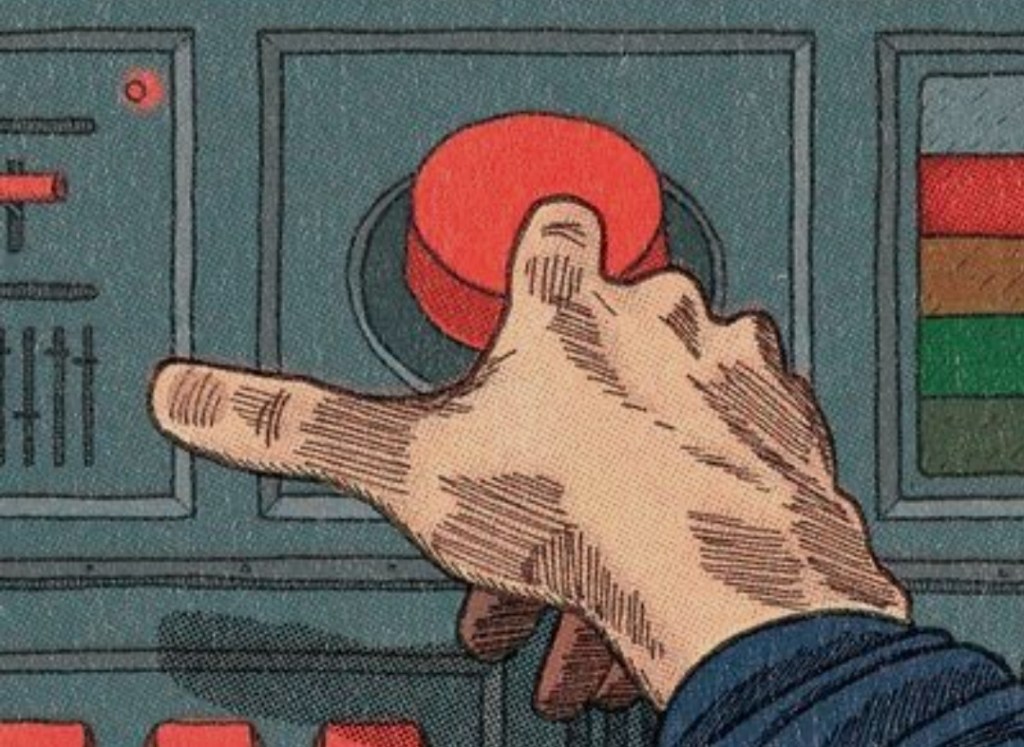
Their headquarters was a windowless room decorated with patriotic wallpaper and a large red button labeled “SIMPLIFY.” No one knew what it did, but pressing it made everyone feel better, which, in the Committee’s view, was the same as being right.
At the head of the table sat Chairman Blunt, a man who believed nuance and coherence were contagious diseases. He began the meeting with the usual ritual: a moment of silence for the complexity they had successfully eliminated that week.
“First order of business,” he announced, tapping his gavel like it owed him money. “We’ve received complaints that reality is becoming… inconvenient.”
A murmur rippled through the room. Inconvenient reality was their greatest adversary. More dangerous than facts, more persistent than evidence.
“We must act,” Blunt continued. “Suggestions?”A hand shot up. It belonged to Doris, head of the Department of Nostalgia.
“What if we replace reality with a better version?” she offered. “One where everything used to be perfect, everyone knew their place, and no one asked questions we didn’t like.”
“Brilliant,” said Blunt. “We’ll call it Tradition. People love that.”
Another member, Seb from the Bureau of Selective Freedom, leaned forward. “We should also expand liberty,” he said, pausing for effect. “Specifically, the liberty to agree with us.”
Applause erupted. Expanding freedom by narrowing it was a long-standing Committee favorite.
What a classic.
From the corner, a junior aide timidly raised his hand. He was new, still afflicted with curiosity.
“But sir,” he said, voice trembling, “what about people who don’t fit into our… simplified version?”
The room went quiet. Chairman Blunt regarded him with the same expression one reserves for a stain that refuses to come out.
“Then they must be simplified,” he replied.
The aide opened his mouth, then thought better of it. He made a note to himself: Stop thinking.
Meanwhile, the Committee moved on to education reform. Their proposal was elegantly straightforward: remove anything that made people think too much, feel too deeply, or question authority. In its place, they would introduce a single subject: Certainty.
“Children don’t need to learn how to think,” Doris explained. “God forbid. They need to learn what to think. It’s more efficient.”
Efficiency was the Committee’s guiding principle. Why wrestle with messy truths when you could package a tidy lie and sell it wholesale?
As the meeting drew to a close, Chairman Blunt gestured toward the red button.
“Shall we?” he asked.
One by one, they pressed it. The room hummed softly, like a lullaby for inconvenient thoughts. Outside, the world remained as complicated as ever. But inside, everything was perfectly clear.
The Committee adjourned, satisfied. They had once again defended simplicity against the creeping threat of reality.
And somewhere, far beyond the reach of their wallpapered certainty, the unanswered questions continued to multiply. Quietly, stubbornly, waiting for someone brave or foolish enough to notice.
But not here.
Not in this room.
Here, the button always worked.

