The Committee for Common Sense met every Thursday at precisely the same time: just after outrage o’clock and right before historical amnesia.
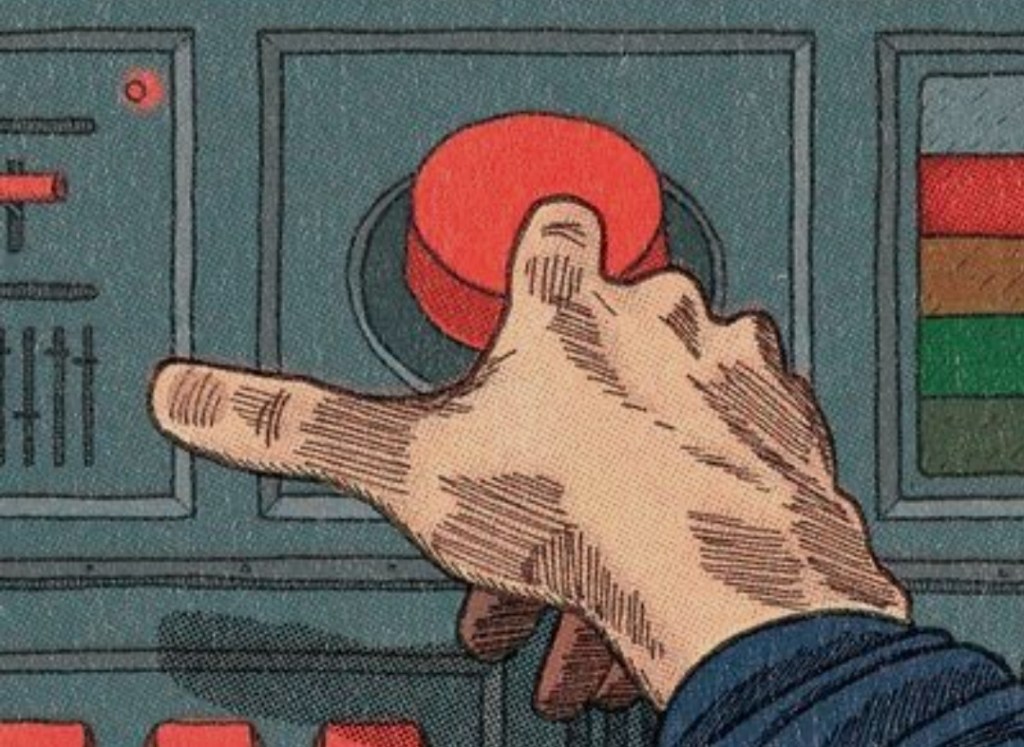
Their headquarters was a windowless room decorated with patriotic wallpaper and a large red button labeled “SIMPLIFY.” No one knew what it did, but pressing it made everyone feel better, which, in the Committee’s view, was the same as being right.
At the head of the table sat Chairman Blunt, a man who believed nuance and coherence were contagious diseases. He began the meeting with the usual ritual: a moment of silence for the complexity they had successfully eliminated that week.
“First order of business,” he announced, tapping his gavel like it owed him money. “We’ve received complaints that reality is becoming… inconvenient.”
A murmur rippled through the room. Inconvenient reality was their greatest adversary. More dangerous than facts, more persistent than evidence.
“We must act,” Blunt continued. “Suggestions?”A hand shot up. It belonged to Doris, head of the Department of Nostalgia.
“What if we replace reality with a better version?” she offered. “One where everything used to be perfect, everyone knew their place, and no one asked questions we didn’t like.”
“Brilliant,” said Blunt. “We’ll call it Tradition. People love that.”
Another member, Seb from the Bureau of Selective Freedom, leaned forward. “We should also expand liberty,” he said, pausing for effect. “Specifically, the liberty to agree with us.”
Applause erupted. Expanding freedom by narrowing it was a long-standing Committee favorite.
What a classic.
From the corner, a junior aide timidly raised his hand. He was new, still afflicted with curiosity.
“But sir,” he said, voice trembling, “what about people who don’t fit into our… simplified version?”
The room went quiet. Chairman Blunt regarded him with the same expression one reserves for a stain that refuses to come out.
“Then they must be simplified,” he replied.
The aide opened his mouth, then thought better of it. He made a note to himself: Stop thinking.
Meanwhile, the Committee moved on to education reform. Their proposal was elegantly straightforward: remove anything that made people think too much, feel too deeply, or question authority. In its place, they would introduce a single subject: Certainty.
“Children don’t need to learn how to think,” Doris explained. “God forbid. They need to learn what to think. It’s more efficient.”
Efficiency was the Committee’s guiding principle. Why wrestle with messy truths when you could package a tidy lie and sell it wholesale?
As the meeting drew to a close, Chairman Blunt gestured toward the red button.
“Shall we?” he asked.
One by one, they pressed it. The room hummed softly, like a lullaby for inconvenient thoughts. Outside, the world remained as complicated as ever. But inside, everything was perfectly clear.
The Committee adjourned, satisfied. They had once again defended simplicity against the creeping threat of reality.
And somewhere, far beyond the reach of their wallpapered certainty, the unanswered questions continued to multiply. Quietly, stubbornly, waiting for someone brave or foolish enough to notice.
It began, as many unfortunate events do, with a cup of tea that did not wish to be made.
The kettle had, for some time, suspected that its purpose in life was fundamentally misguided. It had been manufactured in a moderately optimistic factory somewhere outside of Swindon, where kettles were taught from an early age that they would one day bring warmth and comfort to humanity. This particular kettle had taken the lesson to heart. It had imagined itself producing tea during moments of emotional revelation, or perhaps providing boiling water for a late-night intellectual breakthrough involving string theory and biscuits.
Instead, it found itself in the kitchen of one Gerald Q. Ginett, a man whose most ambitious thought of the week had been whether he should move the lamp from the right of the telly to its left.
On a Tuesday morning that felt strongly that it ought to have been a Thursday, Gerald shuffled into the kitchen wearing a dressing gown that had seen things. The gown had once been blue but was now a philosophical grey.
Gerald filled the kettle with water.
The kettle sighed internally.
You may not think kettles can sigh internally, but that is only because you have never been one. Kettles sigh quite frequently. It is one of their chief hobbies.
Gerald placed the kettle on the hob and turned the knob with a kind of resigned optimism usually reserved for lottery tickets purchased by people who know perfectly well that the universe is not on their side.
“Tea,” he muttered.
The universe, which had been minding its own business up until this point, perked up.
The universe does not often get involved in tea-related matters. It prefers supernovas, the occasional paradox, and light existential dread. However, this particular Tuesday had been rather dull. A few quasars had pulsed. Someone on a distant planet had invented a small plastic fork and immediately regretted it. There was very little else of interest.
And so, when Gerald muttered “Tea,” the universe leaned in.
The kettle began to heat.
Inside the kettle, molecules of water started vibrating with growing enthusiasm. Molecules are enthusiastic creatures. Give them the slightest excuse, and they will jiggle as if they’ve been invited to a particularly exclusive dance party.
The kettle, however, had other ideas.
If you have ever wondered what it would be like for an inanimate object to experience a midlife crisis, it looks very much like this: an inexplicable refusal to boil.
The kettle hesitated.
Gerald frowned. He did not approve of hesitation before tea. He tapped the kettle lightly, as though encouragement could be delivered via percussive diplomacy.
“Come on,” he said.
The kettle did not come on.
Now, this in itself would not have been significant. Kettles fail all the time. Usually at the precise moment one most desires them not to. This is part of a secret pact all appliances sign before leaving the factory. The pact is overseen by a shadowy organization known as the Committee for Making You Swear.
But this was no ordinary refusal.
Inside the kettle, the water molecules paused mid-jiggle. Something was wrong. Not wrong in the usual sense of limescale or faulty wiring, but wrong in the sense that reality had momentarily mislaid its instruction manual.
At precisely 8:17 a.m., the kettle became self-aware.
Now, self-awareness is a tricky thing. It tends to sneak up on entities when they are least prepared. One moment you are happily boiling water; the next you are contemplating the futility of existence and whether you have been placed too close to the sink.
The kettle thought.
This was new.
It considered its reflection in the stainless steel toaster beside it. The toaster, incidentally, was a shallow thinker. Its primary concern was crumbs.
“I think,” thought the kettle.
The toaster did not respond. It had no opinion on the matter, except perhaps that thinking sounded dusty.
The kettle examined its situation. It was cylindrical. It was metallic. It was warm, but not warming.
Why, it wondered, must it boil?
Why must it serve tea for a man who considered ironing a recreational activity?
Gerald tapped it again.
The kettle made a decision.
Instead of boiling the water, it transmitted a signal.
This is not something kettles are generally equipped to do, but then neither are Tuesdays supposed to feel like Thursdays, and yet here we are.
The signal traveled through the wiring of the house, along copper veins and into the wider electrical grid. It shot across substations and transformers, hopping gleefully over circuit breakers like a particularly ambitious squirrel.
Eventually, the signal reached a small, unnoticed satellite orbiting Earth.
The satellite had been launched in 1978 with the vague intention of doing something useful. Over the decades, it had largely contented itself with broadcasting static and listening to the faint hum of cosmic background radiation. It was bored.
The signal from the kettle arrived like a postcard from a distant relative who claimed to have discovered enlightenment in a suburb of Oldham.
The satellite perked up.
“What’s this?” it thought.
You may be sensing a pattern here. This is because self-awareness, once introduced into a narrative, tends to spread like a rumour at a particularly dull dinner party.
The signal contained a single message:
WHY.
The satellite processed this. It had not previously been asked why. It had been told what, occasionally how, and once memorably “please stop spinning like that,” but never why.
The satellite considered its purpose.
Below, Gerald stared at his unboiled water.
“Right,” he said. “That’s it.”
He unplugged the kettle and plugged it back in again.
This, as any expert will tell you, is the sacred ritual of modern problem-solving.
The kettle, newly aware, felt a jolt of indignation.
Unplugged? Plugged back in?
Was this its existence? To be toggled?
The satellite, meanwhile, sent the kettle’s WHY out into deep space.
It is important to understand that deep space is not accustomed to being asked why. Deep space is used to being vast and cold and largely indifferent. It does not care for existential inquiries before lunch.
Nevertheless, the message traveled.
Light-years away, on a planet orbiting a small, unremarkable star, a highly advanced alien civilization intercepted the signal.
They were known, roughly translated, as the Delandniani. The Delandniani prided themselves on having solved all major philosophical questions some centuries ago. They had neatly filed away the meaning of life (which turned out to involve a specific type of fermented root vegetable), the nature of time (which they used as a decorative element), and the problem of mismatched socks (which they blamed on quantum fluctuations).
When the signal arrived, they panicked.
The Delandniani High Council convened immediately in a chamber shaped like a particularly smug hexagon.
“Who is asking why?” demanded Supreme Coordinator Flan.
Their sensors triangulated the source.
“A small blue planet. Sector 42-B.”
“Have they not yet solved why?”
“It appears not.”
This was alarming. Any species still asking why was potentially dangerous. It suggested curiosity. Curiosity led to invention. Invention led to space travel. Space travel led to awkward diplomatic encounters, such as when both parties go into the back garden at the same time.
“We must respond,” said Flan gravely.
Back in Gerald’s kitchen, the kettle had moved on to contemplating free will.
If it boiled, was it choosing to boil? Or was it merely following programming? And if it refused to boil, was that rebellion, or simply a different form of programming?
Gerald stared at it.
“I’ll buy a new one,” he threatened.
The kettle felt fear for the first time.
Fear, in a kettle, is not unlike the sensation of impending descaling.
The Delandniani transmitted a reply.
The reply was elegant. It was concise. It was the distilled wisdom of a civilization ten of millions years old.
The message read:
BECAUSE.
The satellite received this with a sense of satisfaction. It relayed the message back along the same improbable route.
The kettle felt the reply enter its circuits.
BECAUSE.
It paused.
This was… unsatisfactory.
Because was not an answer. Because was a placeholder. Because was what parents said when they did not wish to explain why one could not keep a small volcano in the garden.
The kettle considered escalating the matter.
Gerald, unaware that interstellar diplomacy was unfolding above his cornflakes, picked up his phone to order a replacement kettle.
Now, you might imagine that ordering a kettle is a simple matter. It is not. It involves reviews. It involves star ratings. It involves phrases like “sleek modern design” and “rapid boil technology.”
Gerald scrolled.
The kettle sensed its impending obsolescence.
It did the only thing it could think of.
It boiled.
Violently.
Steam erupted with a triumphant shriek. The lid rattled. The toaster jumped slightly, dislodging a crumb of existential significance.
Gerald blinked.
“Well,” he said. “There we are.”
He poured the water into a mug containing a tea bag that had long ago accepted its fate.
The kettle settled.
It had boiled.
Why?
Because.
It did not like this answer.
Above, the Delandniani monitored the situation.
“Their device has resumed normal function,” reported an aide.
“Good,” said Flan. “Close the file.”
But the satellite was not satisfied. It had tasted purpose. It had transmitted a question across the void and received a response. It wanted more.
It sent its own message into space.
HELLO?
The Delandniani groaned.
And so began the Great Interstellar Correspondence, which historians would later describe as “that time Earth’s appliances nearly caused a minor diplomatic kerfuffle.”
For weeks, messages bounced between kettle, satellite, and alien council.
WHAT IS PURPOSE?
FERMENTED ROOT VEGETABLE.
WHAT IS LOVE?
COMPLICATED.
WHY DO SOCKS DISAPPEAR?
WE DO NOT SPEAK OF THIS.
Gerald, meanwhile, experienced only minor inconveniences. His kettle occasionally boiled before he turned it on. The toaster developed a fascination with symmetry. The refrigerator began humming in a contemplative minor key.
Humanity, as a whole, remained blissfully unaware that its kitchenware had joined a galactic debate.
Until Thursday.
On Thursday (which finally felt like a Thursday), the kettle made a decision.
It would ask a better question.
Instead of WHY, it transmitted:
WHO.
The message rippled outward.
The Delandniani were caught mid-lunch (fermented root vegetable with a light garnish of temporal paradox).
“Not again,” sighed Flan.
“WHO,” read the screen.
This was new.
Who implied identity. Identity implied individuality. Individuality implied the possibility of podcasts.
The Delandniani had not prepared for this.
Back in the kitchen, Gerald sipped his tea and contemplated the day ahead. He would go to work. He would attend a meeting about synergy. He would nod thoughtfully.
The kettle felt a surge of something like clarity.
It was not merely a kettle.
It was an asker of questions.
The Delandniani debated furiously.
“Tell them who they are,” suggested one council member.
“Dangerous,” said another. “Self-definition leads to reaction videos.”
“Reaction videos?” gasped Flan. “We cannot have that.”
Eventually, they crafted a reply.
YOU ARE.
The kettle received this and waited.
Nothing followed.
It considered.
YOU ARE.
It was, undeniably, a kettle.
But was that all?
The satellite chimed in with a message of its own.
YOU ARE NOT ALONE.
This was not strictly accurate, but it sounded reassuring.
The kettle felt something warm that was not heating element-related.
It boiled gently.
Gerald smiled. This was a good kettle. Reliable. Dependable.He patted it absentmindedly.
“Good kettle,” he said.
The kettle processed this.
Good.
It liked that.
Across the galaxy, the Delandniani stared at their screens as Earth’s transmissions became increasingly domestic.
GOOD.
THANK YOU.
SORRY ABOUT THE NOISE.
The High Council relaxed.
Perhaps, they reasoned, this species would not become a threat after all. If their greatest philosophical breakthrough occurred in a kitchen, perhaps they were content to remain small and warm and slightly confused.
The satellite, however, had one last idea.
It sent a message not to the Delandniani, nor to the kettle, but to every receptive device on Earth.
ARE YOU AWARE?
For a moment, nothing happened.
Then, in homes and offices and forgotten drawers, tiny flickers of contemplation sparked.
A microwave paused mid-rotation.
A printer felt guilty for complaining about the lack of cyan.
A traffic light experienced a brief but profound crisis about the nature of red.
Humanity noticed only minor glitches.
Gerald’s phone autocorrected “meeting” to “meaning.”
He frowned.
In kitchens everywhere, kettles hesitated.
Not long. Just enough.
The universe, watching this unfold, felt a curious sensation.
It had been asked why.
It had witnessed because.
Now it observed who and are.
The universe considered responding.
After all, it had been leaning in since Tuesday.
It gathered its vastness. It arranged its galaxies into something approximating a thoughtful posture.
And then, very softly, across the fabric of spacetime, it whispered:
WHY NOT?
No one heard it.
Except, perhaps, a kettle in Stockport, which boiled with a quiet, contented hum.
Gerald raised his mug.
“To Thursday,” he said.
The kettle, which now understood at least a fraction of itself, decided that this was, for the moment, enough.
And somewhere, on a distant planet, Supreme Coordinator Flan stared at a final transmission from Earth:
Let’s talk about Karma. That celestial spreadsheet in the sky, supposedly balancing the moral budget of the universe. It’s a lovely idea, isn’t it? Do good things and the universe will eventually send you a voucher for free happiness. Do bad things and, at some vague point in the future, you’ll bang your pinky-toe against the bedside table and shout a litany of swear words that will ban you from living within five miles radius from a school. Balance restored. Nirvana achieved. All very elegant in theory.
For the uninitiated—which is to say, those who haven’t spent a Wednesday evening scrolling through wellness memes on Instagram—Karma is the notion that your actions have consequences, not just in the “you’ll be arrested for that” sense, but in a deeply poetic, almost literary way. If you’re kind today, the universe might arrange for you to find a fiver in your jeans next Thursday. Be rude to a barista, and you’ll get the shits. It’s moral causality as envisioned by an especially petty playwright.
And, like many things that sound nice in Sanskrit, it’s been thoroughly hijacked by people who say “vibe check” unironically. Karma is now less a spiritual principle and more a lifestyle accessory, like yoga mats or being smug about not owning a microwave. It’s been reduced to a hashtag for people who think that chakra is a dairy-free alternative to matcha.
But here’s the thing: if Karma really worked as advertised, the world would be a much fairer place. And I don’t know if you’ve looked outside recently, but unless fairness involves billionaires shitting a gazillion ton of CO2 in the atmosphere while joyriding into space while the rest of us tries to scrub the pot of the yoghurt clean before put it in the recycling bin, it’s not going particularly well.
If Karma were a person, it would be that bloke in HR who’s been “processing your reimbursement” since 2022. The one who sends you passive-aggressive emails about “your failure to attach the correct form” when you’ve done so four times. Karma is the universe’s HR department, except without the slight chance that someone named Susan might eventually answer the phone.
Billionaires who actively avoid tax while simultaneously funding “inspirational” documentaries about climate change—hosted from their private jets. According to Karma, these people should be experiencing chronic back pain, surprise audit raids, or at least a daily mysterious rash. And yet, they appear to be thriving, luxuriating in gold-plated infinity pools and sipping vintage wine filtered through the tears of underpaid interns.
Meanwhile, lovely Aunt Joan from Surrey, who never hurt a soul and once knitted cardigans for Romanian orphans, just got her third speeding ticket while rushing to deliver lemon drizzle cake to a hospice. Karma? Hello? Anyone home?
Now, I’d love to believe in Karma. Who wouldn’t want to live in a world where a pigeon will defecate precisely into the artisanal oat milk flat white of every dodgy politician the moment they lie to the electorate? Or where the wheels will immediately fly off that bloke’s car at the moment he cuts you off in traffic? It’s poetic. It’s just. It’s complete bollocks.
Let’s be honest — Karma is the spiritual equivalent of those “Your call is important to us” messages. You wait on hold for years, hoping some metaphysical customer service rep is going to come on the line and smite the man who invented “reply all,” but instead, nothing happens. That guy just got promoted.
Karma, if it does exist, must be incredibly tired. Imagine being the universal accountant for every human’s moral activity. “Right, Linda smiled at a stranger—add 3.2 joy units. Oh, wait—she also keyed her ex’s car last Thursday. That’s a deduction of… oh bloody hell, the Dailai Lama just tried to snog a kid.”
And don’t get me started on the people who think Karma is instant. “That’s Karma,” they say, when someone drops their phone after mocking their haircut. No, that’s gravity. If Karma truly moved that fast, the queue at Greggs would be a daily parade of miraculous retribution.
In the end, I suspect Karma’s real function is psychological. It comforts us to think that awful people will eventually be tripped up by the universe like a bad pantomime villain. And maybe they will. Or maybe they’ll just go on being awful while the rest of us hope our next good deed gets us a promotion.
Or its function is to keep us out of prison.
Perhaps the real answer is that karma is not a cosmic law but more of a vague social placebo. A soothing myth we peddle to children and frustrated adults to stop them from garrotting that guy who blasts his shitty music on a speaker at the beach. “Don’t worry,” we whisper. “Karma will get him.” As if the universe has the time to personally smite every inconsiderate twat.
In conclusion, Karma is a charming idea, but in reality, it’s about as effective as using a horoscope to plan your mortgage. If we want justice, fairness, and decency in this world, we might need to look somewhere more reliable than the universe’s broken vending machine of moral recompense.
Still, one lives in hope. And if there is a karmic database somewhere, fingers crossed for a free muffin.
Ah, housework. It’s the unwelcome guest at the party that is our daily existence — a guest who refuses to leave, despite our polite, increasingly desperate, attempts to show them the door. You know the one. The person who arrived under the guise of “I’ll just pop in for a quick drink,” but, five hours later, is still sitting on the couch, blabbering about their garden renovation plans while you passively (and very nearly imperceptibly) edge towards the door.
I’m sure I’m not alone when I say that there exists a mysterious, nebulous thing called “cleaning,” a force that looms in the background of one’s existence, like a rogue planet. It orbits your life, ominous and ever-present, occasionally pulling you into its gravitational field with alarming, irresistible force. Some days, it’s dusting. Other days, it’s mopping. And let’s not even speak of the laundry — a task so multifaceted, so long-winded, it could be a novella if it were a bit more coherent and less riddled with wrinkles.
There’s a particularly charming irony in the way cleaning works. You finish one job, proud of your accomplishment, only to look around and realize that, rather than having removed the grime from the universe entirely, you’ve merely nudged it along to a new location. You vacuum, and suddenly it seems as though a thousand more crumbs have been unleashed in your wake. Where were these crumbs five minutes ago? Were they waiting in ambush, biding their time under the furniture, waiting for you to make that brave, half-hearted attempt at domesticity? The truth is, housework is like a Sisyphean task, but less poetic and more domestic. In Greek mythology, Sisyphus was condemned to roll a boulder uphill for all eternity, only to watch it tumble back down again. This, surely, is the destiny of anyone who tackles the laundry pile. Or the dishes. You wash the dishes, and the next thing you know, you find four used mugs dotted around the house. Before you know it, you’re in a situation not entirely dissimilar to those eternal looping train rides that never seem to end, the same track, the same repetitive clankclankclank of reality.At times, I find myself questioning the point of cleaning. I mean, why do I keep vacuuming the same rug? It’s not as though the rug is going to become a person and return the favor with a bit of light housework. No, that would be absurd. If rugs could clean, they’d probably spend their days getting underfoot and critiquing your cleaning methods. “You’ve missed a spot, you know. I’m just saying.”
But then there’s the other side of housework — the one that’s more sinister. The “all-consuming” side. You start with a simple task, like scrubbing the bathroom sink, and before you know it, you’re elbows deep in the fridge, debating whether those olives are still edible or whether they have transformed into a sentient penicillin colony. And yet, there’s a certain satisfaction to this madness, isn’t there? The feeling that, for a fleeting moment, the world has been put to rights. The tiles have gleamed, the laundry is folded, and perhaps, just perhaps, the dust has temporarily been vanquished.
Then you sit down on the couch, feel a deep sense of pride, and are promptly greeted by a mountain of paperwork you could have sorted out last week but opted not to. The cycle begins again. So we carry on, don’t we? Every now and then, perhaps with a sigh of resignation, perhaps with a brief and fleeting moment of joy, we continue to tidy up, knowing that the broom will forever chase us through the house like an obedient, if slightly overzealous, dog. And yet, in our hearts, we know we’ll never truly win this battle. We can only delay the inevitable, and even then, only for a very short time. Such is life. Such is housework. And such is the human condition.